I picked the last of the peaches from the old tree yesterday. The wooden props and straps holding the limbs and trunk together remain. We are debating whether to remove all the supports and see how it weathers the winter. The tree is 16 years old. Like a family pet we tend to it in its old age, loathe to let it go.
This is a year of tomato riches. Trays of tomatoes clutter our kitchen counter with more ripening on the vine. While I type this post, a huge pot of chopped tomatoes with minced garlic and a bit of salt simmers on the stove, to be savored on a mid-winter snowy evening. For best flavor I've taken to using a mix of tomato varieties--paste tomatoes, red slicers, large orange ones--whatever is on hand. I'm wishing for a late frost to extend the tomato season deep into autumn.
Insect sounds and chipmunk chatter dominate the natural soundscape during these early days of September. Birds have mostly gone quiet. The resident birds remain busy: woodpeckers tap trees in search of insects and chickadees busily search for seeds. Squirrels are active harvesting acorns in the tree tops of oaks. Sometimes they take a few bites before letting them drop to the ground. Occasionally an acorn hits me on the head. The acorn crop seems to be modest this year -- not small and not huge.
The tail end of Hurricane Isaac is dropping some rain here this week. The timing was good, the garden needed a drink. The rain has stirred the tree frogs and spring peepers. I hear them half-heartedly trilling and peeping.
There is still much to do in the garden, although even the weeds have waned. It's time to plant the spinach and more cilantro. And harvest more tomatoes, along with beans and okra. And what to do with all the tomatillos. I smell the tomatoes simmering and its time to stir the pot.
Thursday, September 6, 2012


Tuesday, September 4, 2012
The Garden Bounty
My best laid plans went awry again this year. Perhaps it was that I did not really plan, I was just hopeful. And who could have predicted such a bountiful garden year. You see, my goal was to schedule my work during the year to avoid the peak garden times. But alas, my work and the garden have collided. Too much work and too many fruits and vegetables all at the same time. I suppose there are worse things.
We expanded our garden this year, and most everything had a good year. Tomatoes outperformed. After year upon year of blight and pests and too much rain, this year was perfect. The tomato plants are sagging under the weight of all their fruits. As the days grow shorter and a bit cooler, the plants are just starting to whither. Two dozen quarts of canned tomatoes sit on our basement shelf. We could do more, but work is taking up too much time. Now, gardening is work too, that is why I need to free up my time come August and September. I did not plan for a superior tomato year.
The young peach tree -- a Red Haven -- bore many fruits back in early August; tasty but not super sweet. We canned more than a dozen pints. We planted the old peach in 1996. In recent years it has dropped a few big limbs. Each year we consider chopping it down. A month ago its fruits were small and hard and green. The old peach ripens late. It is a hardy peach, a Reliance, its fruit sweet and juicy. For a week now we've been harvesting basketfuls of peaches from this tree. Yesterday Srini and his mother canned a dozen pints. We're done with canning peaches for the year, the old peach may live on.
 Eggplants and peppers, okra and cabbages, onions and potatoes all had a good year. Perhaps our best crop this year are the cantaloupes. We never had much luck with them and they take up a lot of room. This year I raised my own seedlings -- Hannah's Choice from Johnny's Seeds. The fruits take awhile to ripen--90 days according to the packet. A week ago I was wondering whether the large, oval-shaped fruits would ripen. Since then we've harvested 8 cantaloupes, all are sweet with firm, dark orange flesh. That is the thing with gardening, it often comes all at once. This week we are eating peaches and cantaloupes morning, noon, and night.


The only crop that has suffered this year are the green beans. A deer mowed down the bush beans a couple times. It eventually recovered to yield a handful of beans every few days. My pole beans neglected to climb the poles until late, by which time the Japanese beetles found them.
I'm already planning for next year. Thinking about how to outwit the deer and how to schedule my work to leave open time for the garden harvest. Or maybe I am just hopeful.
We expanded our garden this year, and most everything had a good year. Tomatoes outperformed. After year upon year of blight and pests and too much rain, this year was perfect. The tomato plants are sagging under the weight of all their fruits. As the days grow shorter and a bit cooler, the plants are just starting to whither. Two dozen quarts of canned tomatoes sit on our basement shelf. We could do more, but work is taking up too much time. Now, gardening is work too, that is why I need to free up my time come August and September. I did not plan for a superior tomato year.
The young peach tree -- a Red Haven -- bore many fruits back in early August; tasty but not super sweet. We canned more than a dozen pints. We planted the old peach in 1996. In recent years it has dropped a few big limbs. Each year we consider chopping it down. A month ago its fruits were small and hard and green. The old peach ripens late. It is a hardy peach, a Reliance, its fruit sweet and juicy. For a week now we've been harvesting basketfuls of peaches from this tree. Yesterday Srini and his mother canned a dozen pints. We're done with canning peaches for the year, the old peach may live on.


The only crop that has suffered this year are the green beans. A deer mowed down the bush beans a couple times. It eventually recovered to yield a handful of beans every few days. My pole beans neglected to climb the poles until late, by which time the Japanese beetles found them.
I'm already planning for next year. Thinking about how to outwit the deer and how to schedule my work to leave open time for the garden harvest. Or maybe I am just hopeful.
Monday, August 27, 2012
Camel's Hump
I hiked to the top of 4,083-foot Camel's Hump on Sunday morning with my nephew, Reid. This was my second climb of this peak in the Green Mountains of Vermont. The first time was on a cold and clear Christmas Eve last December with Srini and Kodi. In my description below of Sunday's hike, I've included a few side-by-side comparisons of the two days.




Reid and I set out early to avoid the heat and the hordes--Sunday was going to be hot and hazy and Camel's Hump is a popular hike. We drove from Charlotte on Lake Champlain along rolling roads that wind past grazing cows, hayfields, dairy farms, fields of solar panels, and small villages. The sun was just rising behind Camel's Hump as we neared. Below are pictures of the summit from across a field in the small town of Huntington--in August and in December.

We reached the parking lot on the west side of the mountain by 7 am; four other cars were already there. By the time we finished our hike at 11 am the parking was full with 28 cars, and more on the way up.
On Sunday, we hiked the 5.8-mile loop clockwise, via the Burrows Trail (2.1 miles), the Long Trail to the peak (0.3 miles), the Long Trail down to Wind Gap (1.9 miles), the Forest City Trail (1.4 miles) to the Connector Trail (0.1 miles). Last winter, Srini, Kodi, I hiked it in reverse. Here is the beginning (or end) of the Connector Trail on the two days, which were decidedly different in temperature and conditions. The temperature at 7 am on Sunday was in the mid-60s and humid, while on Christmas Eve last it was only 5 degrees above zero.

The Burrows Trail is a steady, moderate climb to the Long Trail and the ridge that leads up to the Summit. Many hikers and runners go up and down Burrows for exercise or to catch the sunrise or for the quickest way to the summit.

The short segment of 0.3 miles on the Long Trail to the summit is a bit steeper, but still an easy, quick climb. A sign along the trail alerts hikers to the sensitivity of the alpine zone. We could read the sign on Sunday, not so in ice-covered conditions of December.

The sunrise was just beginning to catch the western slope of the mountain as we approached the summit. Fog hung in the valley and haze obscured the distant views, but overhead was blue sky.


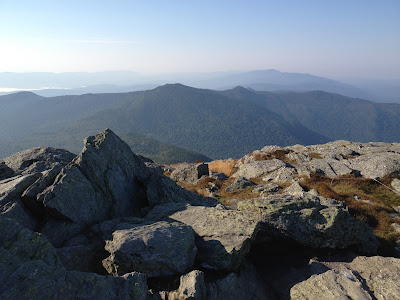
We reached the summit by 8:30 am, in 1.5 hours from the parking lot. Reid stands on the summit with Mt. Mansfield behind him to the north.


We spent 25 minutes on top, with the summit to ourselves, soaking up the morning sun and taking in the 360 degree view. A wonderful breeze cooled us just right. Despite the haze the views were stunning, including the view south along the ridge and the path of the Long Trail toward Mt. Ellen in the distance.


The summit is rocky (a combination of schist and quartz covered in lichen) with patches of alpine vegetation in between, which are cordoned off with white string, keeping hikers on the rock and off the plants. A chipmunk ventured out from his rocky hideout to look for bits of food dropped by hikers.


By 9:00 am we took in our final views and began the steep descent south along the Long Trail. Both directions require some careful stepping in summer and in winter.


Along the way we looked back at the summit of Camel's Hump. We passed many people on the Long Trail and on the Forest City Trail as they were climbing up; we were happy to be heading down as the heat of the day was rising.

The Long Trail is a windy, up and down trail with steep pitches and narrow slots to climb through. When we hiked the trail in December we paused every so briefly at this sign.

In the lower picture, the sign is on the tree to the right of Srini. The trail was indeed tricky to follow in winter. It was exhilarating to climb it in December and fascinating to see the trail again in summer. I'd recommend this loop as we did it both times: clockwise in summer, counterclockwise in winter. We finished the hike on Sunday in 4 hours, which included 25 minutes on the summit. The winter hike took 6 hours, in part because the Long Trail from Wind Gap to the Summit was not broken out and was icy in a few spots.
A bridge crosses a deep section of Brush Brook at the junction of the Forest City and Connector Trails. This is a lovely spot near the end of the hike. Thanks to Vermonters who maintain the roads, parking areas, trails, bridges, and signs. It is a lovely state for visiting and hiking.


Monday, August 20, 2012
A Meadowhawk
Around about 4:00 in the afternoon, after Kodi has eaten his supper, the two of us head outside for a walk about the yard. Actually Kodi usually settles into a comfortable spot on the lawn. He just likes to be outside. As do I.
I emerge from the garage with small clippers and a harvest basket. This is my favorite time to walk through the vegetable garden. I check for ripe tomatoes, green beans, okra, eggplant. The top third of the bean plants were nipped by a deer again so the bean harvest has slowed dramatically. About once a week I find a giant hornworm munching on one of the tomatoes, and pause briefly to extract him from his camouflaged perch to which he does not return. Each day I fill my harvest basket. Today it was several handfuls of fresh basil, for pesto, along with San Marzano and garden peach tomatoes and a pint of sun golds and cherry tomatoes.
Once the garden is checked and ripe veggies are harvested I move on to Japanese beetle patrol. Their numbers have eased a bit, but not nearly enough. Interestingly I find them in four distinct places in the yard -- on our highbush blueberries, on some wild raspberries and on a single large stalk of goldenrod at the edge of the backyard, and on the hazelnut bush. I assume they give off pheromones to attract one another. Sometimes I find a pile of 8 or more beetles on one leaf.
This afternoon, as I checked the blueberries for beetles, I noticed a dragonfly--a meadowhawk--perched on one bush. I walked within three inches of this meadow beauty and it did not budge. Presumably it was waiting very patiently for an insect of the right size to fly by, or it was just resting in the afternoon sun. What an afternoon delight.

I emerge from the garage with small clippers and a harvest basket. This is my favorite time to walk through the vegetable garden. I check for ripe tomatoes, green beans, okra, eggplant. The top third of the bean plants were nipped by a deer again so the bean harvest has slowed dramatically. About once a week I find a giant hornworm munching on one of the tomatoes, and pause briefly to extract him from his camouflaged perch to which he does not return. Each day I fill my harvest basket. Today it was several handfuls of fresh basil, for pesto, along with San Marzano and garden peach tomatoes and a pint of sun golds and cherry tomatoes.
Once the garden is checked and ripe veggies are harvested I move on to Japanese beetle patrol. Their numbers have eased a bit, but not nearly enough. Interestingly I find them in four distinct places in the yard -- on our highbush blueberries, on some wild raspberries and on a single large stalk of goldenrod at the edge of the backyard, and on the hazelnut bush. I assume they give off pheromones to attract one another. Sometimes I find a pile of 8 or more beetles on one leaf.
This afternoon, as I checked the blueberries for beetles, I noticed a dragonfly--a meadowhawk--perched on one bush. I walked within three inches of this meadow beauty and it did not budge. Presumably it was waiting very patiently for an insect of the right size to fly by, or it was just resting in the afternoon sun. What an afternoon delight.

Sunday, August 19, 2012
A Sweet Stretch of Weather
This weekend was the best of the summer, weather-wise. Today was ideal with temperatures in the mid-70s and humidity down near 50 percent. Rainfall in recent weeks combined with warm temperatures has helped the garden grow and the lawn stay green. Usually by mid-August much of our lawn is crispy brown, when even the crabgrass looks parched. This year, the periodic rains have kept everything lush. We are fortunate given that much of the country remains in a drought.
Today we sensed a hint of fall in the air: a morning cool enough for a long-sleeved shirt, acorns underfoot, potatoes to dig, and a few red maples showing a touch of red in their leaves. The garden bounty continues to make us proud. For Sunday Supper tonight we created several dishes with vegetables plucked straight from our garden: potatoes and kale with onions and garlic, sauteed okra, and eggplant with tomatoes.
The periodic rains feel extra special--keeping the gardens lush, filling the aquifers (the source for our drinking water) and causing mushrooms to spring forth. This past week has seen an explosion of new fungi emerging, of all sizes and shapes and colors. On my woodland walks with Kodi I stopped often to check out each new mushroom that was not there the day before. Here's a sampling from this past week.


 I don't search out edible wild mushrooms, although that would be a plus if I found some. Just seeing mushrooms push up through the forest floor makes me happy. For me, these mushrooms are a sign of plentiful moisture. In these times, with the climate fluctuating and heating up, these mushroom sightings offer a respite from my climate worries. At least for a day or a week or a month, we are okay. The mushrooms tell me so.
Today we sensed a hint of fall in the air: a morning cool enough for a long-sleeved shirt, acorns underfoot, potatoes to dig, and a few red maples showing a touch of red in their leaves. The garden bounty continues to make us proud. For Sunday Supper tonight we created several dishes with vegetables plucked straight from our garden: potatoes and kale with onions and garlic, sauteed okra, and eggplant with tomatoes.


Thursday, August 16, 2012
Crickets
I spotted a one-inch long black cricket in our garage this week. My best guess is a northern fall field cricket (Gryllus pennsylvanicus). This is the common cricket that you hear chirping at night in late summer. The male cricket raises its wings over its body and rubs one against the other. Its thin, papery wings vibrate, amplifying the sound. If you try to find a chirping cricket it quickly goes silent as you approach.
 During the past week I've noticed more crickets--in our garden, at New Roots Farm in the high tunnels, along meadow paths. Earlier this summer a friend said she noted a lack of crickets in her yard the past few years. I wonder if her free ranging chickens are the culprit. Although crickets are most active at night, when the chickens are safely tucked away in their coop, I assume chickens can search out and eat crickets during the day. And crickets do start chirping on warm summer afternoons, just when chickens are out scratching around in the barnyard.
As I was reading about crickets on the Internet, I discovered the website, Singing Insects of North America. The website mentions a book, Guide to Night-Singing Insects of the Northeast by John Himmelman, that sounds (yes a CD comes with it) intriguing. I might add that one to my bookshelf.
In his delightful book, Crickets and Katydids, Concerts and Solos, Vincent Dethier wrote this about a chirping cricket:
"The instrument of this indefatigable musician is his interlocking front wings, the stiff parchment-like covers for his membranous hind wings. As the bow of a violin is drawn across the strings and sets them vibrating and as the body of the violin is set resonating by transmission of the vibrations through the bridge, so the cricket draws a scraper across a file of small teeth and sets the wing covers to resonating. The wing covers are raised in song at an angle of about forty-five degrees and brought together periodically. With this closing motion, a ridge on the upper wing cover scrapes across a file on the lower wing cover and generates a high-pitched sound lasting about one-hundredth of a second. Each chirp consists of a group of three or more of these sound pulses. They are executed so rapidly that the human ear cannot resolve the pattern. We hear only the chirp."

As I was reading about crickets on the Internet, I discovered the website, Singing Insects of North America. The website mentions a book, Guide to Night-Singing Insects of the Northeast by John Himmelman, that sounds (yes a CD comes with it) intriguing. I might add that one to my bookshelf.
In his delightful book, Crickets and Katydids, Concerts and Solos, Vincent Dethier wrote this about a chirping cricket:
"The instrument of this indefatigable musician is his interlocking front wings, the stiff parchment-like covers for his membranous hind wings. As the bow of a violin is drawn across the strings and sets them vibrating and as the body of the violin is set resonating by transmission of the vibrations through the bridge, so the cricket draws a scraper across a file of small teeth and sets the wing covers to resonating. The wing covers are raised in song at an angle of about forty-five degrees and brought together periodically. With this closing motion, a ridge on the upper wing cover scrapes across a file on the lower wing cover and generates a high-pitched sound lasting about one-hundredth of a second. Each chirp consists of a group of three or more of these sound pulses. They are executed so rapidly that the human ear cannot resolve the pattern. We hear only the chirp."
Wednesday, August 15, 2012
Jalapeños and Tomatoes
We pickled and canned jalapeño peppers for the first time yesterday. I picked several quarts of jalapeños at New Roots Farm--another banner year for this easy to grow hot pepper.
 Amma (my mother-in-law) and I sliced and de-seeded each pepper then stuffed them into pint jars along with 1/2 teaspoon canning salt, 1/4 teaspoon pickling spices, and one clove garlic. The jar was then filled with a mix (50-50) of simmered water and white wine vinegar. We have a pressure canner, but read that a boiling hot water bath is preferred so we used the latter method, for 10 minutes.
 After slicing up 6 pints worth of jalapeños we realized that using gloves would be useful next time. By the end our fingers were tingling from handling jalapeños. Now we wait a couple weeks to let the pickling do its thing before we taste test.
This is also one of the best tomato years. We've had a few bad years of late--with early blight, late blight, too much rain, not enough rain, too many hornworms. This year conditions seem to be just about right. Two trays of tomatoes sit on the kitchen counter waiting to be canned later today.
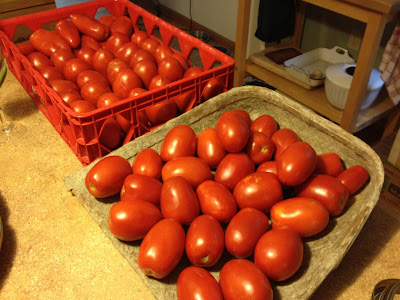 From here we move on to making salsa.....so much produce in such a short time.


This is also one of the best tomato years. We've had a few bad years of late--with early blight, late blight, too much rain, not enough rain, too many hornworms. This year conditions seem to be just about right. Two trays of tomatoes sit on the kitchen counter waiting to be canned later today.

Subscribe to:
Posts (Atom)
-
 Whenever it rains hard during the summer, pine cones seem to rain down, the cones knocked from branches in the upper canopy of tall white pi...
 -
 It was a mourning dove, the pile of feathers beneath the tall white pine. The feathers that I showed yesterday in my blog. You can tell by t...
 -
 The oldest known hardwood tree in North America--at 700 years old--is a black gum tree tucked away in a hummocky swamp in southern New Hamps...