Friday, March 22, 2013

Panama -- Mist Netting Birds

By mid-March in 1983, I was well ensconced in the lowland forest of central Panama. After two and a half months mist netting birds, I could quickly identify the birds in hand. I recognized the pre-dawn owl-like call of the rufous motmot, "ho-hoo-hoo" and the nasal "cwahnk" of its cousin the broad-billed motmot. After more than two months in the tropics I was used to seeing armadillos and anteaters root around in the leaf litter. I was acclimated to the humidity and the steady 80 degree days. Yet, I was still thrilled to watch the ungainly flight of the locally common keel-billed toucan.

On December 31, 1983--the first full day living in Gamboa and only two days after we arrived in Panama--three keel-billed toucans flew by us as we walked around the small town. I exclaimed with delight at seeing my first toucan, and one with such a huge, colorful bill. Jim, who had been studying birds here for many years, barely gave it a look, calling it a "dirt bird." Birders use that term for birds that are so common, they don't give them a second look.

Toucans live in the tree tops and since we were studying birds in the understory, we never caught them in our nets. I never tired of seeing them fly across the road from one tree top to another. Check out this link to toucan photos if you want to gasp at their physical beauty. We caught plenty of other common and not so common birds in our nets. Here is how we did it.

Our main study site was located along Pipeline Road, an old discontinued road that leads deep into Soberania National Park. We drove 5 miles from town to reach our main study plots -- each about 5 acres in size and encompassing different habitats. The four sites had different moisture/humidity conditions ranging from dry to moist to humid to wet. These were slight differences, but apparently enough to affect the movements of resident birds. Our goal was to study whether birds were moving among these different habitat conditions, within a given season, from season to season, or year to year. In other words, did they migrate locally to take advantage of more food or higher humidity, or some other local condition.

The trees in mature lowland tropical forest in central Panama reach more than 120 feet tall. Most are deciduous, dropping their leaves at the beginning of the dry season. The understory of these forests is relatively open, although we still carried machetes to clear back the encroaching jungle so we could erect our mist nets.

Mature lowland tropical forest along Pipeline Road, Panama (1983)
At each plot we put up 15 mist nets, spaced 150 feet apart. Mist netting is a black nylon 36 mm mesh, measuring 12 meters (36 feet) long by 3 (9 feet) meters high. We suspended the net between two PVC plastic poles that were then tied to trees. Birds had a hard time seeing the mesh net as they flew through the forest. When they hit the net they bounced into a little pocket, staying caught until we came around to check the net and release them from their entanglement.

The plastic PVC poles with rolled up mist nests,
at our main study site along Pipeline Road
My co-worker Hanni, sets up a mist net with a volunteer
(photo by Larry Kolczak)
I untangle an orange-billed sparrow from the lower tier of the mist net
(photo by Larry Kolczak)
We monitored each set of 15 nets from 6 am to about 6 pm. Sometimes we closed the nets earlier if we reached our goal of 100 captures per plot. In between net runs, we often had down time, to relax in a small clearing, read a book, or watch birds, butterflies, or other tropical creatures. This was a time before GPS, laptops, cell phones, iPads, and other forms of distraction. It was us and the jungle and I'm glad for it. On the last net run each day we furled each net so that birds and bats would not get caught.
If we opened the nets too early in the morning, when it was just a bit too dark, we caught bats. And oh boy are they hard to remove from a mist net. Still, in the forest it was always a little dark on the opening round at about 6 am. We had to carry a flashlight, although sometimes we got lazy or thought we could manage with just our eyes. That is until Jim reinforced the real reason for the flashlight -- to avoid stepping on a poisonous snake. Like a fur-de-lance......a deadly pit viper.

Jim with a fer-de-lance, which he released after reminding us of their potential,
and hence the need to carry a flashlight in the morning
When mist netting birds we wore a small bag with banding tools -- pillowcase, weighing scale, pliers, metal leg bands. When possible we banded birds at the site of their capture. Sometimes we brought them back to a clearing - our headquarters in the forest -- to process and to show others. Then we'd take them back to the point of capture and release them. The birds were weighed and measured and banded. For some of the bigger hawks we had to measure their leg size to get the right size band. We blew on their wing feathers to see if the birds were molting.

Measuring and banding birds along Pipeline Road
(photos by Larry Kolczak)
Panama is home to more than 900 species of birds - an incredible number for such a small country. About 125 of the 900+ are migrant birds, including species that spend the breeding season in New England. While I was in Panama I saw 340 different species of birds. We captured about 40 different species in our mist nets. Some of my favorites....

The male and female royal flycatcher. These birds raise their crest and turn their head from side to side only when handled. Likely it is a threatening defense mechanism. We were happy to release them and allow them to lower their crests and their stress levels.

A male royal flycatcher has a red crest with black spots and deep purple tips,
while the female has a yellow crest with black spots and blue tips.
Some birds required special handling for other reasons. The hawks had huge, dangerous talons. Woodpeckers had huge beaks. The tanagers had short, stout but strong beaks that could really take hold  of a finger, or worse, a pinch of skin between fingers. Ouch.

A semiplumbeous kite

Tomorrow I will share more photos and stories of the birds and other wildlife along Pipeline Road and other sites that we studied thirty years ago in central Panama.

Thursday, March 21, 2013

Panama - A Look Back

Thirty years ago, on December 29, 1982, I flew south to Miami, then on to Panama City, Panama. In Miami, I met for the first time Dr. Jim Karr, my boss for the next five months, and my co-workers Hanni and Steven. We landed in the evening, it was dark, and as we approached the landing we saw ships floating off-shore, waiting their turn through the 51-mile Panama Canal.

The size of South Carolina, Panama is the southern most country in Central America. It forms an s-shaped land connection between Columbia (South America) to the east and Costa Rica to the west. Most of us know Panama for the canal -- where merchant vessels and cruise ships pass through daily to avoid the 8,000-mile trip around the southern tip of South America -- and for Manuel Noriega, the deposed military leader. From the early 1900s, when the canal was first built by the U.S. Army Corps of Engineers, until 1999, the 60,000 acre Panama Canal Zone was under the jurisdiction of the United States Department of Defense. Military folks would know Panama if they spent time at one of the 18 bases in the canal zone prior to 1999, the year it was turned over to the Republic of Panama.

Jim, Steven, Hanni, and I arrived at the start of the dry season, which would last well into May. We were there to study birds living in mature, lowland tropical forest. At that time, in early 1983, we were oblivious to any political upheavals in the country. Few outside Panama (except perhaps the CIA) knew the name Noriega, but by the end of 1983 (just three months after I left the country) he had become leader of the Panamanian Defense Forces and was flexing his muscles as Panama's strongman. Eventually, as we know, he got too strong for his allies, wherein the U.S. invaded the country and arrested Noriega for drug smuggling and other nefarious activities. But I digress into the future. Let's go back to 1983, before Noriega, to a time when the canal zone was still in U.S. hands, and I was young and carefree and totally into birds for work and for fun.

Our first night was spent at Hotel Caribe in Panama City. From the 10th floor open air bar we had a view of the city. It was hot, humid, and lively. Billboards crowded the view. McDonald's and Burger King were evident. People drove small cars and fast. Spanish was the native language. The next day we bought fresh fruits and vegetables and a new Mitsubishi jeep for the project, which we loaded up and drove north 20 miles to the small town of Gamboa, situated on the east side of the canal. This was our home for the next five months.
A map of central Panama - Gamboa is about in the center
 A vendor in Panama City selling our favorite food - lots of fresh fruit
Our apartment in Gamboa - we were on the top floor, jeep in the carport
******************
Since winter is lingering on too long here in southern New Hampshire in 2013, it seemed like a great time to reflect back on my five months in Panama, to conjure up some of that heat and humidity that would feel so good right now. For the next seven days here at the Spicebush Log, I will write about my time in Panama. I'll share stories of seeing and handling an incredible diversity of birds and watching monkeys, anteaters, sloths, armadillos, huge insects, and other fantastic creatures (and a diversity of humans too) of these forests. While there, I ventured to places outside the canal zone -- to the San Blas Islands in the Caribbean, to the highlands of the Chiriqui near Costa Rica, and other places close in. It was a great adventure and I look forward to re-living a bit of it with you. The pictures that accompany this story are scanned by me, from slides taken 30 years ago -- so they will be a little grainy.

A younger me with a rufous motmot - a phenomenally beautiful bird
(photo by Larry Kolczak)

More tomorrow!

p.s. the new header photo is of a marsh along the Chagres River, walking distance from our apartment in Gamboa. These were some of the first birds that I saw upon arrival. There are two species of birds in the photo -- see if you can identify them. 

Wednesday, March 20, 2013

First Day of Spring

The last few snowflakes fell this morning as we cleared the driveway and paths of a foot of new snow. A welcome sight in mid-February, not so much on the first day of spring. A few scenes from this morning.

Happy Spring!

Thursday, March 14, 2013

Frisky Chipmunks and Bare Ground

Kodi and I found a woodland trail that was nearly free of snow. He was keeping an eye on frisky chipmunks, while I was breathing in the smell of bare earth. It seemed a good day to think spring (again).

Wednesday, March 13, 2013

Woodcock and a Wasp

This is the week that woodcock usually return to our neighborhood after spending the winter farther south in the U.S. Last year we heard the first "peenting" on March 12th. As we walked with Kodi around the block this morning (March 13th) just past 6:00 am, we heard the first woodcock peents of 2013. Much of the neighborhood still remains covered in snow, so the birds would have to search around for open ground, although they will peent and dance on snow. This morning, though, they seem to be limited to the few snow-free spots -- mainly the south facing edges of wet meadows and woods.

The snow is going quickly and I expect to hear more woodcock doing their spring dance at dawn and dusk in the days ahead. You can read my past posts on woodcock here and here.

Earlier this week I heard a killdeer and a red-winged blackbird. Today a paper wasp emerged from her winter hibernation and rested on our garage door. She was moving slowly so I was able to get close.
This is the best time to "enjoy" a paper wasp (or any stinging bee, wasp, or other insect). Because when they are slow and not yet defending a nest, you are also not running away or swatting them. Instead you can pause and admire their beauty in form and color.

The northern paper wasp is dark, rust-brown in color with yellow bands on its abdomen. And look at that slender body with its tiny waist. Females have a rusty face, while males are yellowish. This is a new, young queen bee. The queens hatch in the fall, then emerge in spring after hibernating to start a new nest. All others -- males, female workers, and old queens -- die in the fall.

The paper wasp can be pesky if nesting in the wrong place around your living space, but they are fine predators of caterpillars in the garden and worthy of keeping around. And to see this new queen on March 13th is another sign that spring is on its way.

Sunday, March 10, 2013

Avalon-Field-Willey

By Friday noon another six and half inches of fresh snow had fallen, adding to the still deep snow in our yard. We decided to accept that winter is still with us, rather than lament the lack of an early spring. The high summits forecast for Saturday called for clear skies from dawn to dusk, light wind, and seasonally warm temperatures. So, yesterday we drove north to Crawford Notch for a snowshoe hike into the Willey Range under a brilliant blue sky.

Getting underway a few minutes past 9 am
I started out slow, to get my hiking legs, and to look at fisher tracks and snowshoe hare tracks and all the beautiful birches along the trail.

Fisher tracks head off in the direction of snowshoe hare
The temperature was above 30 degrees when we started and climbed steadily into the upper 40s. We warmed quickly as the climb is steady and steep in places, especially the half mile climb to the col just below the summit of Mt. Avalon. Here we paused to catch our breath and enjoy the snowy woods.

Snowy woods in the col below the summit of Mt. Avalon
The 100 yard hike to the top of Mt. Avalon (3,442') is steep, but worthy of the effort. A look behind on the way up offered a view over to Mt. Tom to the north and Mt. Field to the south.
Mt. Tom 
Mt. Field
A group of seven bare-booting 40-60+ year olds were ahead of us. They consumed a lot of the terrain on top, but eventually they headed off to Mt. Field, messing up the trail along their way going without snowshoes. The view from Mt. Avalon is just awesome and yesterday the High Presidentials looked to be brushed with a coat of white paint.

Mt. Washington and its brethren
Kodi takes in the awesome view
A great view of Mt. Jackson (left) and the cliffs of Mt.Webster (right) from Mt. Avalon
The 1+ mile climb from Mt. Avalon to Mt. Field
was slow, steady, snowy, and beautiful
Atop Mt. Field we fueled up on hot wild rice and chicken soup, before embarking on the 1.4-mile hike over to Mt. Willey (4,285). This was our first ever attempt and the trail was nicely tracked for us, so we pushed on. This is a lovely hike in winter, with downs and ups, and sweeping views south and west into the Pemigewasset wilderness area.

Along the trail from Field to Willey, looking west from left to right:
Bondcliff, Mt. Bond, Mt. Guyot, Zealand Mtn, and South and North Twin.
About in the middle, snow-covered Franconia Ridge peaks over the Bonds.
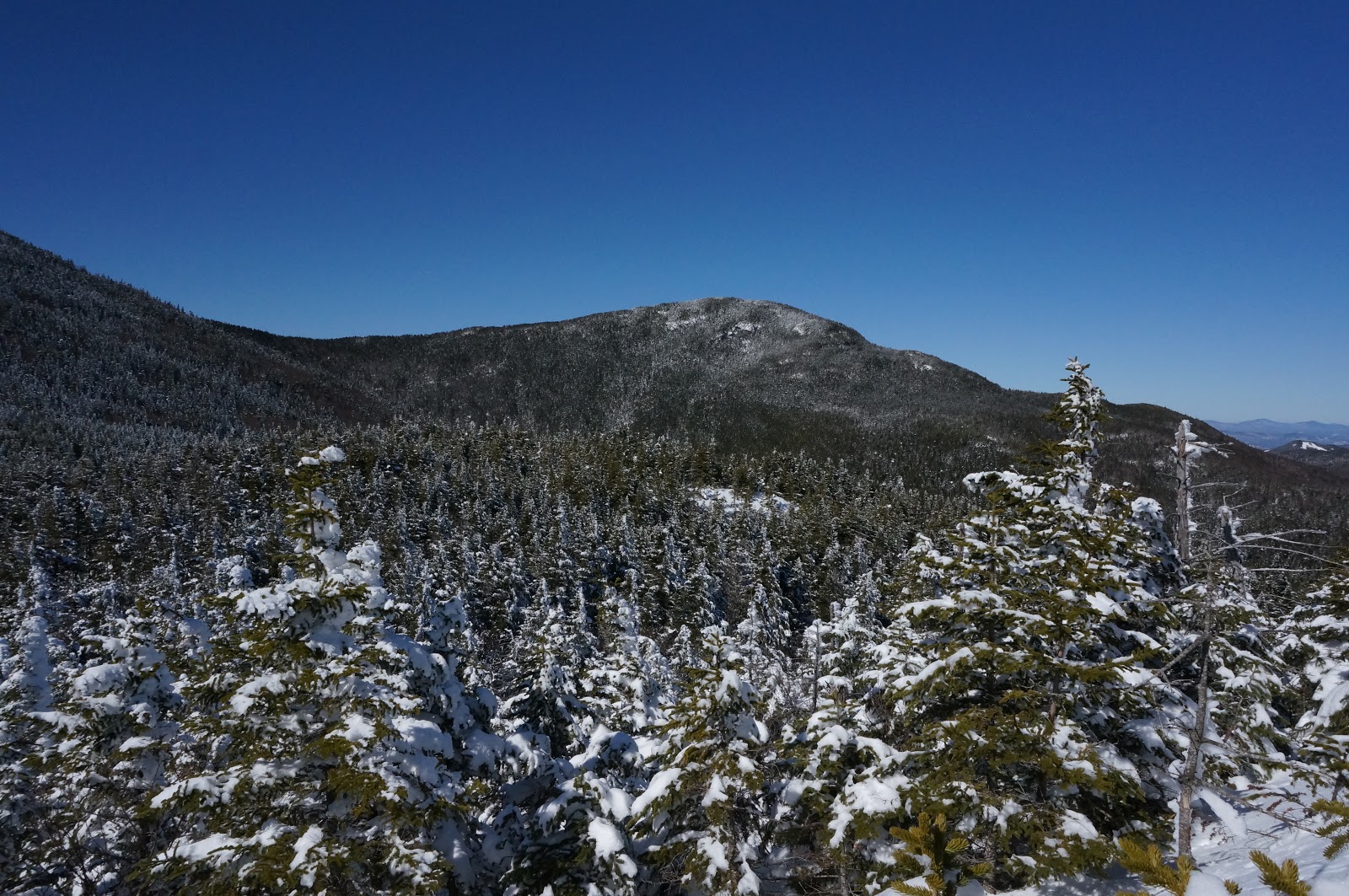
Mt. Willey - our destination
This route offers a spectacular view down into the Lincoln Woods Scenic Area
and south to Mt. Carrigain--an imposing mountain.
We had the Willey Range Trail from Mt. Field to Mt. Willey and back again all to ourselves. It was quiet, but for a couple curious boreal chickadees. We relished the solitude and the winter beauty. A well-laid snowshoe track and the blue trail blazes let us enjoy the walk and the scenery.
We've done the Avalon-Field-Tom (this time Avalon-Field-Willey) before in summer and winter. It is a favorite hiking route as it offers so many fabulous views all day long and in nearly ever direction.

Descending from Mt. Field,
another great view west to Franconia Ridge and the Twins.
The Willey Range Trail from Mt. Field to the junction with the A-Z Trail
was just too beautiful that I kept pausing to take photos.
At this point our legs were growing tired, so we decided to skip the extra 1-mile round trip to the top of Mt. Tom, and headed back down the A-Z trail and Avalon Trail to Crawford Notch. 
The afternoon sun bathed the woods in light, 
highlighting the emerging buds of hobblebush.
Winter is still at hand here at home and in the mountains.
Snow and ice are a long way from melting in the Willey Range.
By the time we finished the 9+ mile hike we were tired and sore,
but all smiles, and still enjoying winter. 

Ice Out

 Ice Out