Tuesday, March 6, 2012

A Moose Carcass

Our friend Ann and I and our dogs meet up often for a local walk. We've been returning regularly to a favorite stretch of the Sweet Trail between Durham and Newmarket. The trail is surprisingly wild. A large animal carcass set back in the woods from the trail attracts the attention of Persica and Kodi each time we pass nearby. I think Persica led Kodi to the carcass the first time, although Kodi never passes up the chance to gnaw on a deer rib or leg.

Today part of the carcass was next to the trail. I noticed that Kodi was chewing on something and sure enough it was the entire skull and part of the vertebrae. Ann and I looked closer and realized it was a moose skull, a small moose, maybe a yearling. The antlers had clearly been sawed off, by the hunter that tagged this moose last fall, we presume. The Sweet Trail passes by many wetlands and I mentioned the wildness, so it doesn't surprise me that a moose was wandering through this area last fall. It also could be that someone happened upon this moose after it died and took the antlers, moose do succumb naturally to several ailments.

According to New Hampshire Fish and Game moose biologist Kris Rines, people in the southeastern part of the state--our area--don't want too many moose. Ann and I--and probably the hunters--disagree. A few more moose would be fine. However, we might not have much say or sway over how many moose live here. Winter ticks, warmer temperatures, and other parasites may limit their population to cooler climes.

Kris recently gave the keynote at the annual meeting of Bear-Paw Regional Greenways, a local land trust for which I am a Board member. Her talk on moose was a little sobering for the moose. They face many challenges, not least of which are winter ticks. A single moose can become infested with tens of thousands of ticks in winter. Such a moose becomes preoccupied with scratching, licking and rubbing its skin and also becomes anemic from loss of blood. Compounding the tick problem are warming temperatures from climate change. Hot summers and warmer winters helps the tick and stresses the moose.

It makes you shiver thinking about so many ticks on a single moose. Moose evolved with the winter tick so they can make it through if not too stressed and develop a new coat come summer. I hope moose can hang in there as they are such a curious looking creature and otherwise so well-adapted to northern forests.

Sunday, March 4, 2012

Gerry

We lost our friend Gerry to cancer last week, an illness that struck suddenly and fiercely, claiming him just as he turned 59. We met Gerry more than 15 years ago as we walked our dogs in the early morning down Bald Hill Road. Gerry was an early riser too. Back then he ran and mountain-biked until his knees slowed him to walking. Gerry liked birdwatching and snowmobiling and could fix most anything--especially lawnmowers and snowblowers.

On weekend mornings we'd look for Gerry, the dogs would greet him with tails wagging. We would stop and chat about recent bird sightings, the weather, picking up trash along the road, weekend chores, plans for the day--never politics or the news, that was not Gerry's interest. He and Srini would talk about engine repair. One season he helped Srini repair our snowblower after mice built a huge nest inside.

We had not seen Gerry for a while, but we were busy and sometimes our walks were shorter or later. Then Gerry's wife Cecile called a week ago to say that Jerry was in hospice. We were stunned as we didn't know he was ill. When Cecile mentioned to Gerry that she was going to call us and some of his other friends, he said, "Oh, don't bother them with this." That was Gerry--so kind and unassuming that he didn't want to bother us even with his own death. We shared the news with others along Bald Hill Road, "morning friends" who also walked with Gerry when they happen to meet up.

Gerry kept everything at his house in working order--never leaving anything undone, whether repairs to the house or cars or tidying up the yard. Cecile said he was calm at the end, he was at peace with his condition, and there was nothing left for him to do. He lived simply.

The great horned owl hoots for you Gerry.
A bluebird flashes its beautiful blue feathers for you.
A red tail soars over the fields,
and the turkeys cluck from the hillside for you.
The woodpeckers carry your spirit as they fly,
from tree to tree along Bald Hill Road.
We hear the mournful coo of the mourning dove at dawn.
We look for you Gerry as the sun rises,
and we will think of you,
when the first red-winged blackbirds arrive,
and when the grass turns green.

Monday, February 27, 2012

Bird Crops

On our early morning walks with Kodi, Srini often asks a question, the answer to which I'd forgotten (which happens a lot). This leads to a bit of research and sometimes a blog post. Like most mornings, today we walked into the hayfield along Bald Hill Road. Kodi leads us there and then he moves slowly, tail down and ears back, as he sniffs each clump of little bluestem grass. Kodi carefully studies the scent of wild turkeys or more likely the coyotes that are tracking the birds. The thought of wild turkeys led Srini to ask about a bird's crop and whether that helps to grind up acorns that turkeys devour in the fall.

I had to refresh my understanding of a bird's digestive system. A sketch by David Allen Sibley in National Audubon Society's The Sibley Guide to Bird Life & Behavior helped:


Many birds, but especially pigeons, doves, and "gallinaceous" (turkeys for example) have large crops. A crop is an expandable pouch that is an extension of the esophagus. It serves as a storage chamber, much like a chipmunk's cheek pouches. Birds stuff extra food into the crop where it can be digested later from the safety of cover. A bird with a full crop may look like it has a huge Adam's Apple--a large protrusion at its throat.

Food stored in the crop eventually makes it way into a bird's two-chambered stomach. First into the proventriculus where digestive juices begin to soften up the food, and then into the gizzard. It is the strong, muscular gizzard with rough skin-like ridges and an accumulation of grit that finally grinds the food--such as acorns--into smaller bits. The gizzard in birds acts like the grinding molars in mammals or similar to a millstone grinding wheat into flour.

Pigeons and doves have a particularly unique crop. When pigeons are born they reach into their parents mouths for "crop milk." This fluid, rich in protein and fat, is produced in the crop of both parents by a sloughing of fluid-filled cells from the crop lining. Young pigeons rely on this milk for their first 5 to 10 days, before switching to regurgitated plant and insect matter.

Bird digestion is actually quite efficient, so food stored in the crop doesn't last long.

Sunday, February 26, 2012

Tom & Atticus

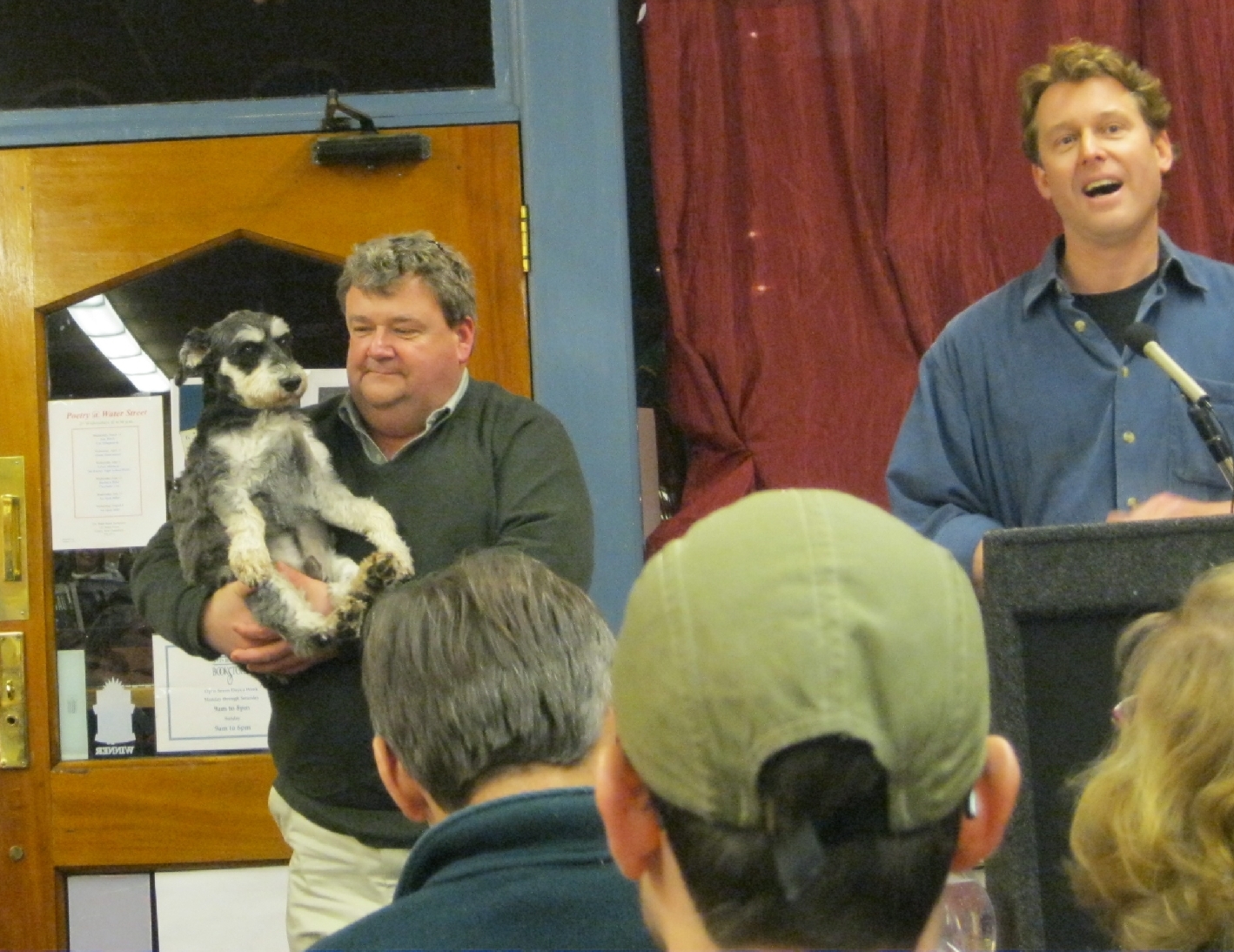
Water Street Bookstore in Exeter was packed last night, filled with people eager to meet Tom Ryan and Atticus M. Finch. We arrived early but not as early as most everyone else. One benefit of our timing was that Atticus suddenly appeared trotting down the sidewalk, a few yards ahead of Tom. I bent down to rub his back and ears; he ignored me but I think appreciated the rub anyway. It was my first in person encounter with Atticus, a handsome, confident, miniature schnauzer and Tom's best buddy and hiking companion. Meeting Tom would have to wait, as he and Atticus needed more walk time before the event started.

We settled into our seats not long before Tom and Atticus entered the bookstore to great applause, especially when Tom lifted Atticus into the crook of his arm.

 Tom & Atticus are introduced at Water Street Bookstore
(Photo by Dale Wisler)
I first "met" this extraordinary pair more than three years ago through their blog, The Adventures of Tom & Atticus. It was Tom's writing and their adventures together that inspired me to start a blog. I've been so humbled by Tom's support of my own Spicebush Log. What an honor to finally meet them both last night at the bookstore.

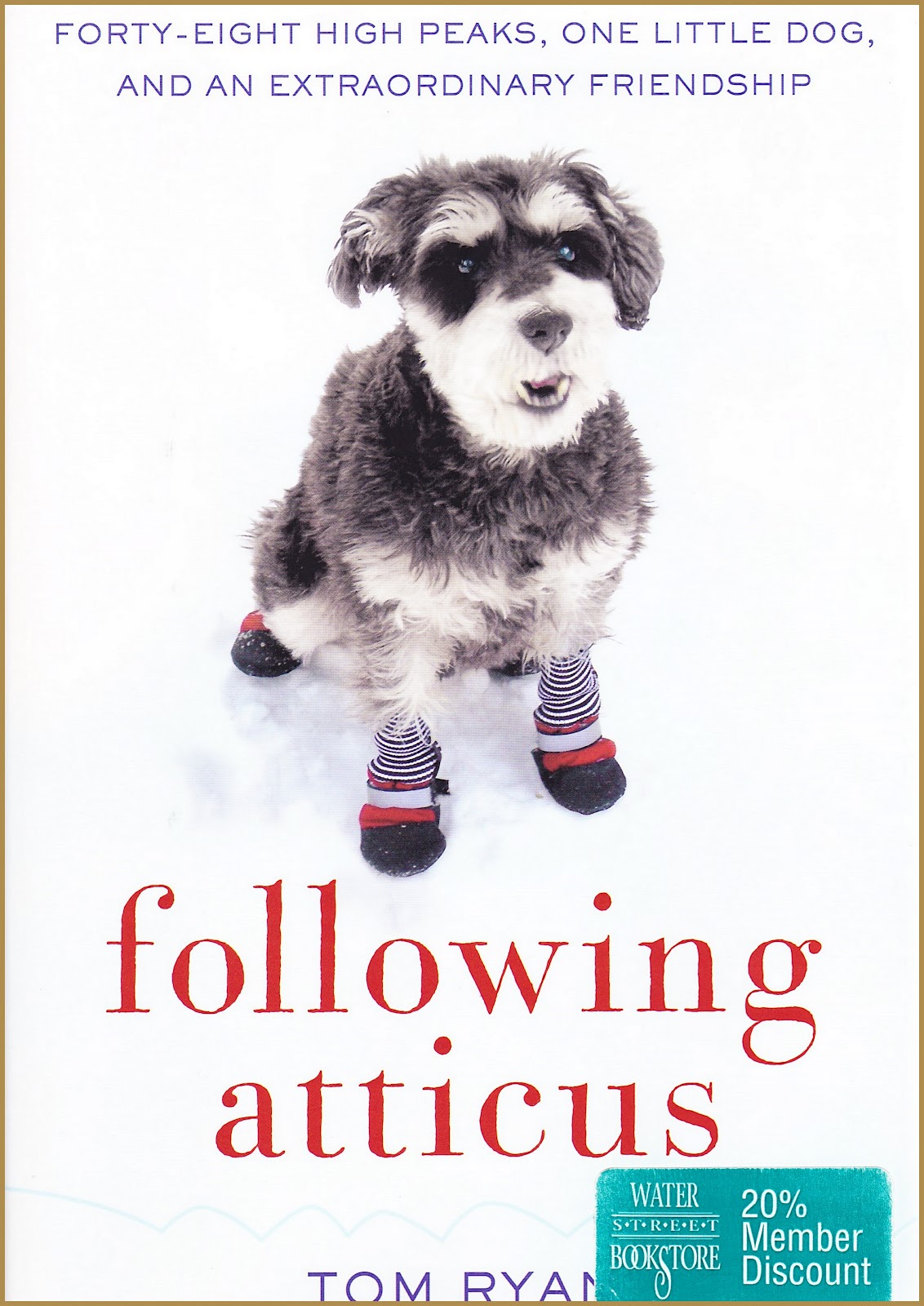
Last night Tom re-told stories of his life, about his family, his Newburyport newspaper--the Undertoad, life with his adopted miniature schnauzer Maxwell Garrison Gillis, and the special bond with Atticus over the past 10 years. Tom and Atticus are on book tour for Tom's book, Following Atticus, forty-eight high peaks, one little dog, and an extraordinary friendship, which was published last September. A book that is receiving well-deserved rave reviews.


Atticus is part of the star attraction of this duo, although on book tour Atticus rests or sleeps on a soft blanket beside the lectern while Tom tells his story that extends all the way back to his own childhood. Tom was funny and entertaining and enthusiastic about being in front of a large crowd, even though by his own admission it hasn't come easy. After-all, he and Atticus often prefer to be out on the trail by themselves hiking in the wilds.

At one point Atticus requested a drink of water and another time Tom picked him up while he was narrating part of his story. Atticus laid his head down on Tom's shoulder, perhaps a tender hug and reassurance that they both need during these public talks, which must require some stamina by both.

Tom & Atticus at Water Street Bookstore
(photos by Dale Wisler)

After Tom finished speaking, there were a dozen or more questions from the audience. Importantly people asked about their health -- good for both. Many of us then formed a line for the book signing. I was feeling a little nervous, like I was meeting my in-laws for the first time. I had not met Tom yet, although I knew them both so well through emails, Tom's blog, and his book. And I had already introduced myself to Atticus on the sidewalk. When I introduced myself to Tom at the signing, he gave me a big, gentle hug and one for Srini too. Any nervousness on my part disappeared as I felt the warmth and grace of this man who cares so deeply about a little dog named Atticus.

Following Atticus generates almost as many tears as smiles, but this is an upbeat story, about overcoming, or at least confronting, fears, family dysfunctions, illness, and other life struggles. I look forward to following Tom and Atticus on more of their adventures together and Tom assured us last night that there is more to come.

Happy trails Tom and Atticus.

Friday, February 24, 2012

Coyotes Calling

Two nights this week we've heard coyotes calling behind our house, either from the wetland edge or the Mitchell hayfields. Even with the windows closed on a February night their calls seep into our bedroom. The first time was earlier in the week at about 1:00 am, a pack of coyotes howled and yipped. Last night at 3:30 am I heard one lone coyote howling. I wished I was out there nearby watching them silently. They are such beautiful animals--weighing 30 to 50 pounds with thick fur and a bushy, black-tipped tail. Their wolf DNA expressing itself in their large size, compared to their cousin, the western coyote.

Lying in bed I pictured the lone coyote howling, its head tilted back and long, narrow nose pointed skyward. It howled to locate the rest of its pack--its lifelong mate and their adult offspring. Or perhaps it was warning a non-family member to stay out of its territory, a territory of 2 to 25 square miles that the family pack defends vigorously by howling and scent marking. The other night it was several pack members yipping and howling, likely re-uniting after they each hunted on their own. I imagined the variety of foods that they found on their respective hunts: berries, woodland mice, road-kill, garbage, a cat, a chicken, a songbird.

Christine Schadler wrote an informative article on the eastern coyote in New Hampshire Fish and Game's Wildlife Journal, which can be read here. You'll see beautiful pictures there too, including a side-by-side comparison of a wolf and coyote.

The alpha pair is in the midst of their breeding season. The number of pups born in 63 days depends on the food supply. Typically the female will give birth to 4 to 6 pups, in good years maybe more. Hunting coyotes mostly increases the number of offspring, since fewer adult coyotes means more food for the pups, so more survive.

Coyotes adapt well to our human landscapes. I welcome them into my neighborhood, thrilled to hear them howling to each other or yipping as they re-unit after a night's hunt. Even Kodi seems to be adjusting to their presence, methodically sniffing the tips of small twigs that a coyote might have brushed during the night.

Wednesday, February 22, 2012

A Mindful Walk

We walk down Bald Hill Road, Kodi and me. Overturned recycling bins line the roadside,
the blue bins just emptied by the trash hauler. The ditch is littered with beer cans,
tossed aimlessly from a car as if someone missed the recycling bin.
Do they laugh, I wonder, when they throw their empties out the window.

Specks of mica in the road pavement sparkle in the midday sun.
A bluebird sings from a sugar maple tree. No one has tapped the maples this year.

We walk onto the Cole Farm, through Vern's old orchard. The scraggly pear trees
are covered in lichen, they are passed their prime, as Vern has now passed.
His land conserved for all to enjoy. We walk the same paths that Vern walked,
through the fields and forests into the dark pine and hemlock glade where Vern wandered
to find solitude and respite from memories of war. The wind blows through the tree tops,
the swaying pines whine as they rub against each other.

We walk on to the Greenway to see the logging underway. Today, however
the machinery is idled. The weather has warmed, the road is too soft and muddy
for heavy equipment. The loggers wait for a colder day to return to their livelihood.
How they manage the stress of unpredictable weather I do not know.

The loggers have been busy since I last visited with the forester to see what should be cut,
to make habitat for hares and grouse and chestnut-sided warblers and other animals
that like new, young growth.The site looks clean, they worked hard to make it
so. Cutting and hauling wood is rough on their bodies and at first looks rough on the land.
The land recovers with time, more quickly when the logging is careful as it was here.

I can see Bald Hill from the new, big clearing. Kodi too looks out across the opening,
a clearing that is soon to be home to birds and insects and other sun-loving animals.
Turkeys scurry down a freshly cleared woods road, but not quick enough before Kodi
catches a glimpse. He chases but gives up, the turkeys run fast, fast enough to outrun
a coyote, or a dog.

The logged area draws my attention because it is so raw. Yet most of the forest remains,
the mature oaks and hickories, Vern's dense stand of hemlocks and pines, and much else.
Mud cakes the bottom of my boots. I think again that it is too warm for middle February.
Kodi wanders too far to eat something that he should not. I am not patient and try to
calm my wandering mind.

The clearing

Tuesday, February 21, 2012

Missing Snow, Finding Beauty

When I return home from hiking in the wintry north I often feel at a loss for a few days. I miss being in the midst of snow-covered spruce where snowshoe hare tracks bound across the soft powder and sometimes the only sound I hear is my heart thumping.
This winter especially it seems so dull back home where the bare ground is covered in decaying brown leaves, the trails ice-covered, and the woods empty of snow.

Thus, this morning I set out on a nearby trail to find beauty amidst the brown and the gray. Kodi always finds joy, whether he is rolling around on hard-packed snow at 4,300 feet or sniffing about in the dead leaves at sea level. Today, to his delight, he found a small piece of deer bone. I too was delighted by what I found on our walk, when I really looked again at the woods and the wetlands. Even the common sights and sounds and the subtle colors of a brown mid-winter's day were lovely when I stopped to look and listen and absorb.

Oaks and pines cast long shadows across the frozen marsh

A flock of noisy crows flies across the wetland, over the still silent heron nests

Wooden nest boxes await the return of cavity-nesting wood ducks and hooded mergansers

Rock and reindeer lichens look healthy in their respective habitats bathed in a warm winter sun
A turkey vulture soared effortlessly and silently on its bowed wings overhead, while the soft notes of a foraging nuthatch floated over from a nearby red oak. I was shielded from the wind as I watched the nuthatch creep along a thick branch in search of insects. I'm sure the nuthatch prefers the snow free woods, and today it felt good to me too.

Ice Out

 Ice Out