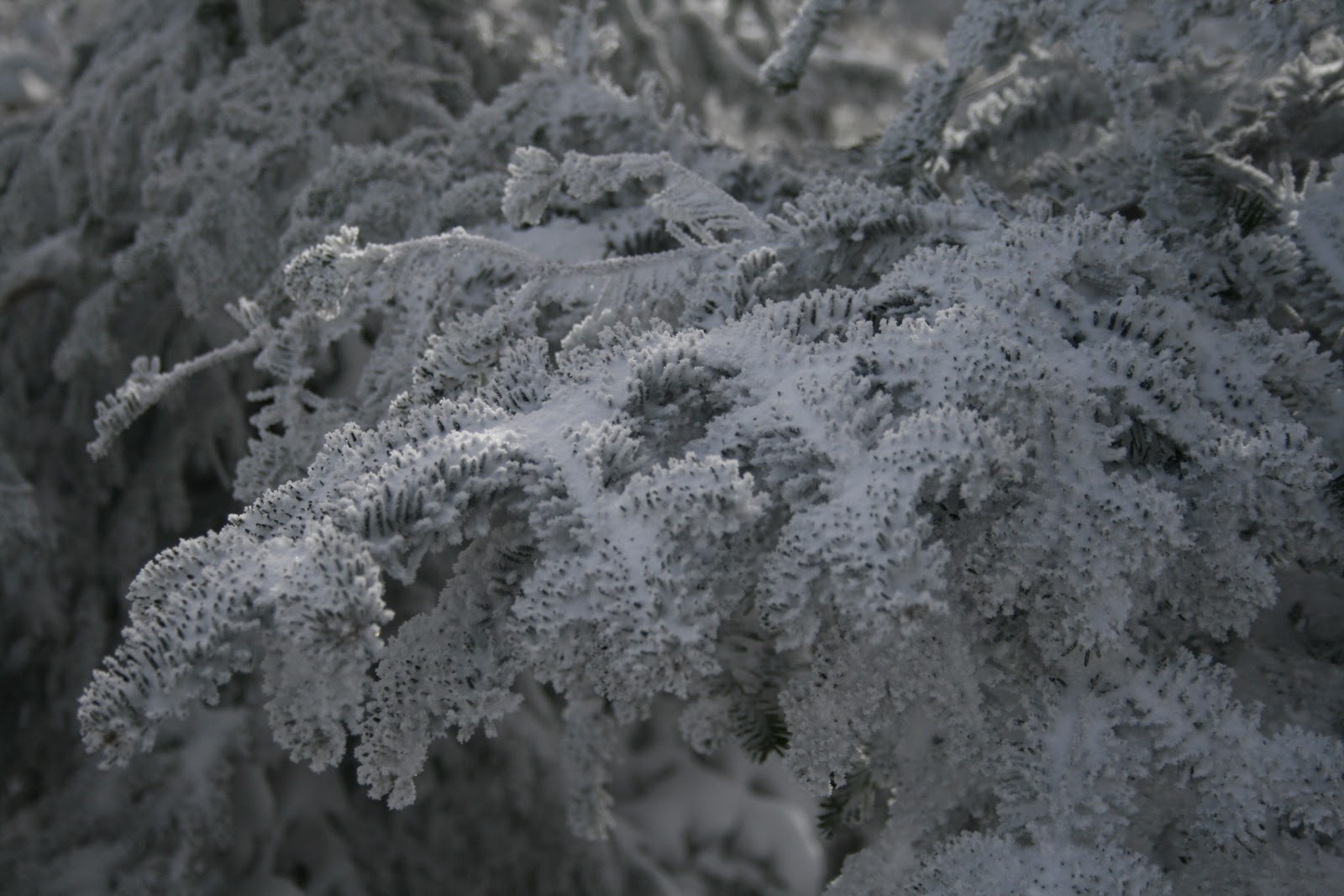
Today reminds me of a cartoon that I saw years ago. A guy is on the phone, telling the weather forecaster to come over and shovel off of his driveway a foot of "partly cloudy." The forecast for today was 1-3 inches; when the snow finally petered out by noon nearly 8 inches of fresh powder had fallen. More wintry than we expected. Kodi and I took advantage with a long snowshoe hike at one of our favorite local haunts. Kodi had a huge smile on his face as he raced through the deep snow.
I've been away since Wednesday. The four dozen redpolls must have moved on while I was gone. Four male and two female purple finches spent some time at the feeders around midday, along with the usual flock of American goldfinches. The squirrels are not yet out today; they prefer to stay hunkered down in their dens during these winter storms.
A female downy woodpecker kept her male counterpart away from the suet. She wanted it all. When a female hairy woodpecker arrived, she tried to ignore it, but the heavier and bigger hairy caused too much of a stir so the downy left. A pair of red-breasted nuthatches visited the suet last week. I've been watching for them today, but they too must be staying put in a tree cavity in the back woods. Here's a decent photo of the pair from last week through my home office window.
A friend was needling me the other day for taking down our pine trees, while we complained about a neighbor taking down a big red oak. In our defense I noted that we still have many pines on the north side of the house - plenty for the red-breasted nuthatches, purple finches, brown creepers, and red squirrels, which like pines. Plus, we kept the red oaks in our woods and removed the pines, thus releasing the oaks from the over-topping pines. The oaks should grow bigger and broader, producing more acorns for all kinds of wildlife. Our neighbor had the one big oak and replaced it with some non-native plants. I think our strategy is better. Seeing the nuthatch pair reinforced for me that our yard is still diverse and has suitable habitat for these little birds.
Sunday, February 27, 2011
Friday, February 25, 2011
Finding Treasures
My young nieces and I snowshoed around the back forty at my parents Winterberry Farm yesterday. This was the first time, I think, that they were on snowshoes. They both walked well on their plastic shoes.
We made discoveries along the way. I showed them the rabbit tracks and the rabbit scat under the brambles. These would be Eastern cottontails and they seem to be everywhere here. They noticed a ridge pattern in the snow and wondered how it came to be. We snowshoed to the pond and saw a small area of open water along its edge. We saw huge turkey tracks.
We saw holes in the snow made by squirrels digging for acorns. Then we discovered the remains of a deer in the woods. Only the fur was left. We brought a sample back to show everyone. I broke off a twig from the spicebush to let them sniff the spice.
Back at the house my oldest niece talked excitedly about the snowshoe hike and the treasures (her word) that we found, especially the deer fur. This is what I like about snowshoeing - the pace is just right for finding treasures.
We made discoveries along the way. I showed them the rabbit tracks and the rabbit scat under the brambles. These would be Eastern cottontails and they seem to be everywhere here. They noticed a ridge pattern in the snow and wondered how it came to be. We snowshoed to the pond and saw a small area of open water along its edge. We saw huge turkey tracks.
Eastern cottontail scat among the brambles
We saw holes in the snow made by squirrels digging for acorns. Then we discovered the remains of a deer in the woods. Only the fur was left. We brought a sample back to show everyone. I broke off a twig from the spicebush to let them sniff the spice.
Remains of a deer in the woods
Back at the house my oldest niece talked excitedly about the snowshoe hike and the treasures (her word) that we found, especially the deer fur. This is what I like about snowshoeing - the pace is just right for finding treasures.
Monday, February 21, 2011
Redpolls and Finches
Four dozen redpolls showed up at the feeders today. This goldfinch-sized finch is another one of those "irruptive" birds that come down from the north in some winters. The redpolls feed side-by-side with the more regular American goldfinches. You can identify them easily by their small yellow bill, black around the face, and most distinctly a bright red patch on their forehead. Redpolls have a bit of streaking and the adult males have a splash of pink on their breast.
When so many arrive at once -- and they do seem to move about in big flocks -- there is only so much space on the thistle feeders. Redpolls are voracious eaters so many spend a lot of time on the ground, while others claim space on the feeders. The gray squirrels are a little defensive of their feeding space beneath the feeders, keeping the redpolls on one side of the feeder post, while they occupy the other side. This photo through my office window is not great, but you get the idea.
There was more splash of color as two pairs of purple finches arrived too. They first showed up last Friday. As the bird guides say, male purple finches look like they've been dipped in red raspberry juice. It was certainly a red finch day here.
When so many arrive at once -- and they do seem to move about in big flocks -- there is only so much space on the thistle feeders. Redpolls are voracious eaters so many spend a lot of time on the ground, while others claim space on the feeders. The gray squirrels are a little defensive of their feeding space beneath the feeders, keeping the redpolls on one side of the feeder post, while they occupy the other side. This photo through my office window is not great, but you get the idea.
When the squirrels leave, the redpolls spread out.
There was more splash of color as two pairs of purple finches arrived too. They first showed up last Friday. As the bird guides say, male purple finches look like they've been dipped in red raspberry juice. It was certainly a red finch day here.
Sunday, February 20, 2011
Into The Wind
The only time I wear high heels is when I am snowshoeing. Seriously. Our MSR snowshoes have these "televators" that you lift up under your heel when climbing steep sections of trail. This reduces fatigue on your calves. It is THE only time that I wear shoes with raised heels! The televators came in handy today as we headed north to Crawford Notch for a repeat hike of Mounts Avalon, Field, and Tom - a trio that we hiked in August.
Crawford Notch creates its own weather. We arrived at the Highland Center parking lot at 8:00 am; many other hikers were gathering there too with similar ideas. The winds whipped through the notch, making the 7 degree ambient temperature feel much colder -- well below zero. The surrounding mountains, including our trio, were in the clouds. We met up with our hiking party: the same group that hiked Mt. Moosilauke, plus one. Six of us in all plus Kodi.
Our route took us up the Avalon Trail to Mt Avalon (3,442') and then on to Mt. Field (4,340'). Then a descent on the Willey Range Trail to the A-Z Trail with a side trip up to Mt. Tom (4,051), before the descent back to Crawford Notch. The weather got better as the day progressed; the clouds dissolved and the bluest sky emerged. But the wind did not abate and temperatures remained in the teens, although on the summit of Mt. Tom we were sheltered from severe wind gusts. We wore snowshoes the entire way -- all 7.2 miles. The trails were fairly well-packed by previous hikers, except here and there where snow drifted over. Kodi hiked far more miles - running up and down many sections of trails several times. Gray jays visited us on Mt Field and Mt. Tom. Kodi chased the birds around the summit as best he could.
In the area of the A-Z Trail up to Mt. Tom we saw many fresh (pine) marten tracks. As we descended from Mt. Tom on the A-Z trail I was near the front with Kodi. At one point he wandered off trail, sniffed around the base of several trees, then sat quietly beneath a balsam fir looking up into the tree. I glanced up looking for whatever he smelled or saw. And there about 20 feet up in the fir tree was a marten!! This is the first marten that I have seen in the wild. He or she peered down at Kodi from its perch, watching his every move. All but one person in our group arrived in time to see this very cute member of the weasel family, with its golden-brown face, small, rounded ears, and dark tail. Marten are a threatened species in New Hampshire, although their population is expanding, so we hope to see more of them on future hikes. I did not get a photo, but here is a link to a picture of a marten on Wikipedia.
It was a fabulous day to be out, despite the wind. What follows are a series of photos from our hike today.
Crawford Notch creates its own weather. We arrived at the Highland Center parking lot at 8:00 am; many other hikers were gathering there too with similar ideas. The winds whipped through the notch, making the 7 degree ambient temperature feel much colder -- well below zero. The surrounding mountains, including our trio, were in the clouds. We met up with our hiking party: the same group that hiked Mt. Moosilauke, plus one. Six of us in all plus Kodi.
Our route took us up the Avalon Trail to Mt Avalon (3,442') and then on to Mt. Field (4,340'). Then a descent on the Willey Range Trail to the A-Z Trail with a side trip up to Mt. Tom (4,051), before the descent back to Crawford Notch. The weather got better as the day progressed; the clouds dissolved and the bluest sky emerged. But the wind did not abate and temperatures remained in the teens, although on the summit of Mt. Tom we were sheltered from severe wind gusts. We wore snowshoes the entire way -- all 7.2 miles. The trails were fairly well-packed by previous hikers, except here and there where snow drifted over. Kodi hiked far more miles - running up and down many sections of trails several times. Gray jays visited us on Mt Field and Mt. Tom. Kodi chased the birds around the summit as best he could.
In the area of the A-Z Trail up to Mt. Tom we saw many fresh (pine) marten tracks. As we descended from Mt. Tom on the A-Z trail I was near the front with Kodi. At one point he wandered off trail, sniffed around the base of several trees, then sat quietly beneath a balsam fir looking up into the tree. I glanced up looking for whatever he smelled or saw. And there about 20 feet up in the fir tree was a marten!! This is the first marten that I have seen in the wild. He or she peered down at Kodi from its perch, watching his every move. All but one person in our group arrived in time to see this very cute member of the weasel family, with its golden-brown face, small, rounded ears, and dark tail. Marten are a threatened species in New Hampshire, although their population is expanding, so we hope to see more of them on future hikes. I did not get a photo, but here is a link to a picture of a marten on Wikipedia.
It was a fabulous day to be out, despite the wind. What follows are a series of photos from our hike today.
Kodi atop Mt. Avalon; the clouds linger into mid-morning
The view from Mt. Avalon into Crawford Notch
The trail signs are nearly buried in the deep snow pack
The spruce and fir are coated in fresh snow
On the way from Mt. Avalon to Mt. Field, the intense blue sky emerges
And Mount Washington is visible in the distance
And a black ghost walks in the white forest
A rainbow of colors reflect off the fast-moving clouds overhead
Nearing the summit of Mt. Field
A view just below the summit of Mt. Field
Then from the top, another view to Mt. Washington
Mt. Field - a windy spot, but friendly to gray jays;
the birds capture our attention
And some people like to feed them
While Kodi likes to chase them around the spruce-fir thickets
A view of Mt. Field from near the summit of Mt. Tom
We arrived back at the Highland Center parking lot by 3:20 pm;
the sky was now clear but the wind still whipped through the notch
Friday, February 18, 2011
A Brown Creeper Sings
A touch of spring today, with temperatures soaring into the low 60s. The sun never felt so good. Some snow melted, although the snow pack in our yard is still two feet deep. I heard a brown creeper sing its spring song in the backyard today.
On the morning walkabout with Kodi, I heard two male cardinals singing dueling songs from their tree-top perches. The females, I presume, were hanging out somewhere in the underbrush. New Roots Farm tapped a few sugar maples; the first taps that I've seen as the maple syrup season gets underway. Such welcome signs that winter is losing its grip and is slowly, but steadily, melting away.You could smell spring in the air.
Today was just a teaser though. The winds are already gathering force as the sun goes down. It is back to freezing temperatures for the foreseeable future. Well, there is nothing we can do about the weather, so we are off to tackle another 4,000-footer or two this weekend, winter gear and all.
On the morning walkabout with Kodi, I heard two male cardinals singing dueling songs from their tree-top perches. The females, I presume, were hanging out somewhere in the underbrush. New Roots Farm tapped a few sugar maples; the first taps that I've seen as the maple syrup season gets underway. Such welcome signs that winter is losing its grip and is slowly, but steadily, melting away.You could smell spring in the air.
Today was just a teaser though. The winds are already gathering force as the sun goes down. It is back to freezing temperatures for the foreseeable future. Well, there is nothing we can do about the weather, so we are off to tackle another 4,000-footer or two this weekend, winter gear and all.
Monday, February 14, 2011
75 Bohemians
Yesterday we went on a pre-Valentine's Day outing -- first to Seapoint Beach in Kittery, Maine (more on that below), then on to Freeport and our favorite outlet store Patagonia. We don't shop much, but we scoot up there once every few years to catch good deals on Patagonia clothing. It lasts forever and some of it is made from recycled plastic or organic cotton. Before leaving town we had lunch at the Azure Cafe on Main Street - highly recommended.
Anyway, just before we got in our car to head home, I noticed a bunch of birds in a nearby tree. Even with my naked eye I could tell they were waxwings -- with their upright stance, brownish crest, and their high-pitched notes. As I lifted the binoculars I noticed something a bit different. This was a flock of 75 Bohemian waxwings, a somewhat uncommon winter visitor from the north. Bohemians are slightly bigger than the more common cedar waxwings. They also have beautiful rufous undertail coverts (feathers); these feathers are white in cedar waxwings. Both waxwing species have yellow-tipped tail feathers. Bohemians also have a colorful white and yellow edging in their wing feathers.
Today I checked the NH Bird Listserve and perhaps by chance my friend Scott had 54 Bohemian waxwings in his yard on Saturday. He's a fabulous photographer (and naturalist); see his great photos of these birds on Flickr. While there, also notice Scott's photos of flying squirrels in a bird house. He's got many more great photos of other wildlife on his site -- spend some time there.
As I mentioned, we stopped at Seapoint Beach in Kittery on the way north. I've mentioned before that winter is the best time to visit a beach. Sounds crazy, but there are few people, good parking, and cool birds to view off-shore. Also, the few people that do visit bring their dogs and Kodi has a fabulous time. He ran along the beach with two small dogs. I am certain they were laughing as they chased each other.
Meanwhile, I glanced out into the ocean to look at the sea ducks. The water was a little rough and the birds a bit far off. Nevertheless, we got nice views of a common loon, bufflehead, red-breasted merganser, common eider, black duck, surf scoter, and common goldeneyes. By the time we left no one else was on the beach. That does not happen in summer. I noticed that Tom and Atticus are thinking the same thing -- spending a week on the Outer Cape Cod beach. The coast is cold and stark in winter, but as Tom says, something draws you to it.
Anyway, just before we got in our car to head home, I noticed a bunch of birds in a nearby tree. Even with my naked eye I could tell they were waxwings -- with their upright stance, brownish crest, and their high-pitched notes. As I lifted the binoculars I noticed something a bit different. This was a flock of 75 Bohemian waxwings, a somewhat uncommon winter visitor from the north. Bohemians are slightly bigger than the more common cedar waxwings. They also have beautiful rufous undertail coverts (feathers); these feathers are white in cedar waxwings. Both waxwing species have yellow-tipped tail feathers. Bohemians also have a colorful white and yellow edging in their wing feathers.
Today I checked the NH Bird Listserve and perhaps by chance my friend Scott had 54 Bohemian waxwings in his yard on Saturday. He's a fabulous photographer (and naturalist); see his great photos of these birds on Flickr. While there, also notice Scott's photos of flying squirrels in a bird house. He's got many more great photos of other wildlife on his site -- spend some time there.
As I mentioned, we stopped at Seapoint Beach in Kittery on the way north. I've mentioned before that winter is the best time to visit a beach. Sounds crazy, but there are few people, good parking, and cool birds to view off-shore. Also, the few people that do visit bring their dogs and Kodi has a fabulous time. He ran along the beach with two small dogs. I am certain they were laughing as they chased each other.
Meanwhile, I glanced out into the ocean to look at the sea ducks. The water was a little rough and the birds a bit far off. Nevertheless, we got nice views of a common loon, bufflehead, red-breasted merganser, common eider, black duck, surf scoter, and common goldeneyes. By the time we left no one else was on the beach. That does not happen in summer. I noticed that Tom and Atticus are thinking the same thing -- spending a week on the Outer Cape Cod beach. The coast is cold and stark in winter, but as Tom says, something draws you to it.
Sunday, February 13, 2011
Winter Wren
This is the first year that I have seen a winter wren in winter. So far, I've seen two. I am surprised that this little wren - the smallest of our wrens - chose this winter to stay here in the north, so cold and snowy. A reference on New England Wildlife by DeGraaf and Yamasaki, says that the winter wren is not particularly hardy and does not winter north of Massachusetts. These wrens are apparently redrawing their winter range map.
A few weeks ago I saw a small brown bird with a stubby tail in the underbrush near the Exeter River. My first thought was a young bird, but of course this was the middle of winter, so not an option. This bird flew among small seeps and overturned root balls of big white pines. Last week I saw a similar bird in our back woods. I watched the bird make a rapid but short flight into a seep and then to an upturned tree root. I got a better look at this bird and realized that both sightings were of a winter wren. A small, dark brown bird with a stubby, upturned tail and a quick flight; a bird that flies furtively in the understory.
The winter wren is one of my favorite birds during the breeding season; its song is long and melodious. They live in conifer or mixed wood forests -- preferring spruce-fir forests -- usually near water. They hang around in the dense understory of upturned roots, fallen limbs, rock crevices, seeps, mossy hummocks along streams. You won't find them in a forest with an open understory lacking these features. Year-round, winter wrens glean insects from the ground. I think the wrens I saw were looking for insects in the woodlands seeps, like the one below that is in our back woods.
The open water in these woodland seeps (typically a few feet in diameter) attract other animals. A mammal entered this seep, then left muddy footprints when it climbed back out. I noticed this on several seeps in our woods. Maybe a squirrel or a raccoon. The snow is crusty, so track patterns are hard to read.
We need a fresh snowfall. Instead, tomorrow looks to be warm -- warmer than it's been for more than a month. Look (or more likely smell) for skunks - they are emerging from their winter dens about now. The warm temperatures on Valentine's Day will surely bring them out in search of mates.
A few weeks ago I saw a small brown bird with a stubby tail in the underbrush near the Exeter River. My first thought was a young bird, but of course this was the middle of winter, so not an option. This bird flew among small seeps and overturned root balls of big white pines. Last week I saw a similar bird in our back woods. I watched the bird make a rapid but short flight into a seep and then to an upturned tree root. I got a better look at this bird and realized that both sightings were of a winter wren. A small, dark brown bird with a stubby, upturned tail and a quick flight; a bird that flies furtively in the understory.
The winter wren is one of my favorite birds during the breeding season; its song is long and melodious. They live in conifer or mixed wood forests -- preferring spruce-fir forests -- usually near water. They hang around in the dense understory of upturned roots, fallen limbs, rock crevices, seeps, mossy hummocks along streams. You won't find them in a forest with an open understory lacking these features. Year-round, winter wrens glean insects from the ground. I think the wrens I saw were looking for insects in the woodlands seeps, like the one below that is in our back woods.
The open water in these woodland seeps (typically a few feet in diameter) attract other animals. A mammal entered this seep, then left muddy footprints when it climbed back out. I noticed this on several seeps in our woods. Maybe a squirrel or a raccoon. The snow is crusty, so track patterns are hard to read.
We need a fresh snowfall. Instead, tomorrow looks to be warm -- warmer than it's been for more than a month. Look (or more likely smell) for skunks - they are emerging from their winter dens about now. The warm temperatures on Valentine's Day will surely bring them out in search of mates.
Subscribe to:
Posts (Atom)
Ice Out
Ice Out
-
Whenever it rains hard during the summer, pine cones seem to rain down, the cones knocked from branches in the upper canopy of tall white pi...
-
It was a mourning dove, the pile of feathers beneath the tall white pine. The feathers that I showed yesterday in my blog. You can tell by t...
-
The oldest known hardwood tree in North America--at 700 years old--is a black gum tree tucked away in a hummocky swamp in southern New Hamps...