Thursday, May 23, 2019

Mauna Kea, Silverwords, and the Hairy Hill

At 13,796-feet, Mauna Kea is the highest point on the Big Island, and on all of Hawaii. It is 125 feet higher than its more massive neighbor, Mauna Loa. The two volcanoes offer a stunning landscape perched high on either side of Saddle Road, which runs between Kona and Hilo, and is the quickest way to travel across island.

The road from Kona to Mauna Kea is in good shape and takes about 1.5 hours. A few miles west of the entrance on Saddle Road is the Mauna Kea Recreation Area, which is a great place to stop and stretch: excellent, clean bathrooms, picnic tables, outdoor exercise equipment designed by physicists.

Across from the entrance to Mauna Kea is Pu'u Hulululu ("Hairy Hill"). This is another nice spot to stop and take a short hike (0.7 miles round trip). The air is dry in these parts, so take lots of water. This was a lovely hike to take in the vast landscape.


The Mauna Kea visitor's center, known as the Onizuka Center for International Astronomy Visitor Information Station, is 6 miles up the Mauna Kea Access Road at 9,200 feet. It is an easy drive on a paved road. The visitor's center, run by the University of Hawaii, is tiny and they were working on the entrance and parking, so it seemed even smaller. There are bathrooms and picnic tables and some information about the summit and weather conditions, although the staff were not particularly helpful or friendly. Apparently they aren't allowed to recommend any trail hiking due to liability concerns.

We opted not to drive the final 9 miles to the top, which is mostly gravel and steep and the air gets really thin. It would have been nice to see the 13 telescopes and take in the view, but we didn't want to test our 8-passenger rented Suburban nor the thin air. Here's the sign that causes many not to drive to the top:


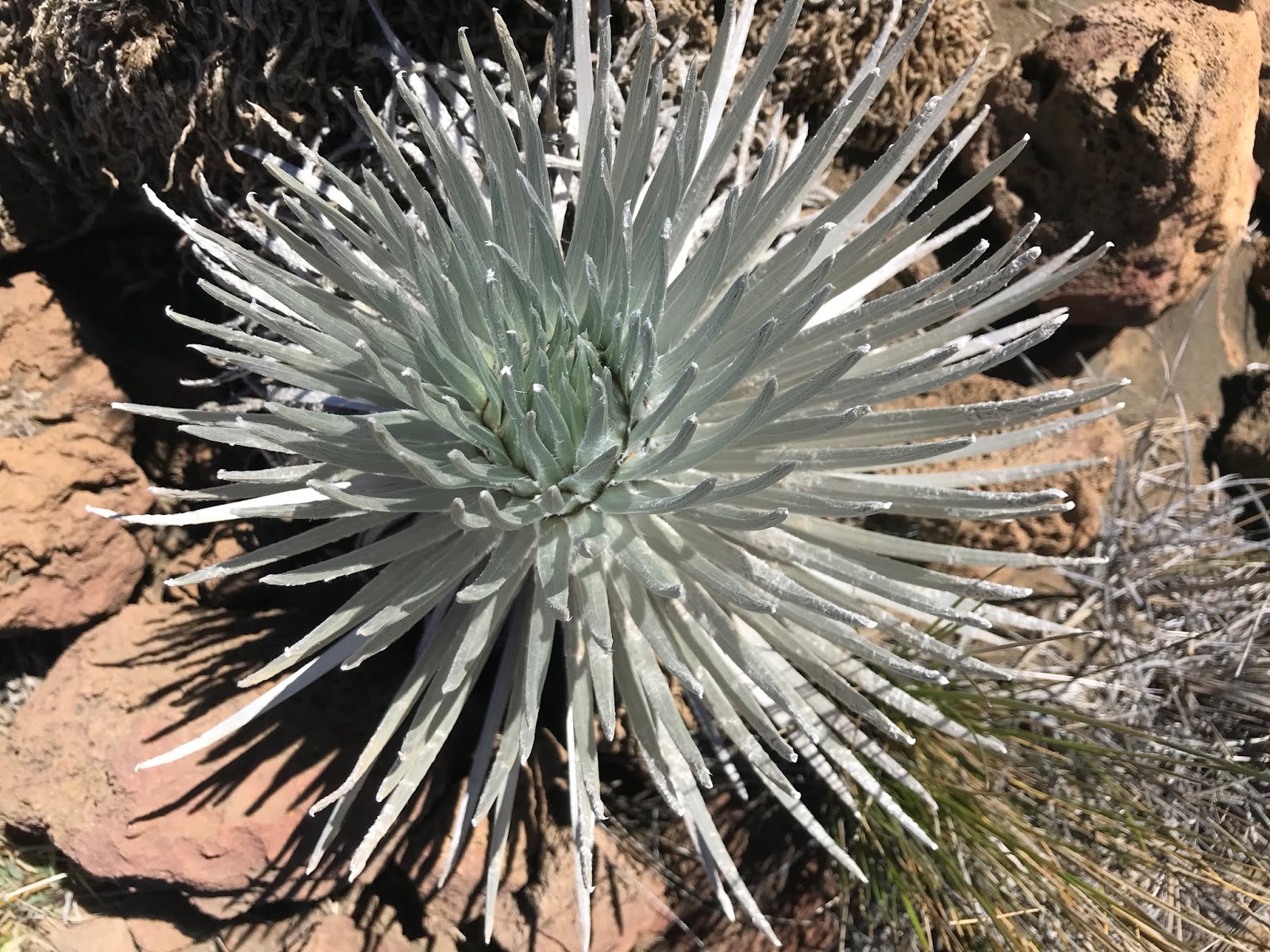
I did learn about a cool plant at the visitor's center: the rare and endangered silversword that is endemic to Haleakala on Maui and Mauna Kea and Mauna Loa on the Big Island. There is a fenced off area behind the visitor's center where the plant grows and was in flower -- apparently a rare occurrence as these plants bloom once in 15-50 years, then die. Each of the three locations where the silversword is found supports a different subspecies (Maui and Mauna Kea) or species (Mauna Loa).

Silverswords were decimated by grazing pigs, goats, sheep, and cattle. The Mauna Kea silversword, Argyroxiphium sandwicense sandwicense, is federally endangered, with less than 50 thought to exist. So we saw a large part of the population. The plant is characterized by a dense rosette of silvery, spiky (but soft) leaves that radiate out from the base. It sends up a tall bloom (up to 6 feet) that sports hundred of purple, aster-like flowers.




From the visitor's center we hiked to nearby Sunset Hill, which offered nice views of the visitor's center, Mauna Kea summit (although the telescopes are on the north side and not visible), stunning landscape over to Mauna Loa, and looking down into a cinder cone. As you can see from the photos, we had stunning weather.


Monday, May 20, 2019

Ohi'a Lehua

Nearly all plants growing in yards and along roads on the Big Island are non-native, and some of those are invasive. Many of the imports are beautiful in color and shape.
Non-native colorful trees in a yard in Kona, Hawaii

However, the most common tree--and I think the most beautiful--growing on the Big Island is the ohi'a lehua. It grows from sea level to alpine and is a pioneer species, being one of the first plants to grow on fresh lava flows. It can look like a shrub, short, scrubby tree, or a tall overstory tree. The most striking feature is the red pom-pom like flowers; the color is from the long, red stamens, not the petals, which are small and inconspicuous. As with lava, I could take a million pictures of this beautiful tree.


A new disease is killing millions of ohi'a trees across Hawaii. Two newly identified fungal species are causing "Rapid Ohi'a Death or ROD. To combat the spread, the state has a quarantine on the movement of ohi'a plants and wood and other guidance for homeowners and people visiting ROD-infected areas.

Many trailheads on the Big Island have the following signs and shoe brush to prevent spreading of invasive plant seeds, fungal spores, and other potential damaging material.

Sunday, May 19, 2019

Hawai'i Volcanoes National Park

The drive from Kailua-Kona to the Mauna Kilauea Visitor Center in Hawai'i Volcanoes National Park is 96 miles; the drive takes about 2 hours. Given the distance, we made only one trip to the main portion of the Park. Next time we would spend a lot more time and stay closer to the Park in Hilo or Pahoa, on the east side of the Island.

These are the highlights of our visit.

We hiked the Sulphur Banks Trail and Crater Rim Trail to an overlook into the Kilauea Caldera. Along the way we passed sulfur vents, huge tree ferns, and other interesting plants.


Sulfur gases waft up from these vents along the Sulphur Banks and Crater Rim Trail.

Beautiful, tall, arching tree ferns line the trail.
I believe this is Cibotium sp. (also called Hapu'u)

A view into the Halema'uma'u Crater in the Kilauea Caldera.

The trails along the Kilauea Caldera are flat, accessible, well-signed,
and pass through beautiful forest and near sulfur vents.

The Kilauea Visitor's Center is small, but the staff will guide you to the best trails, and the interpretive information is quite good. Given our limited time, we then drove down the 38-mile round-trip Chain of Craters Road. This is a must not miss part of your visit. There are several stops along the way and we had time for only a few: Lua Manu Crater and 1974 lava flow, Kealakomo Overlook, and the Holei Sea Arch at the end of the road.

The following photos were take at the Lua Manu Crater stop along the Chain of Craters Road. I could wander about these lava flows for hours and take hundreds of pictures of the plants -- ferns, shrubs, and trees -- that are the first to take hold.


The Kealakomo Overlook offers a stunning sweeping panorama of the 1969-1974 lava flows down to the southern coastline.
At the end of the drivable part of the Chain of Craters Road is a parking lot, small concession stand, and bathrooms. A short hike leads to Holei Sea Arch. The road continues beyond a gate so you can walk a few more miles on this road, although we did not have time.
 Holei Sea Arch
 Sixty-foot cliffs where we saw nesting black noddys


Stunning lava formations created over thousands of years.

Our final stop in Hawai'i National Park, before driving back to Kona was a quick hike on the Kipukapuaulu Trail. This site is accessible off the Moana Loa Road, which is a short distance west of the main park entrance on Route 11. On older maps it was called Bird Park, a nod to the potential for seeing several endemic birds. It was raining and we were short of time, so we walked the 1.2 mile loop trail, very quickly. We heard a few native birds, saw several non-native kalij pheasants, witnessed some of the habitat restoration (removal of invasive plants). This site is worth a visit; buy the trail guide for $2, available at the trailhead.

Saturday, May 18, 2019

Volcanoes on Big Island

The Big Island is about the size of Connecticut, but its population is around 200,000. With such natural beauty you would expect a much higher population, but Hawaii is the most remote set of islands anywhere in the world. California and Alaska are more than 2000 miles away. So, getting goods to the islands is not easy nor inexpensive.

The main reason that the Big Island is relatively sparsely populated is most certainty due to its volcanoes, several of which are still active. For 35 years (from 1983-2018), the Pu'u O'o eruption in the eastern rift zone of the Kilauea Volcano spewed lava, covering hundreds of acres in new lava, burning and burying houses, creating new land along the southern coast of the Big Island, and generating vog (volcanic smog) that caused air pollution across the island. After a final major eruption in May, 2018, the volcano has gone silent. Although there was no active lava flow to witness during our visit, we appreciated the pristine air quality.
This signage describes the 35-year long eruption of Pu'u O'o that ended in 2018.

Within a one to two hour drive you can go from snorkeling in aqua-blue warm waters to hiking on hot, dry volcanic slopes at 9,000 feet. I found the landscape mesmerizing.

The Big Island volcanoes. Mauna Kilauea was active most recently.

At a scenic overlook along Highway 19 (Queen Ka'ahumanu Highway):
lava flow in foreground, blue waters in the distance.

Monday, May 6, 2019

Snorkeling the Reefs of Kona, Hawaii

We went snorkeling four times on the Big Island with rented gear (masks, snorkels, and fins from Jacks Diving Locker in Kona, and for $1 extra, Srini and I got prescription masks). I've snorkeled once before, more than 20 years ago. The rest of our group was a mix of very experienced and never been before.

Our maiden snorkel was at Kahalu'u Beach Park, a 5 minute drive from our VRBO, and just off Ali'i Drive in Kona. The afternoon was a bit breezy so getting in and out across the reef was a little rough (literally, as I got a few cuts), but the water was warm and many beautiful fish swimming among the shallow reef. Sadly, most of the corals are dead as a result of bleaching caused by a warming climate. This is a pattern throughout the world's coral reefs.


The Kahalu'u Beach Park has parking, bathrooms, and freshwater outdoor showers to rinse off saltwater and sand. This handy sign is posted at entrance to the beach, showcasing many of the most common species to see in the reef here. This beach is so accessible that we returned for a second afternoon of snorkeling.

The second place we snorkeled was in Honaunau Bay, at a place called Two Step, named for a set of rocks that allows easy of entry to the reef. This site is about 20 minutes south of Kona. It is very popular, despite the limited parking and not so nice portable toilets. But the reef is terrific for snorkeling.

This is a popular spot, although we arrived early and had a splendid snorkel. Here too, the diversity of fish was good, but there were no large fish and the quantity of fish seemed low. We saw a few birds--wandering tattler (a shorebird) and black-crowned night herons.


A black-crowned night heron stalks fish in a tide pool at Two Step.

Snorkeling is addictive in such warm, beautiful water. Next time we will buy our own snorkeling gear so that we can snorkel anytime we want. We highly recommend Jack's Diving Locker for renting snorkeling and scuba equipment, going on trips with them, and buying gear.

Ice Out

 Ice Out