Thursday, October 15, 2015

Nancy Pond and Environs

We have the good fortune to spend time, on occasion, at a friends' seasonal house in Jackson, New Hampshire. That is where we stayed Columbus Day weekend. From the porch and front rooms of the Hodge House we looked out across a meadow--maintained for monarchs and mice, swallows and sparrows--and across to the northwest flank of Mount Kearsarge North. Over the course of our four day stay, the leaves of the hardwoods blanketing the hillsides changed to a progressively more brilliant palette of reds, oranges, and yellows.

We could have relaxed at the House House all weekend as the view was so spectacular. But we wanted to get out and hike among the colorful trees, reach more expansive views, and explore the backcountry.

A view from the Hodge House on the day we arrived.
Our hike on Saturday--a 14+ mile loop via the Nancy Pond and Carrigain Notch Trails and Sawyer River Road--was decidedly a backcountry trek. The highlights of the first half of the hike along the Nancy Pond Trail from Route 302 to the Carrigain Notch Trail were: the Nancy Cascades, a moosey and mossy stretch of trail through an old growth spruce-fir forest, Nancy and Norcross Ponds, and views east to Stair Mountain and west into the Pemi Wilderness to the Bonds.

The Nancy Cascades--beautiful and full of falling water--rivaled any waterfalls
that we've seen in the Whites and drought-striken Yosemite.
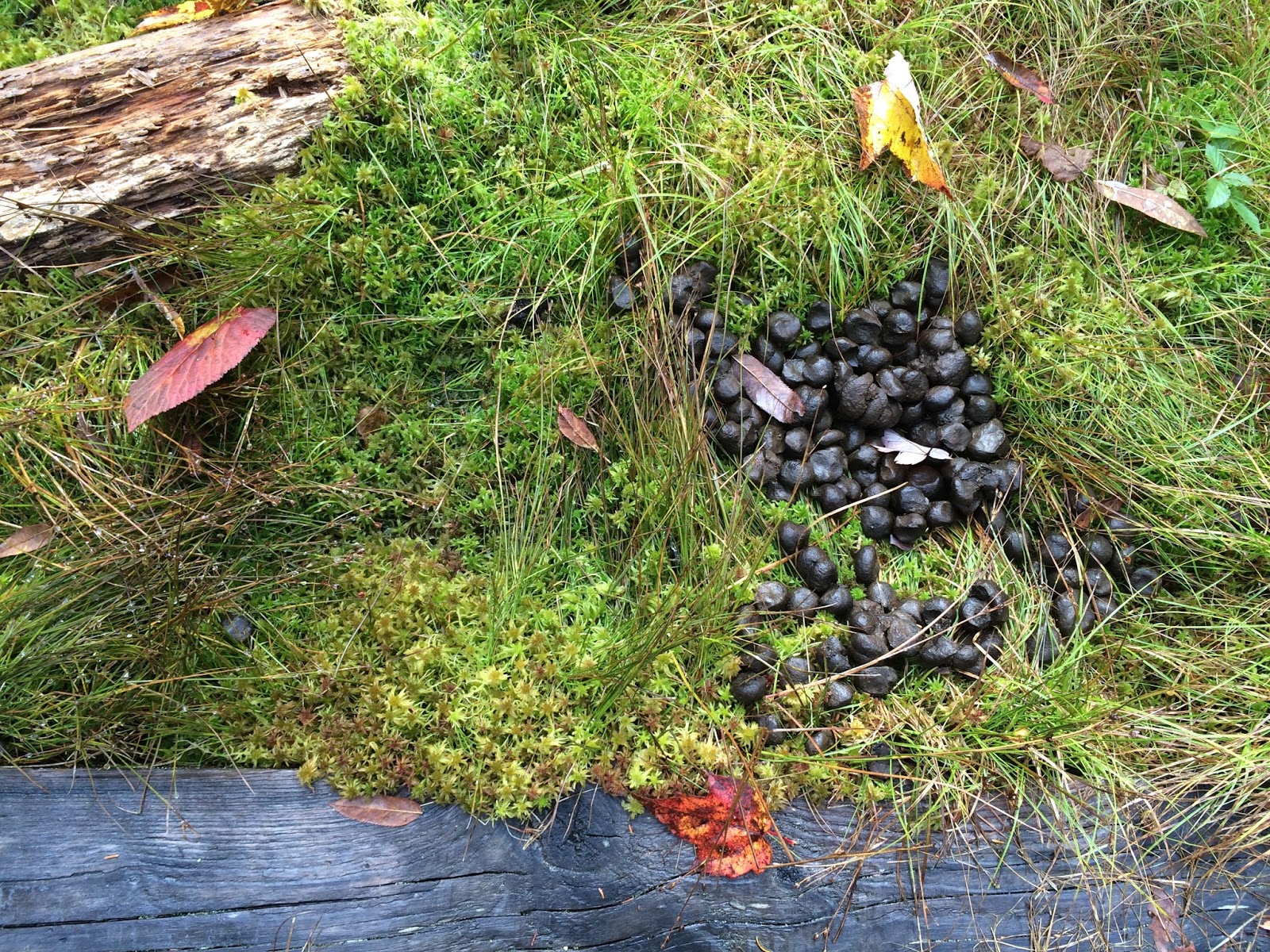
I read one blog write-up of this hike that said the trail from the Cascades to Nancy Pond was "mostly flat terrain and isn't very remarkable." I disagree. The one mile stretch of trail from the falls to the pond climbs then levels out and meanders through a swampy, mossy old spruce-fir forest, with many piles of moose droppings--my favorite kind of place. On Saturday there was also a lingering frost or snow on the vegetation. My favorite images from this area in the heart of the Nancy Pond Research Natural Area:


A view east to Stair Mountain.
By late morning on Saturday snow still lingered on this bracket fungus.
A still life of moose droppings, Sphagnum moss, bog bridge, and fallen fall leaves.
And more images from the Nancy Pond Trail meandering through an old spruce-fir forest.
The trail between Nancy and Norcross Ponds continues through a mossy spruce-fir forest
and on this day the scarlet red Sphagnum moss was stunning.
How can this landscape be described as "unremarkable?" Steve Smith at Mountain Wondering summarized it well: "For a fairly rugged 8.6 mile round trip, with 2200-ft elevation gain, you can take in towering waterfalls, old growth spruce forest, a pair of high country ponds, and a unique view into a remote corner of the Pemigewasset Wilderness."

The north end of Norcross Pond does provide a fabulous view into the Pemi Wilderness and to the Bonds in the distance.
We paused there only briefly as it was rather cold with an overcast sky, temp hovering around 40, and a stiff wind. It was even colder than we expected. We snapped a few pics then headed down into the Pemi wilderness.

The 7+ miles back on the Carrigain Notch Trail are not rigorous, but it is a long haul back out of the wilderness. But we were in beautiful country, walking through colorful hardwoods and thick spruce and fir regeneration.
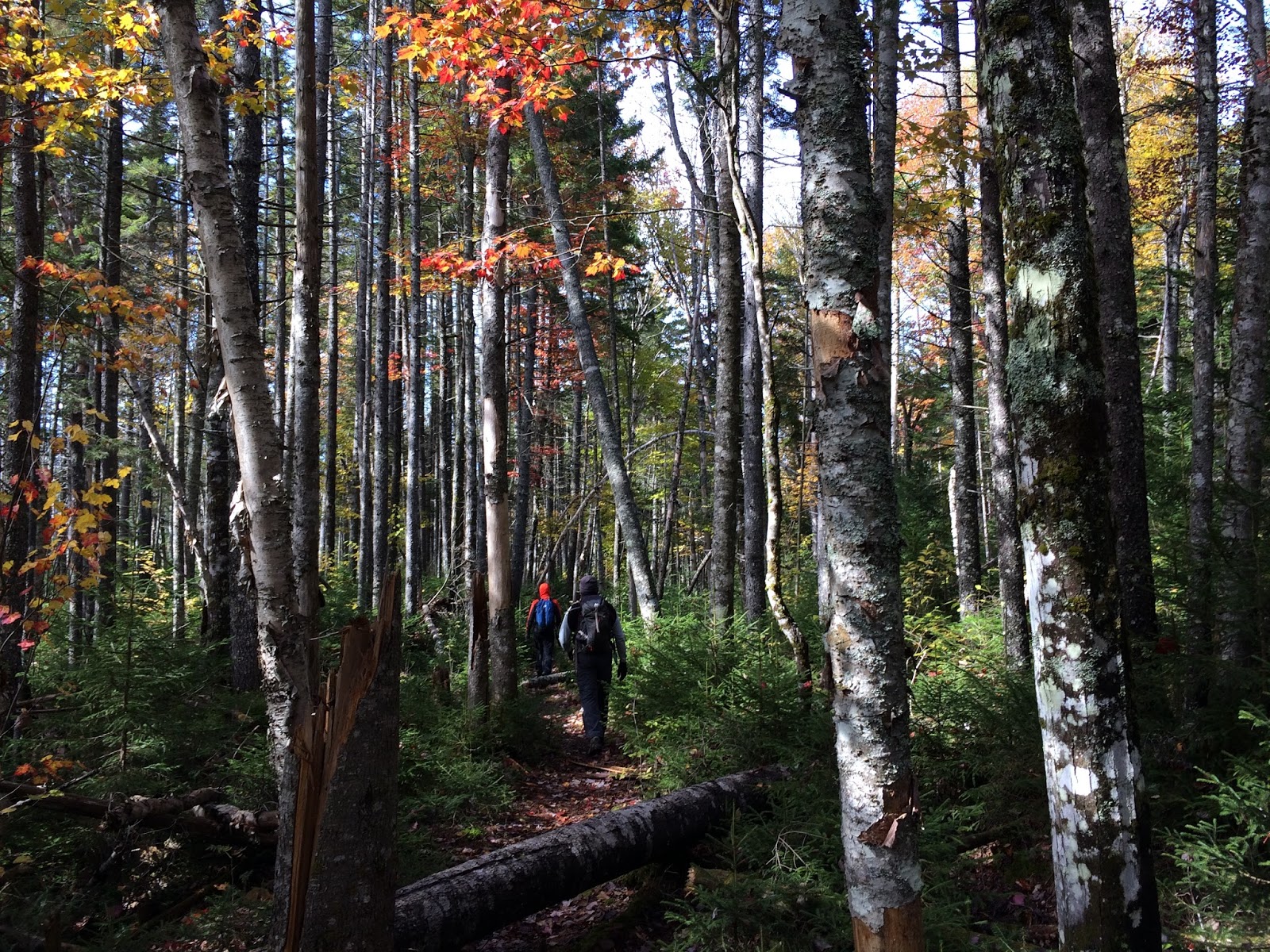
This hike was not about the long views. Instead, we wandered through a beautiful forest, with plenty of sign of moose, bear, and grouse, and only a handful of other people throughout the 8 hour hike. The last bit requires walking on Sawyer River Road, but Srini was able to get a lift back to our car on Route 302 from some other hikers (did not get their names, but appreciated the ride!).

Tomorrow I will highlight our Sunday 10-mile hike to South and North Baldface. 

Friday, August 14, 2015

Molas, Humpbacks, and Sharks!

Under an incredibly beautiful sky, with perfect temperatures and a light breeze, my nephew Sid and I went on a Granite State Whale Watch yesterday morning from Rye Harbor.
Our destination was Jeffrey's Ledge, about 20 miles offshore, beyond the Isles of Shoals. Not long after passing the islands our captain slowed and gently maneuvered the boat to bring us close to a basking mola or ocean sunfish. What a curious fish.
They appear to have only half a body. Females lay more eggs than any other vertebrate in the world -- an average sized mola may have as many as 300 million eggs. Each egg is tiny, but after hatching it grows into the heaviest bony fish in the ocean. The name ocean sunfish comes from its habit of basking on its side at the surface, in part, to allow birds to pick off the very large number of parasites on their body. They keep their mouth open at all times, chasing their favorite food: sea jellies (jellyfish). To our delight we saw four of these wonderfully odd fish yesterday, each about the size of a large dining table.
We never made it to Jeffrey's Ledge as the wildlife watching was better just 14 miles offshore in an area where recreational bluefin tuna anglers were congregated. We spent several hours among the fishing boats watching three different humpback whales surface for air and then dive to feed. All three whales were identified as Highlighter, #0050, and Quill by their dorsal fin and tale patterns by our knowledgeable onboard naturalist Melanie White from the Blue Ocean Society.
After a while we motored north and farther out to search for other whales and sea life. One minke whale surfaced and in our travels we saw four sleek blue sharks up close. The relatively calm ocean with swells of less than two feet enabled us to easily pick out the small dark fins of sharks, sunfish, and whales. We had not expected to see sharks, so an added bonus to a wildlife-rich day.

We watched hundreds of Wilson's storm petrels--a small dark brown seabird with a white rump--skip across the water picking off small invertebrates just below the surface. These petrels are summering here then head south to Antarctica where they breed in November-December. A greater shearwater lifted off from the water as we passed, flying gracefully on its long slender wings just above the swells. Cormorants, black-backed, herring and ringed-billed gulls, common terns, common eiders, and a few harbor seals were sighted as we traveled to and from Rye Harbor.

What a lovely day to be on the ocean.


Sunday, August 9, 2015

Mt. Chocorua in August

Mt. Chocorua is a popular hike in the White Mountains, especially on a beautiful Saturday in August. To avoid some of the high traffic, we arrived at the Champney Falls parking area off the Kancamagus Highway by 8:30 am. Surprisingly we were only the third car.
Rainfall has been light of late so we expected little flow in Champney Brook and over the falls. But water flowed continuously over the falls filling the brook below with plenty of clear, cold water for Henna and Kodi to cool off and slake their thirst.
The loop trail leading up and away from the falls back to the main trail has a well-built series of steps--easy in summer and a very different scene in winter.
Although seemingly more treacherous in winter and when icy, summer presents dangers too. As we descended from Mt. Chocorua after lunch, a hiker was running up asking for an EMT and trying to get cell coverage as one of his friends had fallen maybe 30 feet at Champney Falls and was badly hurt. As we continued our descent a rescue crew was hiking in with a stretcher and the parking lot, now overflowing with cars, was also an incident command center. We hope the young man who fell is okay.

We encountered only a dozen or so other hikers on the way to the summit of Mt. Chocorua. A series of switchbacks provides a lovely view north to the High Presidentials; only the tip of Mt. Washington was in the clouds.
It was a spectacular day to be up in the mountains on a high peak: temperature in the mid 70s, no bugs, mostly blue sky with beautiful cloud formations, no haze.
We reached the summit by 11:00 am and by then many more people were arriving. After a snack on top we headed down and over to Middle Sister for lunch, where we enjoyed a quiet and lovely view all to ourselves. Here is a look back at Mt. Chocorua on our way to Middle Sister.
Kodi enjoyed the hike and the scenery.
There was a hint of fall in the air. The weather felt a bit like early September and the hobblebush were starting to turn color.

Sunday, August 2, 2015

Garlic Harvest 2015

Last weekend we harvested our garlic crop at my parents homestead. We've lost count how many years now that we've been growing garlic….but every October we plant nearly 500 bulbs and every July we pull nearly the same number out of the ground.
My sister Amy and my nephew-in-law Sid from India pulling this year's garlic crop.

We sort the bulbs into large, medium, and small. The large are saved for the fall planting. The smalls are used first, and the mediums--which make up most of the crop--are dried and used all year long, until next July.
Garlic is a very easy crop to grow. We rely on a covering of straw for weed control and the weather for watering. We spend a day or so prepping the rows and planting the cloves and then less than a day harvesting. And that is it. Easy.

Sunday, July 19, 2015

Four Peepers and a Bear Scat

A few times each year we think about moving, to find a smaller house to clean and heat, a shorter driveway to clear of snow, less yard to care for, and where we could walk to a store or the library. These thoughts usually last about an hour or two. In that span of time we remember all the reasons we'd rather not move, at least now yet.

Today--despite the sweltering hot temperature and high humidity--I saw a few things that just reinforced why we are staying put. On my yard walkabout this morning to collect Japanese beetles into a soapy yogurt container, I spotted four different spring peepers. In the morning, the backyard is shaded and heavy with dew, so the tiny frogs sit comfortably on broad leaves and wait for prey--spiders, flies, ants, beetles. They get a bit restless when I loom over them with my iPhone camera, but they usually cooperate.
My next morning "chore" was harvesting veggies from the garden (first remembering to turn off the electric fence): broccoli, summer squash, zucchini, tomatoes, cucumbers, Swiss chard, lettuce, arugula.
To avoid the worst of the heat, I took Kodi and Henna on our daily walk to a nearby conservation area,just down the road a bit. We always see something there: a family of turkeys, snakes, turtles, hawks, mink, deer, signs of coyotes. This week, including today, I spotted large, fresh piles of dark scat full of berries.
Okay, not the best transition from the lovely collection of fresh vegetables, but I'm interested in animal droppings too. I'm fairly certain a black bear is leaving these piles, a mammal that is not that common in this part of New Hampshire. Kodi did seem a little more alert and turned back before we got too far. It could have been the heat, but I think he smelled the bear.

Four peepers and a bear scat. It doesn't get much better!

Saturday, July 18, 2015

Bug-Sized Peepers

Spring peepers are small and loud. In spring, a chorus of high-pitched calls from dozens or hundreds of peepers emanate from every wetland, but they are nearly impossible to see. Adult male peepers defend breeding territories of just 4 to 16 inches in diameter--a good indicator of their small size.

Young frogs move away from their breeding pond in summer. These bug-sized juvenile peepers (about one-half inch in size) hang out in our backyard, on the leaves of raspberries, among jewelweed, goldenrod, Joe-pye weed and sedges. And they are as cute as baby pandas.

Friday, July 17, 2015

First Tomato--Something to Celebrate

It's been awhile since I posted here at Spicebush Log. The last post in mid-April. Spring is always a busy time, this year especially so. My 93-year old parents had some health issues and we are committed to helping them stay active and independent as long as possible, which includes staying in their home of 60 years. It's the place I grew up in and learned about nature, bird song, playing barefoot outside, growing vegetables and animals, caring for the planet and people. That place is as special and important to me as it is to Mom and Dad. I want them to stay there--a nursing home is just not an option. But it takes some time and energy, thus less time to write here at the Spicebush Log.

Other things have intervened as well. Last fall we finally completed foundation drains around our house, something we should have done when we bought the place 20 years ago. Since the front of the house was all churned up last October, I asked my landscaper friend Patty Laughlin at Lorax Landscaping to create a design that included pollinator and edible plantings (e.g., highbush blueberries) and a walkway to our front door. That plan was implemented in May and we've been watering new plants and enjoying the results ever since.
Then it was vegetable garden planting time and we decided to install a solar-powered electric fence to keep out the deer. A local farm -- Walnut Grove Farm in Lee, NH -- sells all you need for electric fencing. It was simple to install and so far the garden is deer free.
What finally motivated me to sit down and pen this post was the ripening of our first tomato of the season. Something to celebrate!
The tomatoes are growing well despite a cool stretch of weather in June and into July. However, the eggplant and peppers were stunted during that period and struggle to put on height. The same is true for the okra, so I covered them with Reemay and in just a couple days they are looking healthier.
As happens with gardening, we are already getting overloaded with summer squash and broccoli, but that feels like a good problem to have. The greens--Swiss chard, beets, kale, arugula, lettuce--are all doing well, as are basil and cilantro and the other herbs along our new walkway.
I'm feeling good about the gardens this year. We've kept ahead of the weeds, the solar electric fence is keeping deer at bay, tomato hornworms have not yet appeared, and we harvest a handful of blueberries each morning for our granola. 

Ice Out

 Ice Out