Thursday, January 31, 2013

Windy and Warm

At 5 AM this morning the temperature was 55 degrees Fahrenheit, a light rain was falling, and the wind blowing. Gray clouds were on the move all morning, booking from southeast to northwest. By late morning, blue sky had replaced the dark clouds. By mid-day it felt like a different day, except for the wind, which kept up its bluster into the evening.

Between the wind and the warmth and the rain, a lot of snow melted in the last 24 hours. Fields and south-facing slopes are suddenly nearly snow free.
Snow has melted away from the tops of the row cover in the vegetable garden. Seedlings of spinach, chard, beets, cilantro, and arugula are waiting out the winter beneath the cover. I assume the plants are resting until day length and temperature stir their cells to re-start green growth. My hope is that we'll find some fresh greens come March, unless the meadow voles get to them first.

Reemay row cover over low hoops -- protecting tender seedlings of spinach and other greens
The air temperature dropped steadily during the day -- 20 degrees in 12 hours. At sundown the temperature was 35 F.

For the past several weeks the Asplundh tree company has been clearing trees and limbs from beneath powerlines in our town. We were pleased that they took down several trees that we had flagged, especially since we kept the wood, while they chipped and removed the tops. This work is done under the auspices of our electric company -- Public Service of New Hampshire (PSNH) -- to help reduce the chance of storm-damaged trees knocking out power. Well, despite all the recent work, we lost power today for several hours. Somewhere along our local grid the high winds knocked a tree across a power line. I heard a few generators start-up in the neighborhood. I waited. With all the Asplundh trucks already in the area, I assumed the outage wouldn't last long, and it didn't.

Now if only we'd get some snow.

Wednesday, January 30, 2013

Fog and Drizzle

The road was slick this morning as we walked with Kodi in the pre-dawn darkness. We walked tentatively in the fog and drizzle, with the temperature hovering just below 32 degrees. The plow truck must have gone by earlier, leaving a spray of salt and sand down the middle of the road. He passed by again at 7:30 am, driving too fast, sprinkling just a pinch of salt (and sand) in his wake. Given the icy conditions, a slow healthy shake would have been more suited to the conditions. The truck whizzed by again an hour later, a few minutes before the school bus passed by.

I serve on my town budget committee, so I am sensitive to the cost of plowing and treating icy roads. I know what is in the budget. We vote on the town budget in March for the fiscal year that runs from July to June. If you thought predicting a week's worth of weather is difficult, try estimating how much sand and salt is needed for your town roads a year from now, and how much it will cost per ton. I empathize with our public works department. Still, perhaps a good, slow shake of salt and sand on the first pass this morning would have sufficed, rather than three pinches on three passes. By the way, if you want to get to know your town, join the budget committee.

The fog only thickened as the day wore on. I felt it seep into my body and brain. On my walk with Kodi I focused close in. Amidst the grayness, I suddenly saw the textures of tree bark more clearly: the cinnamon-reds of hemlock and red oak bark; the symmetrical ridges and furrows of white ash; a peeling yellow birch; and the pale bark and irregular fissures on basswood trunks.
I noticed, too, the prevalence and patterns of lichens, coating tree trunks, branches, and stumps everywhere I looked. Lichens, composed of an alga surrounded by fungi, are greener and brighter in the rain and fog. I learned from Mary Holland, author of Naturally Curious, that the fungi becomes more transparent as it absorbs rainwater, allowing the photosynthesizing green alga to shine through the normally opaque fungi. Lichens really are more brilliant when all else looks gloomy. Have a look.

Monday, January 28, 2013

Wetland Walking

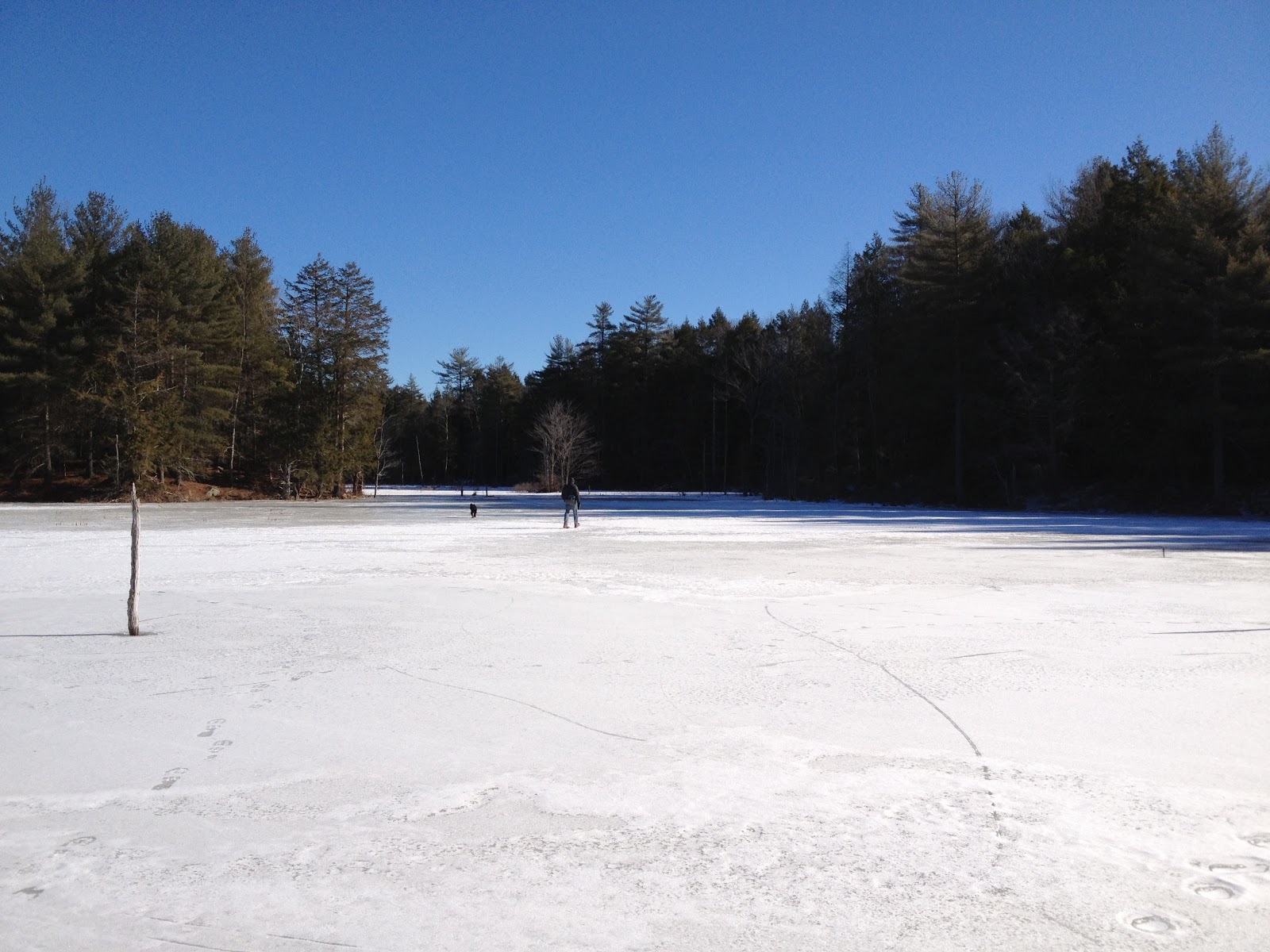
We've had more than a week of continuous below freezing temperatures, with a few nights dipping down below zero degrees Fahrenheit. This cold snap arrived on the heels of a January thaw. The thaw turned snow into slush and melted pond ice, making it thin and dangerous for crossing. This recent cold spell has caused wetlands and waterways to freeze up solid. The wetland behind our house is rock hard, the ice thick and opaque. It's been many winters since we've had such great wetland walking conditions. With a warming trend ahead, we spent as much time out on the ice as possible these past few days, bundled against the cold winter wind.
Day after day this past week, as the sun and wind whisked away snow cover, the ice froze ever deeper. A frozen wetland suddenly offers a whole network of trails (stream channels in ice-free periods) and places to explore. So I explored, walking among the hummocks of tussock sedge and between thickets of alder and buttonbush, with relative ease.
Animals that hunt below the ice, among the sedge hummocks, or along the wetland edge, leave signs of their meals behind. I found an otter latrine on a snow-covered mound of tussock sedge, so noted by the piles of scat filled with fish scales, the main winter diet of river otter. While walking in the middle of a frozen pond along the Sweet Trail, we passed a large exposed rock, with small piles of muskrat scat. The dark cylindrical droppings appeared to be filled with bits of vegetation, likely cattail, bulrushes and other aquatic plants. In the middle of the frozen wetland channel behind our house I looked down at two pea-sized, Army green droppings. I consulted Mary Holland, author of Naturally Curious. She suggested mourning dove droppings, and I think she is right.
If you aren't interested in the fine details and clues waiting to be discovered in animal droppings, then there are plenty of other wonderful things to see and hear while wetland walking.

Under a winter's sun, frozen ponds and lakes boom and yelp and screech as ice expands and contracts. I remember one of the first times I heard a frozen lake boom in the Boundary Waters of northern Minnesota. We thought the lake would open up and swallow us. Mostly though, frozen wetlands are still and silent and beautiful, especially under a winter's clear blue sky. The sun casts long shadows and the wind creates patterns in the ice and snow. Plants are frozen in place. All arranged as if in a series of still-life paintings.
The Sweet Trail, that stretches four miles from Newmarket to Durham in southeastern New Hampshire, meanders past a series of large beaver-influenced wetlands. During one of our recent winter walkabouts we veered off the woodland trail and onto the wetlands, walking across frozen ice and stepping over beaver dams to reach the next flowage.
We wandered among a colony of great blue heron nests, which sit idle, waiting for the return of the large, graceful birds after Spring thaw. Their nests seem perched precariously atop the dead trees, especially as seen up close in winter. Many of the standing dead trees in this wetland have lost their top-most branches, limiting their appeal to herons. In time, this colony will need to search out a new wetland that has suitable tree-tops. 
Kodi and I took a long walk on the wetland this morning. It could be the last wetland walk for awhile, as another winter thaw is on its way. An animal's track left during the last thaw is locked in the frozen ice. Those tracks will likely melt away this week, along with our wetland walks.

Wednesday, January 23, 2013

A Deer Leg

We woke yesterday morning expecting several inches or more of new snow. The weather forecast was for 2-8 inches. But nothing; the storm moved off-shore near Cape Cod, before reaching this far north. I was mildly disappointed as some fresh snow would have been nice.

What we do have is COLD. Four degrees this morning. A trend that will continue for several days, at least into the weekend, which coincides with a full moon on Saturday.

The clouds cleared out early yesterday morning, after the snowstorm petered out to the south. Blue sky helped raise the temperature into the 20s, although stiff winds kept it brisk outside. Woodland trails are now a mix of hard, crusty snow and icy patches on well-worn routes. Kodi and I returned to the Sweet Trail, where Kodi has a nose for animal parts. Last year he discovered the remains of a moose carcass; yesterday it was a deer leg partly buried in the snow.

He was proud of his prize and I let him play with it for a few minutes, before I took some photos and then hung the leg in a tree. Kodi was dismayed that we left it behind.
Deer have many glands, including several on their legs. The interdigital glands are found between the toes of each foot. They discharge some smelly, fatty oils, alerting other deer to their presence and social status. The metatarsal gland is located on the outside of the hind legs, just above the hoof. A round ring of whitish hairs highlights the gland. Interestingly, biologists are unsure of exactly its purpose. The tarsal glands are found on the inside of each hind leg, at the hock. They are covered by a thick tuft of long hair. Deer urinate on the tarsal glands, making them nice and smelly to their fellow deer. No wonder dogs (and other canids) are prone to chase deer, with all those fatty smells coming from the deer.

You can see the locations of all three of these glands in the following photo collage.
With the knowledge of where the tarsal and metatarsal glands are located, you can now easily determine that this was a hind leg that Kodi found and also whether it was the left or right hind leg. I'll leave that for you to ponder (until tomorrow), just as Kodi is dreaming of that leg that is now hung up in a small pine tree.

Friday, January 18, 2013

Winterberry Farm Wanderings

Kodi and I are visiting my parents for a few days at their Winterberry Farm in western Massachusetts. There is less snow here, but still enough to see a few animal tracks. The big coyote--based on the track patterns--still patrols the edge of the woods. Kodi notes its presence (as he has on previous visits). Each time we step out for a walk in the back forty, he goes a little farther down the hill or deeper into the woods. Yet, he is tentative. Here he is following the coyote track into the woods. He stops, sniffs the air, ears back, tail tucked way down, right paw a few inches off the ground. This is his "I'm not too keen on coyotes" posture.
We went no farther. The coyote track continued on downslope through the woods. Kodi turned, tail up,  and ran back toward the house to check for fallen suet under the bird feeders. Much safer territory. Later in the day he managed to follow the coyote track another 100 feet or so, but soon turned again, and trotted back toward the house. While Kodi was sniffing the coyote track, I peeled a small twig from one of several spicebushes in the woods and inhaled the spicy scent.

The snow has melted away from the small drainages in these woods, exposing a skunk cabbage here and there. The flower is still closed up tight against the cold, just waiting for the earliest days of spring to open its "hood."
The temperature hovered around 20 degrees Fahrenheit all day. Not too cold for a small, dark spider to crawl on top of the snow.
Tomorrow we'll set out again to wander the back woods and fields. Kodi wants to be outside here, even if it is just to check on overnight animal movements in the yard and mark the boundary where the coyote patrols. Kodi wants to be brave, but it's not his strong suit.

Thursday, January 17, 2013

A Fresh Snowfall

My wish was granted. After the recent January thaw, it turned colder, and snow fell on Wednesday. Five inches of white, heavy, beautiful snow. Winter has returned. Kodi and I ventured out into the back woods, as the sun was rising and highlighting winter's beauty.


Sunday, January 13, 2013

Shades of Gray

The river ice is gray and melting. A duck walks on water where the river widens and deepens, but it only seems so, as the ice beneath its feet is covered with an inch of meltwater.
A cardinal sings from the top of a red maple; the bird's redness concealed by the fog among the trees. The air is damp and still. A flock of slate-colored juncos flits among the bushes along the river's edge. I note their whereabouts by the flash of white tail feathers and their rapid, chip notes.

Underfoot the snow has turned to a gray slush, while the sky above is a dull, dirty white as far as the eye can see. I hear the rapid wingbeats of a male mallard flying overhead, its bright green head muted against the grayness all around. From somewhere above I hear a lone gull call, like a fog horn in the sky.

Amid the slush and fog, Kodi flashes his white teeth. He zigs and zags in the soft snow, racing in circles just for the pure joy. He urges other dogs to join in, while he lifts my spirits above the fog.

Ice Out

 Ice Out