Saturday, August 11, 2012

Painted Ladies

The painted ladies were on the move today. We saw many of these colorful butterflies among the annuals at Prescott Park in Portsmouth, New Hampshire this afternoon.
Apparently this is the most widespread butterfly in the world, but it is also cyclical so some years they are quite common. This seems to be a boom year. The painted ladies are also migratory, overwintering in the southwestern U.S. and in Mexico. In March and April they fly fast on their northward journey, reaching northern Canada by June, beating the equally migratory monarch to its summer grounds.

Migratory butterflies continue to amaze with their ability to survive such a long distance migration on their tender wings.

Friday, August 10, 2012

Goldenrod

Goldenrod is my August flower. It forms beautiful natural bouquets in meadows and gardens and along roadsides. Sure, it can be a little bit aggressive, popping up in the perennial bed in unplanned places. But unwanted plants are easily pulled. Mostly I leave and enjoy, as does a host of bees, beetles, flies, dragonflies, and butterflies. The golden flowers on their tall arching stems are eye-catching, especially among the muted grasses and sedges and other fading flowers of mid-summer. When the goldenrods bloom I know summer is slowing down, just as the garden is overflowing with produce. When the goldenrods bloom I know it is time for canning tomatoes on a warm, sultry night. When the goldenrods bloom I know the birds and butterflies are on the move.

Our backyard meadow is full of goldenrod, along with Joe-pye-weed, boneset, cattail, sedges, and jewelweed, all lush and growing quite fine on their own. I wonder sometimes at the effort I put into weeding and thinning, mulching and watering the perennial beds to keep them looking nice, while the wild meadow self-sustains. Nature, it seems, is perfectly okay taking care of itself. I am reminded if this each late summer day as I walk around our backyard or through other meadows, enjoying the lovely bouquets of goldenrods.

Kodi and I frequently walk this conservation land--The Cole Farm in Newfields. The field is full of goldenrods.

Wednesday, August 8, 2012

Meditating in Nature

For my late morning walk today with Kodi I chose College Woods in Durham. It is one of my favorite places to walk, beneath towering old hemlock and white pine. Kodi quietly sniffs twigs and logs, takes a cool-off swim in his regular swimming holes, and gives an occasional lazy summer day chase to a squirrel. I listen to the summer resident birds: scarlet tanager, hermit thrush, red-eyed vireo, winter wren. Often we are alone. It is peaceful and meditative.

I hear and see so much when I walk in woods and fields and along wetland edges. This week I spent two days wandering about two different ownerships, lands for which I've written or am writing a wildlife habitat management plan. In a way I get to work and meditate at the same time, at least when I am in "the field" by myself. These particular lands are on the edge of the White Mountains along or near the Maine-New Hampshire border. Territory that is both wild and tamed, with stone walls and lost foundations, old gardens and old trees.

On Monday as I bushwhacked through one property, I flushed a bird from a thicket of young hemlock. The hemlock seedlings were no more than a foot tall growing in a small clearing, not far I might add from a huge pile of bear scat. As I parted the lush boughs, there on the ground was a hermit thrush nest with five blue eggs. Earlier in the day I saw another hermit thrush nest with four newly hatched young beneath a lowbush blueberry shrub. While many birds are already starting their migration southward, the thrushes are still nesting (The robin--also a thrush--is raising her third brood beneath our deck). Here is the hemlock thicket and the thrush nest.
As I emerged from the woods and ambled back to my car for lunch, I disturbed a young garter snake on the dirt road. The snake was rather feisty, even as garter snakes go. The small ones must feel they have to be really tough to defend themselves.
Tuesday morning I woke early to walk the tree-lined edges of meadows in search of invasive plants. I was staying at a client's lovely bungalow on 260 acres with wildflower meadows stretching down a south-facing slope. Mist was rising off the small pond, the dew soaked my shoes and socks and pants, but I was alone in the early morning, peacefully meditating as I wandered about in search of buckthorn and bittersweet.
On this same land, a big barn is left open to allow eight or more pairs of barn swallows to swoop in and out all summer long. I stood in the barn and watched them elegantly and noisily fly up to the rafters where their mud nests clung to the roof. At my feet were hundreds of recently harvested garlic bulbs drying in that cool barn with a summer breeze blowing through and a fantastic view southeast to North Kearsarge. Those barn swallows are most fortunate and so am I.

The barn with a view

Monday, August 6, 2012

Beauty and the Beast

A beautiful, green beast showed up in the garden over the weekend -- the dreaded tobacco hornworm. I found two three-inch long, chubby hornworms chewing on the sun gold plants. I find them beautiful to look at, but they are a beast.
Two rows over from the tomatoes, the okra plants are flowering and fruiting. The flowers are lovely and the fruits make a nice sauté along with fairy tale eggplants.
Outside the garden, birds are flocking to the alternate-leaved dogwood, gorging themselves on the dark blue fruits. Yesterday we watched a family of robins, a pair of kingbirds, and a red-eyed vireo vying for space in the tree. Such bounty in August.


Saturday, August 4, 2012

A Few Beautiful Things

This week I was listening to a radio program on climate change. The guests were upbeat and positive about moving forward with mitigation and adaptation in the face of the great climate changes underway. One noted that there is a lot to be sad about in this world, including climate change, and one can easily be consumed by that sadness. To remain positive he thinks of something beautiful each day.

I like that, as I often feel overwhelmed by the daunting issues of the day. I try to highlight beautiful things in this blog, although sometimes days go by without a post. My new resolution is to post something beautiful each day to keep my mind and spirit focused on the wonderful, beautiful plants, animals, and people around me.

Since I've missed a week of posting, here are a few beautiful things from this past week.

Peaches! Our youngest tree, about 6 years old now, is yielding delicious, juicy, baseball-sized peaches. Some evenings we stand under the tree eating a fresh peach, the sweet juice dripping from our mouths. Thursday night Amma, Srini, and I canned 7 pints of peaches, fruit that we'll enjoy through the winter. Our kitchen counter has two large trays of peaches not quite ripe enough for canning yet. We eat sliced peaches on our cereal, with yogurt, with ice cream, in muffins. We never spray the tree so the fruits are not perfect, but they are fresh and healthy and safe, and still beautiful.
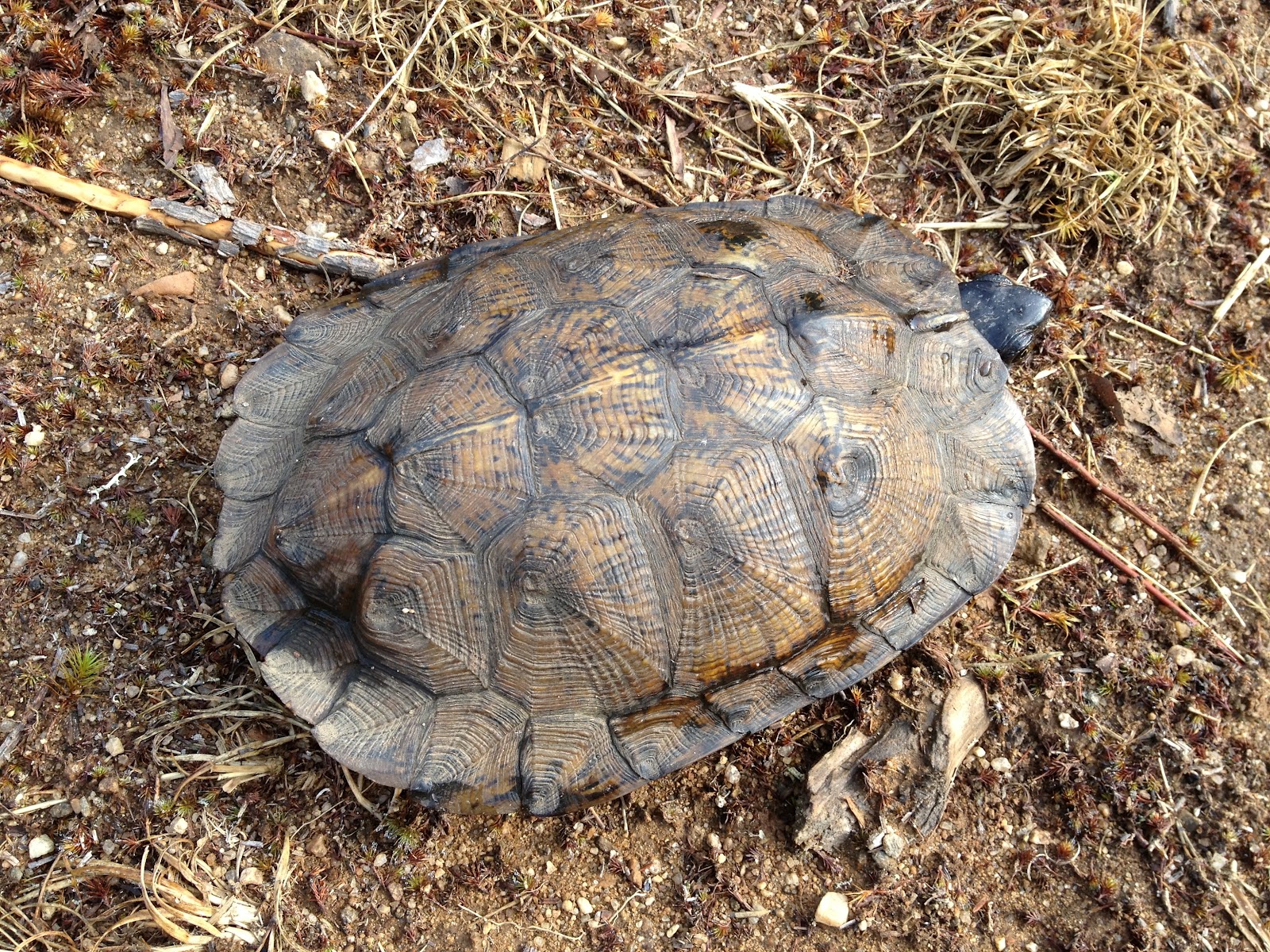
A Wood Turtle. While waiting for a colleague in the field Thursday morning I watched a rufous-sided towhee that was perched atop the tall flower stalk of a mullein. Every minute or so he'd say "towhee." As Kodi and I walked around the woodland opening--a recovering gravel pit--I looked downslope and saw a wood turtle. She was out in the open foraging, perhaps headed for a patch of ripe blackberries or maybe to nibble on the mullein, or grabbing a beetle or other insect that crossed her path--they are opportunistic eaters. Wood turtles are docile with a beautiful sculpted shell. I was able to walk right up to her and say hello.

Each morning my in-laws visiting from India walk up Bald Hill Road and back. They have a keen eye for flowers and animals and other interesting sightings. Yesterday they returned exclaiming about a beautiful mushroom. Later in the day Kodi and I walked down to have a look. It was a large, beautiful chicken of the woods, also called a sulphur shelf. I think this one is Laetiporus cincinnatus: a rosette of flat, wavy-edged caps with colorful white and orange bands, growing on a fallen red oak trunk just off the edge of the road.
And last, but not least beautiful, the speckled swan gourd. I'm growing these beautifully-shaped gourds for the first time. One fruit is nearly full size and looking like an elegant swan!

Saturday, July 28, 2012

To the Knob Again

Kodi and I hiked to Rattlesnake Knob again this morning, although an hour later at 9:30 am. It was still muggy, but hazy with some sun, so it felt hotter. The woods were different this morning, a day later and just an hour later into the morning.

The pewees called again, but seemed more muted; the hermit thrush was silent. I heard a red-eyed vireo and a chickadee. Climbing the steep part to the Knob, along the section of trail lined by many interesting plants--spleenwort, Christmas fern, hepatica, bear corn, among others--I saw millipedes. They were out foraging on detritus in the trail. I did not see them yesterday. They prefer dark, moist places, but perhaps the humidity brought them out to the trail. Here is one curled into a tight, protective coil with a chunk of detritus still in its mouth.
This is the common, North American millipede (Narceus americana), a beautiful 2-3 inch long, and thicker than a pencil, arthropod (not an insect) with reddish bands, and many, many feet. I saw three on the trail. There must be many more in the woods as they have much work to do, breaking down leaves, flowers, and other woodland debris and recycling the nutrients back into the soil.

The round trip hike to the top of Rattlesnake Knob takes one hour, with time for listening to birds, kneeling to see a millipede, pausing for a photo. On the return leg Kodi always trots ahead where I find him lounging in a cool woodland stream.
By 1:00 today the rain started. Finally a long, soil quenching rain that has continued all afternoon. This is a steady, straight down rain, soothing to our ears. We'll sleep comfortably tonight now that the rain has come.

Friday, July 27, 2012

A Humid Forest

At 8:15 am, as Kodi and I hike to the top of Rattlesnake Knob, the woods are dark, like the fading light of dusk. The air is still and thick, my arms are clammy, Kodi is panting.

It feels like the tropics, reminding me of my 5-month stint banding birds in Panama in 1983, before anyone heard of Manuel Noriega. In those days, while I was out on Pipeline Road along the Panama Canal catching colorful birds in mist nets, Noriega was planning his military and political takeover of the country; he was elected (presumably) Governor of Panama six months after I left. My memories of the country are of birds, mist nets, the Canal, Barro Colorado Island, fresh fruit, cockroaches in our cupboards, a tapir, monkeys, and the humidity.

It is the humidity this morning that reminds me suddenly of Panama. As I listen to squirrels lurking among the oaks and beech overhead, I wonder what it would be like to have monkeys living among us. What would Kodi do with a troop of howler monkeys overhead? In Panama the howlers would throw sticks at us while we erected the mist nets. They were always a bit surly about us invading their territory. Still, it would be interesting to hear their loud howls boom through the forest. Kodi has no such thoughts about monkeys, as he sniffs for fox and their kin. He, I think, would not like such an addition to the biodiversity of these woods.

A deer snorts from over the rise, out of sight, and I emerge from my humidity-induced day-dreaming.  A pewee's clear song pierces the still air as we climb steadily to the top. A lone hermit thrush sings from the Knob. The humidity is high today, over 100 percent, the woodland birds are quiet except for the pewee and thrush.
The humidity and the view from Rattlesnake Knob reminds me of central Panama
In Panama we measured the relative humidity, as well as temperature and habitat features, as part of our bird study to learn if humidity affected bird distribution. I don't recall that we found any correlation with humidity. To me (and maybe the birds) it felt humid, regardless if we were in an upland forest or along a stream.

Here on Rattlesnake Knob among the normally dry, upland forest, it is decidedly more humid than is typical or comfortable. Everything waits for a rain. A few drops fall as we hike back down and return to the car, the raindrops gently tap the tree canopy. The rain disappoints, the humidity remains.

Ice Out

 Ice Out