Wednesday, February 15, 2012

North Kearsarge

At 6 am Sunday morning the thermometer read 2 degrees F and I could see the prayer flags blowing on the three season porch. It was cold outside the cabin, but inside we were cozy warm inside our sleeping bags lying not far from the wood stove. The temperature was going to be slow to rise that day so we lingered in bed, until it was time to make coffee, stoke the wood stoves, and ready our gear for the day's hike.

Sunday was day two of our three days in the mountains with my nephew. Our destination was North Kearsarge in North Conway, a not-so-high mountain at 3,268 feet, with a relatively easy 3.1 mile trail to the summit. We had never climbed this mountain before, but it is a popular trail so we thought it a good choice on a cold, windy day. 
There was more snow in the woods than I expected, given how little is left in southeastern New Hampshire. The snow up north though has a thick crust, so walking off trail is tricky--you either crash through the crust or skate on top, so we stuck to the trail.

The trail to North Kearsarge was heavily used and hard-packed. Less than an inch of new snow had fallen in the last day so there was a dusting on top of the icy trail. With microspikes we were able to easily climb and then descend without any trouble.

We were prepared for the cold temperatures (about 8 degrees when we set out) and the high wind. However, the sky was mostly clear and the south-facing trail to the summit offered plenty of sunshine to warm our bodies as we hiked. 

The trail passes through a hardwood forest with many paper and yellow birches, then begins to climb along a ridge of mostly tall hemlock trees.


Pine siskins kept us company all weekend. We heard their wheezy twitters coming from the tops of hemlocks and spruces. The siskins were busy working the softwoods on the slopes of North Kearsarge. In the cool shade of the hemlocks ice flows bulged and formed sharp, menacing icicles among the rock outcrops.

As we climbed higher the blue sky grew more intense and we crossed paths with many animals tracks including red squirrels, a large male fisher, several snowshoe hares, and a ruffed grouse.

The track of a large male fisher.
Snowshoe hare tracks were plentiful up high
It was a gorgeous blue sky day with great cloud formations

Just below the summit we paused in the spruce forest to don our winter parka, balaclava, and goggles. From there we emerged into the bright sun and strong winds. The abandoned fire tower still stands and was a handy rest area on such a cold, windy day. The wood steps and interior floor are heavily pockmarked from the many microspike-wearing hikers that visit in winter.


Kodi very much wanted to follow Srini up the fire tower steps to explore, although he didn't mind hanging around in the wind and the cold. Still, he was quite happy to see Srini come back down.

Alas, the clouds had moved into the High Presidentials by the time we climbed to the top of North Kearsarge. Views were not terrific to the west and north, but we still had clear skies around us. We did not linger long outside the tower. So, soon we retraced our steps, invigorated by the wind and the sun and the great day of hiking.
After finishing the 4-hour hike to North Kearsarge we drove north to Pinkham Notch. The high peaks were socked in, but the usual hustle and bustle of hikers and climbers and skiers was evident. The weather forecast for the day atop Mt. Washington predicted the coldest day of the year with hurricane force winds. We were sipping warm cups of coffee in the AMC dining hall as we read the forecast, glad that we had chosen a small peak for the day's hike.

On Monday morning we finished out the weekend of hiking with a short jaunt down the Rob Brook Trail off Bear Notch Road. Also called the Nanamocomuck Trail, it meanders down to a wetland with fine views of Mt Carrigain to the northwest and Mt. Chocorua to the southeast, although not so good that morning. As I observed elsewhere during the weekend, the trees were heavy with cones and seeds along this trail too. Here is a red squirrel dining table with spent spruce cones scattered beneath the tree and on the trail.
And overhead beech trees were still holding the open husks that once held the three-angled beechnuts.
The Nanamocomuck Trail was a fine ending to three days of winter hiking, which is quite addictive by the way.

Tuesday, February 14, 2012

Three Days in the Mountains

My nephew Reid visited us from Illinois for three great days of hiking in the mountains. We stayed at our friend's cabin off Bear Notch Road--a quiet, secluded spot in winter and ideal as a base camp for day hikes in the White Mountains. We stoked the wood stoves as temperatures dipped into the single digits by Sunday morning. Ice crystals formed on the window, Kodi rolled on the cold, crusty snow, and a gorgeous gray fox trotted by the window one morning.

On Saturday we hiked one of our favorite trails: the 4.8 mile UNH Trail Loop to Hedgehog Mountain. This trail winds through northern hardwood and spruce forests, passes alongside huge boulders, and offers great views of surrounding mountains. The well-packed trail made for easy walking although we wore microspikes, which helped in several icy spots. We applied Musher's wax to Kodi's paws, which worked marvelously all weekend.

 Kodi waited while Reid adjusted his microspikes
  A light snow fell as we climbed through northern hardwoods and then spruce forests
Pileated woodpeckers and loggers had been busy working the woods
This loop trail offers various views of Mt. Chocorua and the great Mt. Passaconaway. Although it was cloudy all day, we caught a brief glimpse of the sun as it lit up the top of Mt. Chocorua as viewed from the East Ledges.
The spruce trees were laden with cones--a food bonanza for red squirrels--and the dark green needles made for a rich contrast against the snow and gray clouds.
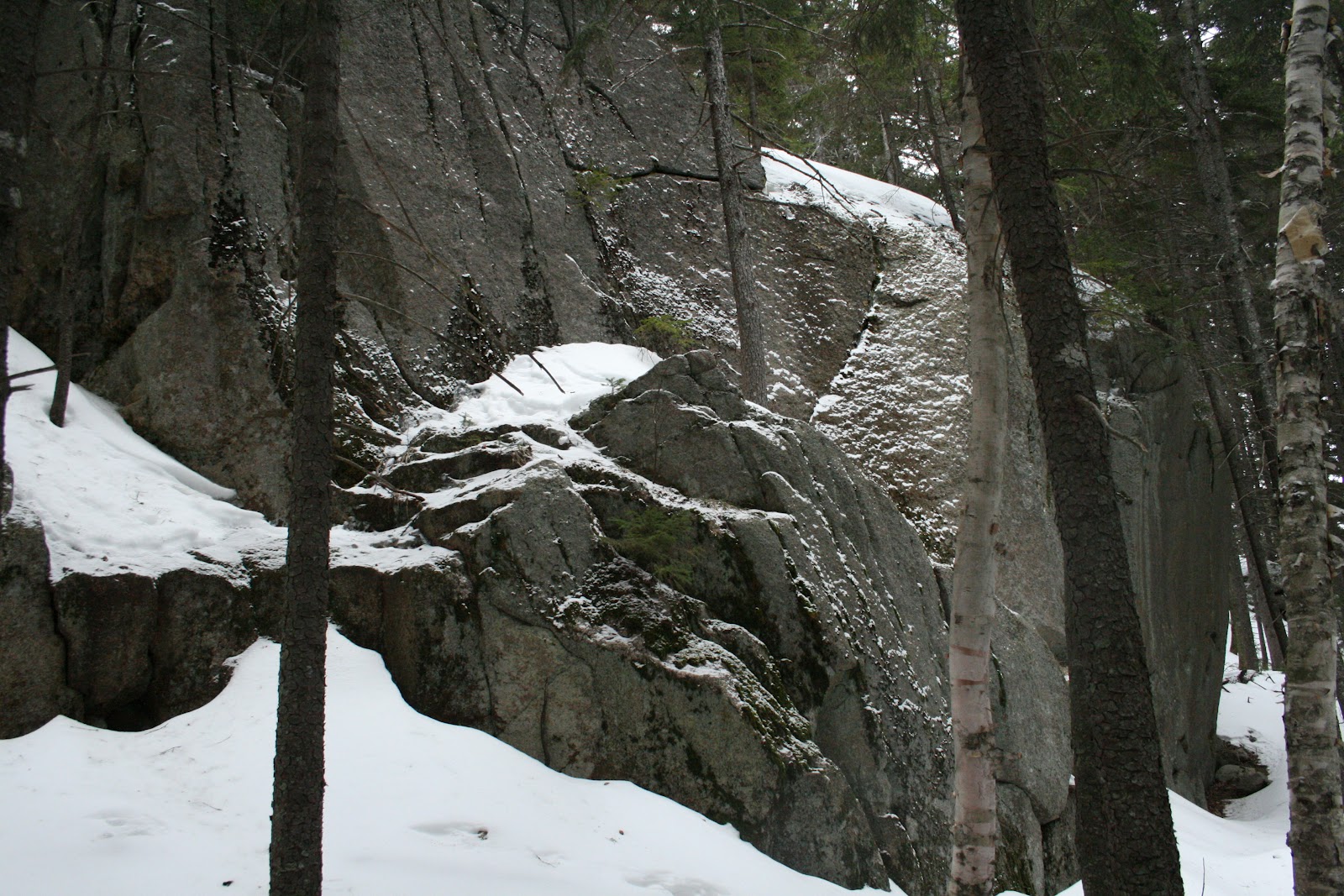
The southerly section of the trail between East Ledges and the mountain summit, passes by a huge rock wall and other giant boulders. And further along, the trail climbs toward the summit with Mt. Passaconaway rising up to the south.
Our final grand view was looking northeast toward The Moats with the sun catching the west-facing slopes. A logging operation, silent on Saturday, was visible in the foreground. And at our feet, in the ice cold snow tiny snow fleas (springtails) dotted the ground like specks of pepper. 
Tomorrow's post will re-count our hike up North Kearsarge on one of the coldest days of the year.

Wednesday, February 8, 2012

February Nature Notes 2012

I smelled a skunk again today while walking with friends Ann and Peter and Kodi's friends Persica and Quercus. The odor was strong and in the same place that we smelled it a week ago today. We kept walking and when Persica trotted past me I caught a whiff of skunk aroma. Oops, Persica must have rolled around near a skunk den as she was smelling a little skunky. I guess she'll spend the rest of the day outside!

What a beautiful full moon this week under clear night skies. According to the Farmer's Almanac, native tribes of the north called this the Full Snow Moon, because February was typically the month with the heaviest snowfall. My how times have changed. Anyway, around about 11 pm Tuesday night -- the full moon night -- when we were sound asleep, Kodi started barking. He kept on barking until I went downstairs to see what got him stirred up. I pulled up the shade and we both looked out the window into the moonlit front yard, just as three big deer bounded off down the road. Kodi barked at them until they disappeared and I pulled down the shade. The intruders were gone, Kodi curled up on the sofa, and I trotted off to bed again.

Deer are spending more time in our yard this winter than I remember in past years. And they look quite healthy. I assume they are having an easy winter given the lack of snow.

A few other uncommon visitors stopped by the yard and house today. A mature hawk perched in the sun in our yard for more than one and a half hours. Part way through her stay she turned her back to the sun. I'm fairly certain it was a female sharp-shinned hawk: broad chest, smallish head compared to size of the body. She was beautiful in her orange-barred breast and slate gray back. She was uninterested in the goldfinches at the nearby feeder. Maybe she had just eaten and was resting after lunch, which is literally when I saw her.

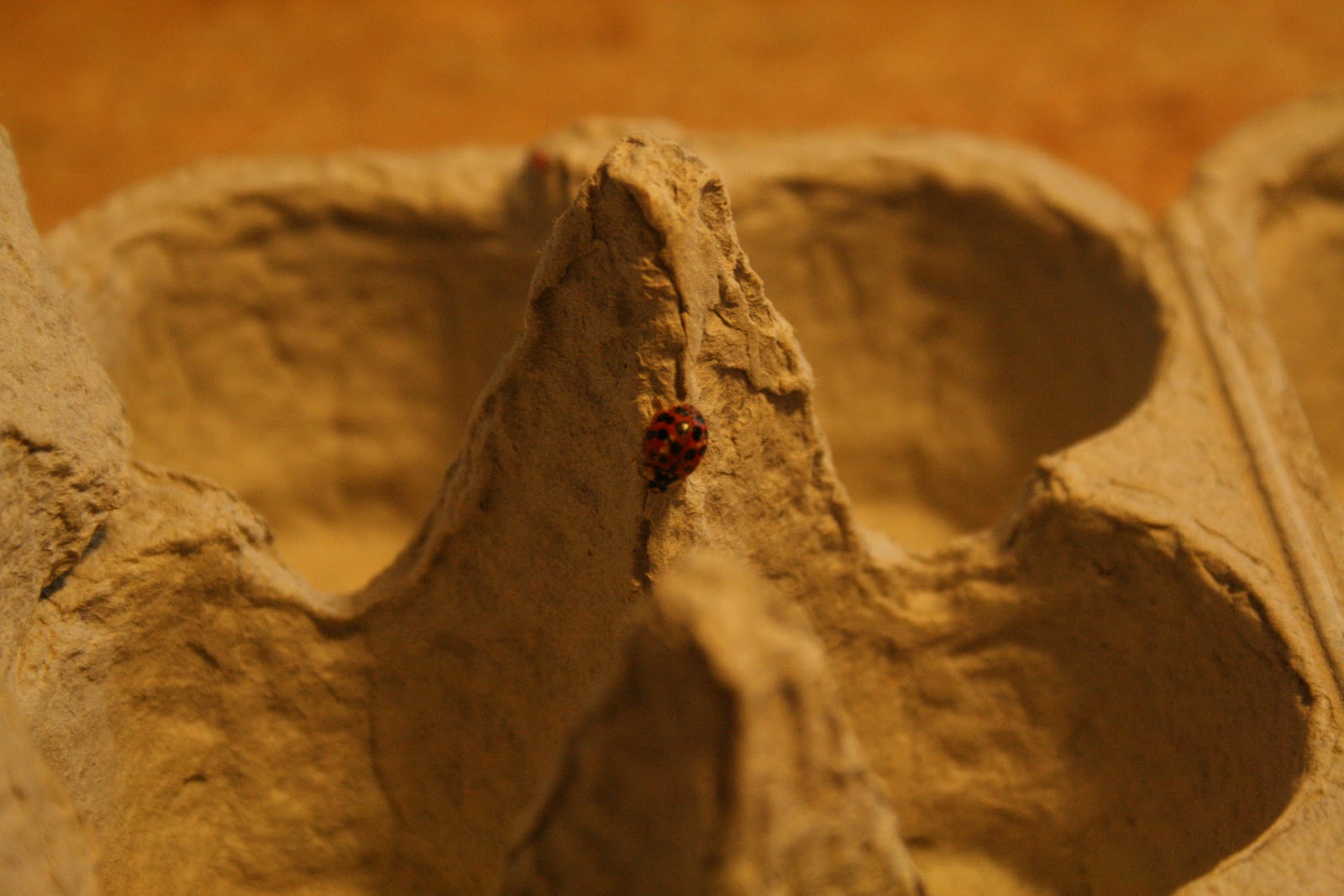
While I was vigorously stirring the batter of a lemon pound cake (delicious by the way) this afternoon, a tiny lady beetle appeared on the empty egg carton. I have not seen many Asian ladybugs this winter. Sometimes they appear in large numbers, but there was just the one today. I think she was enjoying the wonderful afternoon sun that pours into our kitchen. Or maybe she smelled the lemon cake. I'm fairly certain she did not land in the batter. Here she is crawling on the carton and then about to take wing. I assume she flew off to another corner of the house.

Saturday, February 4, 2012

State Champion Black Gum

The oldest known hardwood tree in North America--at 700 years old--is a black gum tree tucked away in a hummocky swamp in southern New Hampshire in the Town of Northwood. Sometime around when Henry VII was crowned Holy Roman Emperor in the year 1312, this black gum sprouted. It grew slowly over the centuries, perhaps only a millimeter a year, surviving hurricanes and land clearing and logging and beavers and other potential threats to a good, long life.

Another black gum, perhaps as old as the Northwood tree, grows not far from my home. This morning a small group of us hiked in to stand beneath and gaze up at this black gum, a state champion big tree--the biggest black gum in New Hampshire. Its circumference is 132 inches; it reaches 89 feet in height (quite tall for a black gum); its crown stretches 58 feet across. The University of New Hampshire Cooperative Extension manages the NH Big Tree Program and this black gum is now in the record book after it was discovered last year by a local tree buff.

Black gums are long-lived, with several traits that enable this longevity. They continue to grow year after year even in deep shade, if ever so slowly. Their wide lateral root system and horizontal branching keeps them upright even during major storms. If a strong wind blows, back gums will lose some top limbs, resulting in a gnarly looking crown. The bark of old trees is thick and deeply furrowed.

Here is the big black gum of Epping that we visited this morning.

Black gums grow in out of the way places and the wood is hard to work, so they've been overlooked by loggers. The gums (also called black tupelo or Nyssa sylvatica) tend to grow in isolated small swamps, not larger wetlands and rivers, so they've been spared the sharp incisors of beavers. Wildlife do like the tree though. Porcupines make dens in the hollows that form at the base of the tree and various creatures inhabit cavities along the tall, straight trunk.
The remains of another black gum stands nearby in the shadow of the big one, decaying as slowly as it grew.
Other smaller black gums grow nearby with perhaps hundreds of years of life left in their trunks and crowns. That is wonderful to contemplate.

Wednesday, February 1, 2012

Skunks are Awake

The midwinter sun and warm days have melted and evaporated much snow this week; the woods on the north side of our yard are now bare. Nineteen mourning doves visited this afternoon, foraging beneath the feeders among the leaf litter and grass. The woods smell moist as evaporating snow creates a thin veil of fog. A spring-like start to February.

Skunks emerged early from their slumber. Given the weather perhaps they never settled into a long nap this winter. On a walk-about with Kodi today we passed through an area with a pungent skunk odor. Now that they are up and about searching for grubs and insects and worms and berries, they will also keep their nose in the air in search of a mate. Mating occurs around Valentine's Day.

In the morning the ground feels hard after a night of below freezing temperatures. Throughout the day the sun warms and softens the ground. By day's end deer create muddy tracks in the back woods, as they step through the soft snow into pools of water beneath.


The setting sun has melted snow off the fallen logs in our woods, exposing a carpet of lush moss. It feels like woolly bears and salamanders should be crawling about soon, but surely that is still a few months away. Maybe cold and snow will return and the skunks can resume their nap. They still have a few weeks before pressed to consider their Valentine.

Friday, January 27, 2012

Snow turns to Slush

The dreary winter of 2012 has returned. The soft, white snow of last weekend has given way to rain and slush. All week as daytime temperatures rose into the 40s, the snow melted away inch by inch, and there wasn't much to begin with. Snow-packed trails turned into ice-covered slippery lanes. Even the dogs were having trouble, skating past each other when they tried to meet up.

This morning the driveway was covered in two inches of slushy snow. Light snow during the night changed over to rain, which will continue into the afternoon. Rain-drenched goldfinches continue to dominate the bird feeders. A red squirrel hangs out below them, taking advantage of their sloppy eating style.

The week ahead looks to be above normal--mostly sunny and in the 40s. At this point in the season I'd like all the snow to melt and then have a fresh start in February. Though, the Farmer's Almanac predicts unsettled weather ahead with more wet snow in store.

One goldfinch is sporting bright new yellow feathers on its back--a sunny spot on an otherwise gray, gloomy day.

Tuesday, January 24, 2012

Kodi and Wild Canids

We are fascinated by Kodi's starkly different reactions to foxes versus coyotes. In the pecking order of wild canids it goes by size: wolves are at the top, followed by coyotes, then foxes. Here in the northeast, the small red fox (10 to 15 pounds) avoids its larger competitor the 35 to 40 pound coyote whenever possible. Kodi weighs in at 50 pounds, but falls between the red fox and the coyote in the pecking order.

Kodi will not accompany me on walks in certain places - those areas where coyote sign is strong and domestic dog evidence is low. If he smells coyote in the air, or sniffs its urine on a twig, or picks up a coyote track, he tucks his tail and ears and turns back toward home. A fox track elicits the opposite reaction. When Kodi picks up the scent of a fox, he runs fast in search of the next track, with tail up and spirits high.

I spent the weekend at my parent's Winterberry Farm in western Massachusetts where both coyote and fox roam. Kodi is reluctant to follow me down into the fields in the back forty, where coyotes travel daily. On Saturday at noon I happen to look outside at the bird feeders and there was a red fox feeding on spilled bits of suet and seeds. He was a mangy looking fox, which is likely why he was seeking food beneath a feeder at mid-day. Mange often kills in winter as the animal is unable to stay warm given the loss of so much fur. Finding food to stay warm is critical.

I waited about a half hour before going outside with Kodi. I wanted to see if he immediately picked up on the fox scent. Sure enough, as soon as we reached the feeders he started sniffing, found the track, then darted in a big circle where the fox had wandered. Kodi was moving fast and I was worried that he might follow the fox track across a busy road so I leashed him up. I let Kodi follow the tracks which led down to one of the back fields. Then we crossed a much larger coyote track. Kodi immediately noticed without any prompting from me. He looked up, sniffed the air, and started back the way we came. Soon, we picked up the fox track and his mood changed again. The thrill of the pursuit was on again.

For the two years that we've had Kodi he has never seen a fox or a coyote up close. His first year of life was spent in a kennel and who knows where else in Indiana. So, his ability to separate coyote from fox seems completely innate and entirely by scent. We've never had a dog that behaved this way with wild canids. It is fascinating, although also frustrating when Kodi refuses to venture into coyote territory. Coyotes are common, so there are some wonderful places that Kodi will not go.

Back at the feeders, Kodi trotted over to several small shrubs and tree seedlings, raised his leg, and urinated. Kodi was alerting the fox that this was his territory. Canid researchers call this "raised leg urination," a key part of the canid scent-marking toolkit. Upon our return to New Hampshire, Kodi immediately insisted on a walk around the neighborhood so he could deploy his own raised leg urination to let friend and foe alike know that he was back.

Ice Out

 Ice Out