Tuesday, December 3, 2013

Views from the Top

With a population of 8.5 million, densely packed together, Bangalore is the third largest city in India.

Srini's parents live in a six flat (apartment) building in the Prasanth Nagar neighborhood of Bangalore. The terrace on top of the building houses the common water tank, clothes lines, satellite dishes, and offers views in all directions.

I go up there every morning to check out the weather, to watch the hustle and bustle in the streets below, and to watch kites soaring in the thermals.The views from the top do not quite capture the scene without the sounds (car horns, street sellers calling out their wares, and traffic noise) and smells (leaves and trash burning), but it gives some sense of life here.

Views from the Terrace
The Water Tank
Seeing many more pigeons and fewer crows compared to last visit
The street below

Monday, December 2, 2013

Arrived in India

I landed in Bangalore, India this morning before dawn after a long travel time via British Airways from Boston to London (6 hrs), a 5 hour layover, and then London to Bangalore (10 hrs). I survived sitting in "cattle class" on the 10 hour flight, despite being packed into a cramped seat, my seat mate snoring, the seat back in front of me tilted all the way back, and a few toddlers bawling (I don't blame them) during take-off and landing.

The road from the Bengaluru International Airport into the city is under construction. This means the existing travel way is filled with potholes and uneven pavement, piles of rubble alongside the road, and autos of all sorts weave in and out to get where they are going, with the help of their car horn.

The sky is overcast today, likely a combination of clouds and smog. The first things I notice on the drive from the airport: street dogs at every corner, bad roads, auto rickshaws--the essential 3-wheeled transport, liberal use of car horns, black or pariah kites--a common bird of prey--lifting off from buildings to scavenge for food, lots of trash-everywhere, people on the move early--many on foot, although a growing number in vehicles.

Srini and I are here visiting his parents. Once we reach their flat, everything again feels familiar, as we've been here several times before. I am welcomed with Amma's (my mother-in-law) coffee decoction, cereal with tiny,sweet bananas and pomegranate seeds, followed by a midday meal of chappatis, dal, vegetable subji, and homemade yogurt with a sour edge.
Amma cooking up lunch of chappatis and subji
Fresh pomegranates from a neighborhood market
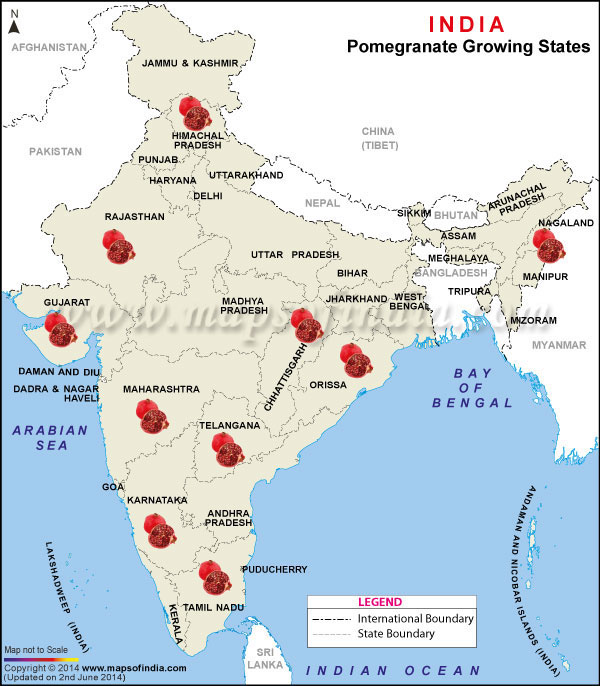
The pomegranate is native to northern Indian and there are mapped pomegranate growing states in India. My niece Lia will be jealous of my access to these fresh, local fruits.
From MapsofIndia.com
Pomegranate Producing States Map
When I left home it was cold and windy. I am enjoying the more tropical temperatures here, a quite pleasant high 70sF. Now to avoid napping; I am off my natural sleep/wake pattern as it is 10.5 hours ahead of home time.

Thursday, November 28, 2013

Thanksgiving Morn at Winterberry Farm

Despite a brisk wind, it is a beautiful Thanksgiving morning here.
At sunrise, Kodi, Henna and I explored the back forty. From there I looked south to Long Mountain, the ridge highlighted by the morning sunlight.
A mockingbird scolded us from a thorny thicket of shrubs. White-throated sparrows were more furtive among the bushes. My favorite redtail lifted off from the tall pines and soared over the pasture. Henna and Kodi foraged in the pasture for Thanksgiving treats. They want to keep going out, so we've had three walks already. It is nice to get outside on a nice day, while the turkey slow cooks in the oven.

Happy Thanksgiving To All.

Sunday, November 24, 2013

A Dusting of Snow

First snow of the season--a dusting--fell during the night. Then the skies cleared and the winds whipped up a fury. Continuing all day. Fallen leaves are swirling and scurrying across the road and covering people's lawns. At dawn the leaves lay still under a light coating of snow and from the overnight chill.

Saturday, November 16, 2013

Our Wild Perennial Garden

Patty Laughlin of Lorax Landscaping suggests NO fall clean-up in perennial beds. Patty says that, "The leaves and debris provide a haven for good insects through the winter. Uncut perennials allow better root and crown protection (they catch leaves and snow for their insulation), provide food and perches for birds and add winter landscape interest for you."

I took Patty's advice and I am now enjoying the garden even more this fall. The big bluestem is six feet tall. Loose clumps of silky milkweed seeds hang on to their stalk, at least until the next big wind comes along.
I enjoy the form and structure and colors of our perennial garden that endures and continues through all seasons. As our own yard takes on more natural patterns and rhythms, perhaps others will take note and lessen their seemingly manic drive to "clean-up" their yards.

Friday, November 15, 2013

A Dog's Life

A news item on NPR this morning highlights some new findings about where wolves first befriended humans. Scientists are still uncertain as to why or how wolves became domesticated by hunter-gatherers thousands of years ago. Maybe it was shared interests or some similarity in social structure or hunting techniques.

I wonder if it was the warmth of the campfire that drew in some wolves. Our sweet Henna is fond of the woodstove, lying within a foot of the door, her body so hot that she starts to pant.
Getting several square meals a day versus hunting down your prey seems like a good deal too. I can see why wolves would figure that out and decide to live with humans. As time went on life got even better--cozy beds, toys, play dates. Dogs, at least in many western homes, have a great life. I think Henna and Kodi would agree and thank their ancestors for making the move to domestic life.

Henna with a buddy at daycare
Kodi with his favorite pillows
Watching chipmunks in the yard
Ready for a road trip--what a life

Tuesday, November 5, 2013

Passenger Pigeon Anniversary

The Year 2014 will mark the 100th anniversary of extinction of the passenger pigeon. Project Passenger Pigeon (P3) is a collaborative effort based at the Chicago Academy of Sciences to raise awareness of the passenger pigeon story as a way to promote species and habitat conservation. Among many other efforts, they are raising money for a film: From Billions to None, The Passenger Pigeon's Flight to Extinction.


The P3 website has a cool map of the U.S. and Canada that is clickable on each state and province. Here is what it says about the passenger pigeon in my state of New Hampshire:

"In his 1903 work on the birds of New Hampshire, Glover Allen summarized the former status of the bird: “Arriving within our borders during the first week of April in tremendous flocks, they nested in large colonies, at least as far north as the White Mountains proper.” The pigeons would stay until October.

Last Records of the Passenger Pigeon:
A bird shot on October 10, 1881 was stuffed and displayed in the Public Library of Acworth, not far from where the bird met its demise. A later report is that of W.W. Flint who told Allen that he killed a bird near his home at Concord during the summer of 1885."


The passenger pigeon was once the most abundant bird in North America--an estimated 3 to 5 billion birds. The P3 website is full of information about the passenger pigeon, the relationship of people to nature, and how we can ensure no other species are lost to extinction because of human actions. There are many creative ideas about how to get involved.

Ice Out

 Ice Out