Wednesday, December 11, 2013

Havelock Beaches and Tidal Flats

On our first morning on Havelock Island I woke early to watch the sunrise as the tide was just coming in around 5:30 am. The DIVEIndia crew was already starting to load scuba gear into their boats.
I could have spent many days exploring the white sand beaches, turquoise waters, and tidal flats at Beach 3. At low tide we walked way out to the edge of the tide on soft, moist sand. It was easy to be mesmerized by the blue waters and expansive horizon, but there was so much to see at our feet. 

The tidal flats are home to thousands of worms, and likely hundreds of species. I was fascinated by their castings--some looked like coiled rope and others like chimneys.
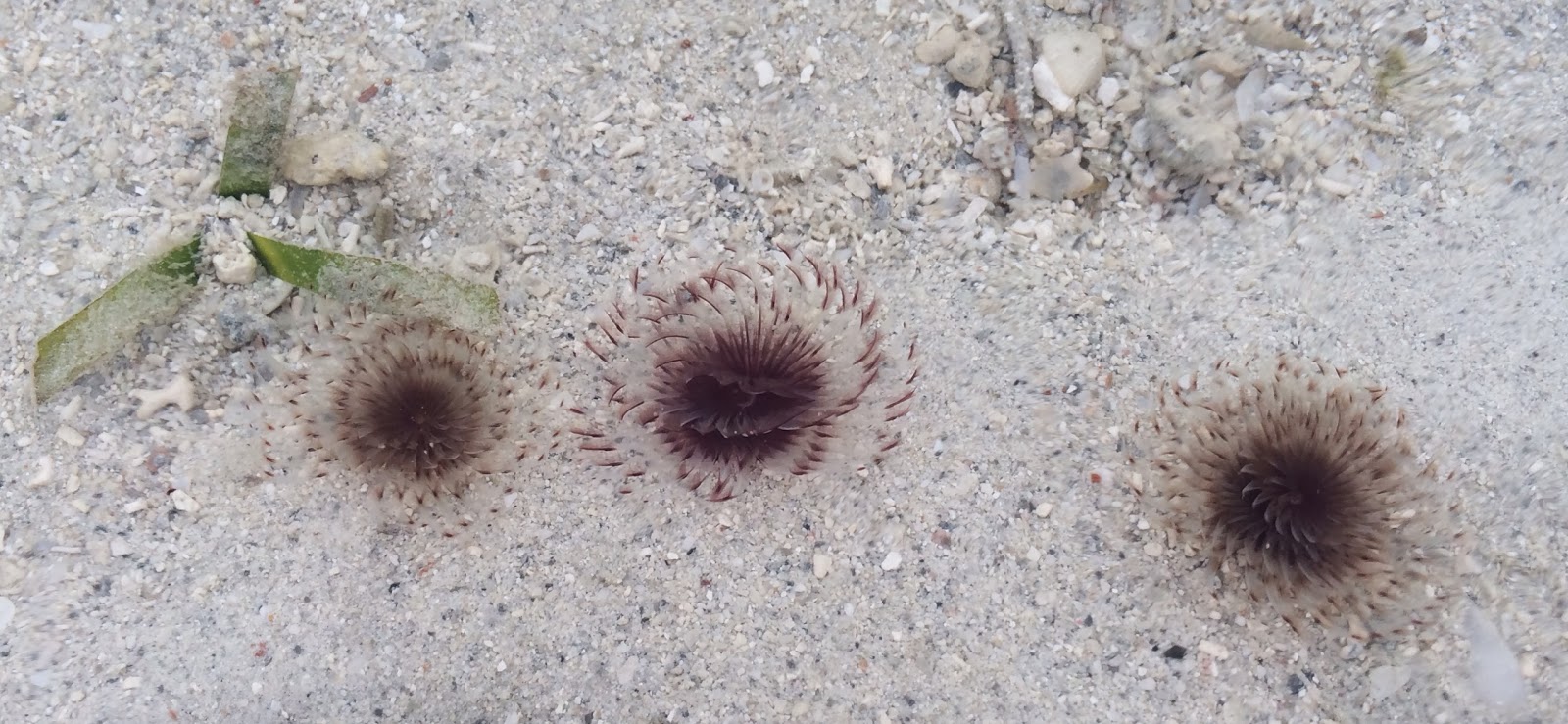
The feather duster worms were stunning. They are mostly hidden under the sand, only extending their feathery feeding appendages above the water. They pull them quickly and completely back under the sand when disturbed. When I stood still they re-emerged. 
I saw a small gobi fish, a sea anemone, a sand dollar (the bleached skeleton of a sea urchin), and holes lined with small shells (I don't know who was living there).
In one area we discovered many black sea cucumbers--these sausage-shape, 8-inch long creatures were much more beautiful than their name suggests.
Here is a hand-sized cushion star and gooseneck barnacles that were attached to a slender bamboo that had washed up on shore.
And then there were the hermit crabs--these are the life of the beach along the high tide line. They spend a lot of time among the wrack, feeding, looking for new shells. Since they have soft bodies (no shell of their own) they seek out other vacant shells, occupying different sizes and shapes depending on their own size. Large shells (we're talking about 1 inch in size) are uncommon so there is great competition. Several hermit crabs will crowd around a newly vacant shell and trade shells depending on their size. Sometimes they fight over them. The smallest hermit crab was smaller than the fingernail on my little finger.
The 2004 tsunami and recent cyclones have caused some damage to the coastline and to the trees. Remnants of these effects are seen in the large tree trunks lying on the beach.
We spent 2 1/2 days on Havelock--not nearly enough time
to absorb all the beauty and explore all the natural places.

Tuesday, December 10, 2013

The Andaman Islands

Yesterday evening we returned from a 4-day trip to the Andaman Islands-- a group of 300+ islands located 600 miles (1000 km) east of the India mainland. This tropical island archipelago is much closer to Myanmar (Burma), but it is part of India.

This map shows the physical features of India, the Bay of Bengal,
and the Indochina Peninsula--note the location of the Andaman Islands
on the eastern side of the Bay of Bengal
Last Thursday we flew from Bangalore to Chennai (Madras) then caught a 2-hour flight on SpiceJet to Port Blair on South Andaman. As we approached the Andamans we flew over one, uninhabited, tree-covered island, ringed with white sand, coral reefs, and turquoise-colored waters.
Many of the Andaman Islands are either uninhabited or home to tribal peoples, where foreigners are not permitted. Large portions of the Andamans are also in forest reserve so the biologically diverse, multi-layered forests are still intact.
In Port Blair all foreigners are required to obtain a permit to visit the islands. This is provided at no charge and relatively quickly at the airport upon landing. From there we got a taxi ride to the ferry, which took us to the Island of Havelock.
The ride takes 2 1/2 hours. On the way over we took the Katchal and on the return the North Passage. The Katchal was smaller and quite stifling hot in the hold, but we climbed up to the deck to catch the sea breeze. Twice we sat near the bow and once we saw a school of bottlenose dolphins.
We arrived at the Havelock jetty at 4:30 pm, as the sun was setting.
Our Havelock destination was DIVEIndia, where Srini's nephew, Sidharth (Sid) works as a scuba instructor. There are numerous resorts on Havelock that offer scuba, but DIVEIndia is considered one of the best. DIVEIndia is located at "Beach 3" on Havelock Island.
Here is a peek at our accommodations at DIVEIndia: a large tent with tiled floor and separate bathroom, electricity, fan, and hot water; rustic but very comfortable. The best thing is that there is no internet or cell phone coverage.
I'll have more on our stay there in my next post, including our kayak paddle, first scuba dive, walking the beach and tidal flats, and more.

Wednesday, December 4, 2013

Fruit and Vegetable Vendors

We walked down the road to visit one of Srini's cousins and to buy a few fruits and vegetables. It is still light here until after 5:30 pm. That in itself is a treat. The fruit and vegetable vendors park along the sidewalks or sit at the street corners. Here are a few pictures from our walkabout.
We leave early tomorrow morning for the Andaman Islands, remote islands in the Bay of Bengal. We'll be offline until Monday--look for my next post then.

Tuesday, December 3, 2013

A Day in Bangalore

Travelling the roads of India is always an adventure. In urban areas it involves navigating an obstacle course of potholes, blocked roads, one-way roads, myriad vehicle types, cows, carts, dogs, people. We don't drive here, leaving the navigation to cab and auto rickshaw drivers, and Srini's nephew who enjoys the challenge of the chaos. The rick and cab drivers don't always know where they are going so it is best to have a sense of the direction of your destination. There are signs along the major roads asking drivers to stick to their lanes, but there are no lanes, just maneuvering and weaving.
The sign reads: "Follow Lane Discipline"
A cycle rickshaw driver walks a tall cargo of cardboard boxes
Since fruits are grown year-round here, at least in some part of India, they always taste fresh and sweet. They are still grown for their taste, not looks or shelf life. Here are two of my favorites: small, sweet bananas and "loose jacket" oranges.
We are relishing homemade food including dosais and idlis, eaten with coconut chutney and sambar. I calculated that Srini's mother has probably made more than 100,000 dosais in her life, since it is a daily staple in south India. Both dosais and idlis are made from a batter of rice and split black lentils (urad dal); one is fried like a pancake, the other steamed.
Amma's dosai
The neighbors made us idlis, coconut chutney and sambar
As you can see, we are eating well. In the morning we read the Deccan Chronicle, the major, south Indian daily newspaper. The topics are similar to the U.S. but with a different flavor, and often with a curious focus. Yesterday this was on the front page--a well-known editor of a paper in the state of Goa was arrested for sexual assault. Note the caption under his picture: "The Tehelka editor shared his jail cell with four local men held on charges of poaching frogs and turtles, on the second night."
Other stories include political back and forth between the two major political parties, complaints about the poor state of infrastructure, especially roads and bridges, complaints about farm subsidies or the lack thereof, accident and police reports. Sound familiar? Everything except the frog poaching!

Views from the Top

With a population of 8.5 million, densely packed together, Bangalore is the third largest city in India.

Srini's parents live in a six flat (apartment) building in the Prasanth Nagar neighborhood of Bangalore. The terrace on top of the building houses the common water tank, clothes lines, satellite dishes, and offers views in all directions.

I go up there every morning to check out the weather, to watch the hustle and bustle in the streets below, and to watch kites soaring in the thermals.The views from the top do not quite capture the scene without the sounds (car horns, street sellers calling out their wares, and traffic noise) and smells (leaves and trash burning), but it gives some sense of life here.

Views from the Terrace
The Water Tank
Seeing many more pigeons and fewer crows compared to last visit
The street below

Monday, December 2, 2013

Arrived in India

I landed in Bangalore, India this morning before dawn after a long travel time via British Airways from Boston to London (6 hrs), a 5 hour layover, and then London to Bangalore (10 hrs). I survived sitting in "cattle class" on the 10 hour flight, despite being packed into a cramped seat, my seat mate snoring, the seat back in front of me tilted all the way back, and a few toddlers bawling (I don't blame them) during take-off and landing.

The road from the Bengaluru International Airport into the city is under construction. This means the existing travel way is filled with potholes and uneven pavement, piles of rubble alongside the road, and autos of all sorts weave in and out to get where they are going, with the help of their car horn.

The sky is overcast today, likely a combination of clouds and smog. The first things I notice on the drive from the airport: street dogs at every corner, bad roads, auto rickshaws--the essential 3-wheeled transport, liberal use of car horns, black or pariah kites--a common bird of prey--lifting off from buildings to scavenge for food, lots of trash-everywhere, people on the move early--many on foot, although a growing number in vehicles.

Srini and I are here visiting his parents. Once we reach their flat, everything again feels familiar, as we've been here several times before. I am welcomed with Amma's (my mother-in-law) coffee decoction, cereal with tiny,sweet bananas and pomegranate seeds, followed by a midday meal of chappatis, dal, vegetable subji, and homemade yogurt with a sour edge.
Amma cooking up lunch of chappatis and subji
Fresh pomegranates from a neighborhood market
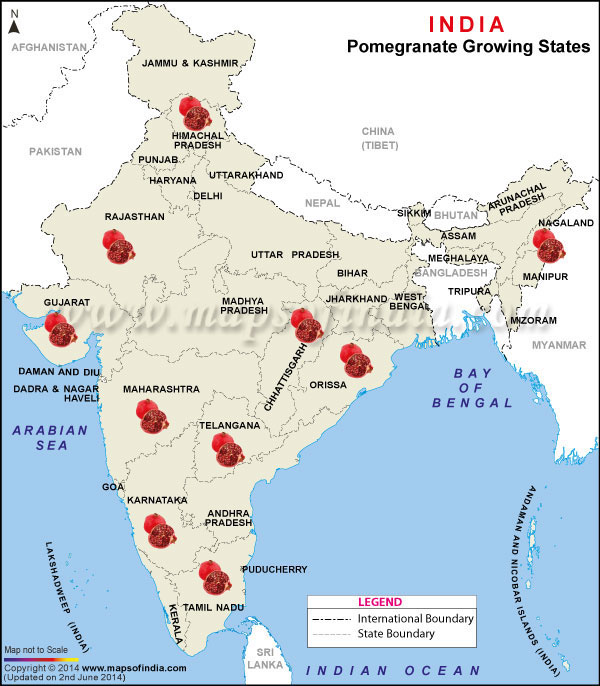
The pomegranate is native to northern Indian and there are mapped pomegranate growing states in India. My niece Lia will be jealous of my access to these fresh, local fruits.
From MapsofIndia.com
Pomegranate Producing States Map
When I left home it was cold and windy. I am enjoying the more tropical temperatures here, a quite pleasant high 70sF. Now to avoid napping; I am off my natural sleep/wake pattern as it is 10.5 hours ahead of home time.

Ice Out

 Ice Out