The common wood nymph (Cercyonis pegala) does not live in the woods, although it is common, especially in July. This past week I've been watching them bounce around wildflower meadows. They don't sit still too long especially if you try to get close. Even at a distance they are easy to identify: a dark chocolate body with a pale yellow patch that surrounds two eye spots on each forewing.
It is one of my favorite butterflies, perhaps because it is easy to identify, or perhaps because it was one I learned running around fields with a butterfly net as a kid. It's perky flight and brown and yellow wing pattern with the eye spots also makes the wood nymph a stand out.
Sunday, July 22, 2012
Friday, July 20, 2012
Escape to the Yard
Kodi growled softly some time during the night. He was lying on his dog bed on the floor near our bed. He doesn't usually growl during the night, and except for the growl he didn't budge from his bed. I should remember that a low growl, however brief, means something. I walked out to the garden this morning to turn on the drip irrigation (it is still quite dry here) and noticed a few okra tops missing. I immediately looked over at the Swiss chard to see a few tall leaves that I was about to harvest gone. A deer jumped the fence again.
Fortunately there was minimal damage, but our fence with its streamers of colorful flagging has been penetrated. I think we'll just have to put up with a little bit of deer herbivory. There really is plenty to go around.
Although we didn't get around to hooking up the drip irrigation in the three raised beds in the backyard, the plants are lush and wild. I hand water every few days. Only the cucumber leaves are yellowing. The cantaloupes are full of buds, the zucchini and crookneck yellow squash yield fruits each day, the winter squash have set fruit, and the speckled swan gourd is flowering -- large snow white flowers.
The mother robin is still sitting on her nest. She and her mate are relishing the fruits of the alternative-leaved dogwood in the front yard.
This week I noticed more bees and dragonflies and butterflies buzzing and flitting about. Bees were busy in the purple bee balm while the hummingbirds continued to patrol the red bee balm for nectar.
Our yard and the gardens are a small oasis away from the ugly news that bombards us each day. Weeding and watering and moving wheelbarrows full of compost are a wonderful escape from the phone, the computer, and even the radio. A walk around the yard, smelling the flowers, watching a tiny spider hunt among a flower, even collecting Japanese beetles is my form of walking meditation. It works wonders for me.
Fortunately there was minimal damage, but our fence with its streamers of colorful flagging has been penetrated. I think we'll just have to put up with a little bit of deer herbivory. There really is plenty to go around.
Although we didn't get around to hooking up the drip irrigation in the three raised beds in the backyard, the plants are lush and wild. I hand water every few days. Only the cucumber leaves are yellowing. The cantaloupes are full of buds, the zucchini and crookneck yellow squash yield fruits each day, the winter squash have set fruit, and the speckled swan gourd is flowering -- large snow white flowers.
The mother robin is still sitting on her nest. She and her mate are relishing the fruits of the alternative-leaved dogwood in the front yard.
This week I noticed more bees and dragonflies and butterflies buzzing and flitting about. Bees were busy in the purple bee balm while the hummingbirds continued to patrol the red bee balm for nectar.
Our yard and the gardens are a small oasis away from the ugly news that bombards us each day. Weeding and watering and moving wheelbarrows full of compost are a wonderful escape from the phone, the computer, and even the radio. A walk around the yard, smelling the flowers, watching a tiny spider hunt among a flower, even collecting Japanese beetles is my form of walking meditation. It works wonders for me.
Saturday, July 14, 2012
Taking Stock in Mid-July
In the midst of a heat wave and on the verge of a drought, it seems like a good time to take stock of life in our yard - the birds and mammals, the good and the bad insects, vegetables, the fruits, flowers and herbs.
The drip irrigation in the main vegetable garden is keeping the crops watered, healthy, and producing. The sugar snap peas are fading a bit as they always do this time of year; peas don't like the heat. Yet I'm still harvesting plump, sweet pods daily, although with 90 degree days forecast for the coming week, their days are numbered. The chard and kale are lush and ready for any meal, they never fade. This morning I harvested our first tomatoes: two luscious sun gold tomatoes.
The robin is nesting for the third time, after two successfully fledged nests. She returned to the same nest under the deck. Robins are doing well. Two of my favorite bird visitors to our yard this year are a pair of ruby-throated hummingbirds and a pair of kingbirds. The hummingbird nest somewhere nearby every year. Someday I hope to see their thimble-sized nest. Mostly we see the female as she visits the red beebalm quickly slipping her slender bill into each flower. The pair of kingbirds is likely nesting at the edge of the wetland and visits our front yard in search of insects. They perch at the top of the pole bean poles, their dark gray back and black head contrasting nicely with their white breast and white-tipped tail. I enjoy their raspy, sputtering song.
Our six blueberry bushes produce a handful of nearly ripe berries each day, enough to accompany our morning bowl of granola. We pick them with a slight blush of pink, before the birds pick off the ripe berries. The peach trees are loaded, the chipmunks are leaving them alone now. There are still plenty of chipmunks in the yard and beyond. Chipmunks are doing well.
The Japanese beetle population is as high as ever. I've collected hundreds already this season, scooping them into a yogurt container of soapy water. They seem to have three favorite plants in our yard: American hazel, blueberry bushes, and evening primrose. The hazel is their favorite. The best time to collect them is in the morning, when they are a bit sluggish. The Japanese beetles are doing too well.
Fortunately garden pests so far are few. I've detected no tomato hornworms, potato beetles, cucumber beetles, and other pesky pests, for now. One has to be ever vigilant. I'm more worried about the dearth of bees, butterflies, dragonflies, and other native insects. The bumblebees were out in force a month or so ago, but have since disappeared. Dragonfly and butterfly numbers seem to be down. My friend Scott in Strafford is seeing similar trends.
My friend Joanne at the Yellow Dog's Barn asked me this week about crickets. She hasn't heard them chirping for several years now. That got me thinking the same. We usually get at least one black cricket in our basement, but probably not for several years. I've been checking around about crickets, but haven't heard about any population crashes. Scott said that the ground crickets emerged in May/June then disappeared with the heat. Srini says the deer flies are really bad this year. For some reason they don't bother me as much as mosquitos. Both are bothersome and doing well.
In general, the yard is looking good, except for the patch of grass over the septic tank which always dies about now. The effort to keep it green is not worth the effort or the water. I save that for the vegetables, which we can eat, and the flowers, which bring in the hummingbirds and bees and butterflies. The bee balm, shasta daisy, coreopsis, coneflowers, and yarrow are in full bloom.
I look forward to hearing from others about what is happening in your yard.
The drip irrigation in the main vegetable garden is keeping the crops watered, healthy, and producing. The sugar snap peas are fading a bit as they always do this time of year; peas don't like the heat. Yet I'm still harvesting plump, sweet pods daily, although with 90 degree days forecast for the coming week, their days are numbered. The chard and kale are lush and ready for any meal, they never fade. This morning I harvested our first tomatoes: two luscious sun gold tomatoes.
The robin is nesting for the third time, after two successfully fledged nests. She returned to the same nest under the deck. Robins are doing well. Two of my favorite bird visitors to our yard this year are a pair of ruby-throated hummingbirds and a pair of kingbirds. The hummingbird nest somewhere nearby every year. Someday I hope to see their thimble-sized nest. Mostly we see the female as she visits the red beebalm quickly slipping her slender bill into each flower. The pair of kingbirds is likely nesting at the edge of the wetland and visits our front yard in search of insects. They perch at the top of the pole bean poles, their dark gray back and black head contrasting nicely with their white breast and white-tipped tail. I enjoy their raspy, sputtering song.
Our six blueberry bushes produce a handful of nearly ripe berries each day, enough to accompany our morning bowl of granola. We pick them with a slight blush of pink, before the birds pick off the ripe berries. The peach trees are loaded, the chipmunks are leaving them alone now. There are still plenty of chipmunks in the yard and beyond. Chipmunks are doing well.
The Japanese beetle population is as high as ever. I've collected hundreds already this season, scooping them into a yogurt container of soapy water. They seem to have three favorite plants in our yard: American hazel, blueberry bushes, and evening primrose. The hazel is their favorite. The best time to collect them is in the morning, when they are a bit sluggish. The Japanese beetles are doing too well.
Fortunately garden pests so far are few. I've detected no tomato hornworms, potato beetles, cucumber beetles, and other pesky pests, for now. One has to be ever vigilant. I'm more worried about the dearth of bees, butterflies, dragonflies, and other native insects. The bumblebees were out in force a month or so ago, but have since disappeared. Dragonfly and butterfly numbers seem to be down. My friend Scott in Strafford is seeing similar trends.
My friend Joanne at the Yellow Dog's Barn asked me this week about crickets. She hasn't heard them chirping for several years now. That got me thinking the same. We usually get at least one black cricket in our basement, but probably not for several years. I've been checking around about crickets, but haven't heard about any population crashes. Scott said that the ground crickets emerged in May/June then disappeared with the heat. Srini says the deer flies are really bad this year. For some reason they don't bother me as much as mosquitos. Both are bothersome and doing well.
In general, the yard is looking good, except for the patch of grass over the septic tank which always dies about now. The effort to keep it green is not worth the effort or the water. I save that for the vegetables, which we can eat, and the flowers, which bring in the hummingbirds and bees and butterflies. The bee balm, shasta daisy, coreopsis, coneflowers, and yarrow are in full bloom.
I look forward to hearing from others about what is happening in your yard.
Monday, July 9, 2012
Mt. Madison
Kodi had a great day yesterday, climbing his first 5,000-footer. We met up with three of our regular hiking partners--Kevin, Mike, and Jerry--to hike the Valley Way Trail to the Madison Hut and then up to the top of 5,366-foot Mt. Madison.
Srini and I have climbed Mt. Madison twice before, but this was our first time coming up from the north. The 8.4-mile round trip is the shortest and easiest route to the top of Madison, beginning at the Appalachia parking lot on Route 2 in Randolph. By 8:30 am the parking lot was already nearly full. However, there are many trails that lead from here up to the high peaks and other scenic destinations that the trail never felt congested with hikers.
Valley Way follows Snyder Brook with several side trails that take in a series of scenic falls. Kodi found deep, cold pools to cool off his black body and to slake his thirst.
Our hike was a slow, steady climb through northern hardwoods, then hemlocks, and finally through spruce and fir. We listened to black-throated blue warblers, Swainson's thrushes, winter wrens, and blackpoll warblers as we climbed.
Juts before emerging from tree cover, a few signs warn hikers to be prepared for adverse conditions and to help protect fragile alpine plant communities.
After four hours of hiking we emerged above treeline and arrived at the recently re-built Madison Spring Hut and looked up at the rocky cone of Mt. Madison. No longer protected by tree cover we quickly donned a few more layers including hat and gloves as winds whipped across the ridge.
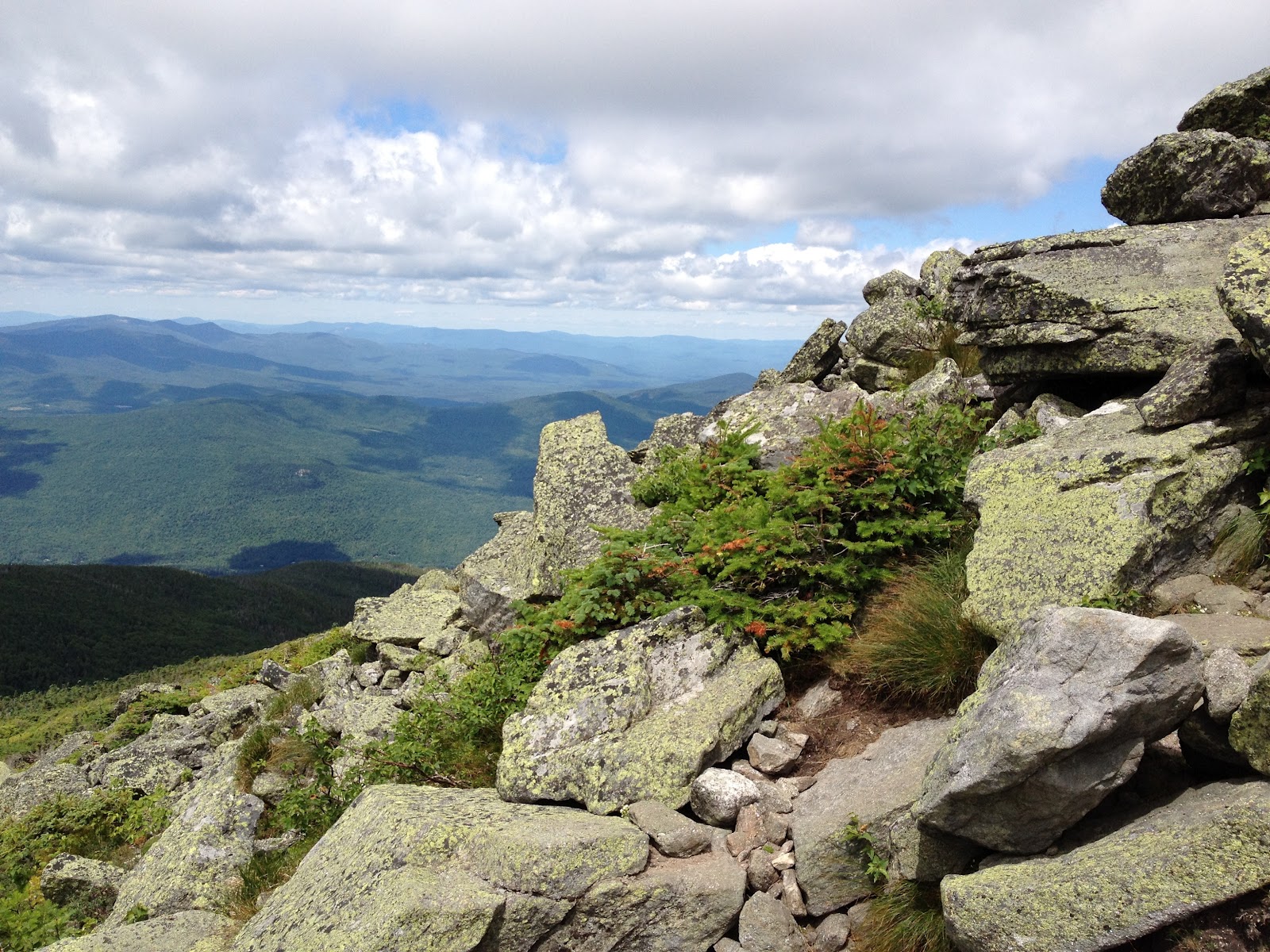
We reached the hut at 1:00 pm; other hikers were heading up and coming down from the top of Madison. One couple just finished climbing all 48 4,000-footers and cracked open their champagne bottle at the hut. The 0.4 miles and 500 foot elevation gain from the hut to the top of Madison took less than an hour round trip. Kodi easily maneuvered up the slope among the huge boulders as we steadied ourselves against the wind, taking in the sweeping 360 degree views.
Srini and I have climbed Mt. Madison twice before, but this was our first time coming up from the north. The 8.4-mile round trip is the shortest and easiest route to the top of Madison, beginning at the Appalachia parking lot on Route 2 in Randolph. By 8:30 am the parking lot was already nearly full. However, there are many trails that lead from here up to the high peaks and other scenic destinations that the trail never felt congested with hikers.
Valley Way follows Snyder Brook with several side trails that take in a series of scenic falls. Kodi found deep, cold pools to cool off his black body and to slake his thirst.
Our hike was a slow, steady climb through northern hardwoods, then hemlocks, and finally through spruce and fir. We listened to black-throated blue warblers, Swainson's thrushes, winter wrens, and blackpoll warblers as we climbed.
Juts before emerging from tree cover, a few signs warn hikers to be prepared for adverse conditions and to help protect fragile alpine plant communities.
After four hours of hiking we emerged above treeline and arrived at the recently re-built Madison Spring Hut and looked up at the rocky cone of Mt. Madison. No longer protected by tree cover we quickly donned a few more layers including hat and gloves as winds whipped across the ridge.
We reached the hut at 1:00 pm; other hikers were heading up and coming down from the top of Madison. One couple just finished climbing all 48 4,000-footers and cracked open their champagne bottle at the hut. The 0.4 miles and 500 foot elevation gain from the hut to the top of Madison took less than an hour round trip. Kodi easily maneuvered up the slope among the huge boulders as we steadied ourselves against the wind, taking in the sweeping 360 degree views.
Looking down at the hut as we climbed.
A view north.
Cairns guide hikers through the mass of boulders to the top.
The windswept, delicate white flowers of sandwort grow among lichen-colored boulders.
The view south to Mt. Washington, with the auto road visible on the left flank.
Views from the top: the trail sign at the top;
Kodi and I celebrate our accomplishment with Mt. Washington in the distance.
As we descended from Mt. Madison we got a nice view of 5,410-foot JQ Adams
and the great mass of 5,799-foot Mt. Adams beyond.
Kodi takes in a final view as we descend back into the col
and to the hut, before the long hike down Valley Way and the end to a very fine hike.
Tuesday, July 3, 2012
A Spleenwort
Kodi and I are at Winterberry Farm for a few days. We spend a few days here every month or so to help my parents with weeding and mowing, cooking and cleaning, pulling invasives. At least once during each visit Kodi and I hike up to Rattlesnake Knob to take in our favorite view of Long Mountain.
My sister and nieces are visiting too so the five of us made the hike. It was mid-day, just after a lunch of paninis with the garlic scape pesto that I made several weeks ago. My nieces rallied for the hike despite a warm day although we slowed a bit on the steep part. Then they charged forward reaching the knob before the adults and the dog.
The steepest part of the trail is lined with many interesting plants. I see something new every time. Today it was an ebony spleenwort (Asplenium platyneuron), a slender fern with a dark red stem (rachis).
Small clumps of bear corn (also known as cancer root), Conopholis americana, lined one side of nearly the entire steep section of the trail. Since this is the only place I see this unusual plant, I look forward to finding it here each time.
Lower down the trail a toad blended into the dried leaves covering the footpath and striped pipsissewa grew nearby, its white flowers set to open. I enjoy finding the common and the uncommon on these woodland walks.
I mentioned in an earlier post that my SLR camera is on the blink and I've been relying on my iPhone for photos. The latter have been less than satisfactory, until just the last few days, when I finally downloaded the 99 cent app called Camera+, and so far I'm impressed with the difference. Perhaps readers can be the judge by letting me know how the pictures in this post look, taken with Camera+. I was researching point and shoot cameras, one that I could fit in a shirt pocket, but the iPhone may suffice for awhile.
My sister and nieces are visiting too so the five of us made the hike. It was mid-day, just after a lunch of paninis with the garlic scape pesto that I made several weeks ago. My nieces rallied for the hike despite a warm day although we slowed a bit on the steep part. Then they charged forward reaching the knob before the adults and the dog.
The steepest part of the trail is lined with many interesting plants. I see something new every time. Today it was an ebony spleenwort (Asplenium platyneuron), a slender fern with a dark red stem (rachis).
Lower down the trail a toad blended into the dried leaves covering the footpath and striped pipsissewa grew nearby, its white flowers set to open. I enjoy finding the common and the uncommon on these woodland walks.
I mentioned in an earlier post that my SLR camera is on the blink and I've been relying on my iPhone for photos. The latter have been less than satisfactory, until just the last few days, when I finally downloaded the 99 cent app called Camera+, and so far I'm impressed with the difference. Perhaps readers can be the judge by letting me know how the pictures in this post look, taken with Camera+. I was researching point and shoot cameras, one that I could fit in a shirt pocket, but the iPhone may suffice for awhile.
Saturday, June 30, 2012
June End
The kingbird and the phoebe perch atop the bean poles,
then sally out to catch a fly.
Hummingbirds dance among the red bee balm, while
bees crowd around the lavender.
A deer browsed the garden night before last,
snipping off the tops of all the sunflowers.
One doe jumped the fence,
snacking on some tomato tops and chard leaves.
The robins fledged; the fuzzy-headed phoebe young
are still in their nest tucked beneath the canoe.
Garden salads and sugar snap peas are staples at our table.
Kale and chard, onions and garlic, cilantro and parsley
fresh from the garden adorn our plates as well.
Meanwhile, we wait for eggplants and peppers,
tomatoes and potatoes,
and the lovely okra
to grow under the summer sun.
The peaches are swelling, the chipmunks are fewer.
Thursday, June 21, 2012
A Hot Start to Summer
It is a hot, windless start to summer. By 9:00 am yesterday I was beginning to wilt while finishing the yard chores: finally planting the pole beans, watering some just-planted annuals and a few nasturtium seedlings. I am feeling good about the drip irrigation. This morning at 5:00 am I walked around to the back of the house and turned on the outdoor faucet, then listened to the drip, drip, drip as the main garden slowly absorbed the moisture. Today, when the temperature is predicted to reach 100 F, the irrigation system will earn some of its cost.
Here's how the garden looks on the first full day of summer, just as the morning sun is peaking over the house.
The heat-loving okra and peppers should show a burst of growth the next few days, while the cool-loving peas might sag. Speaking of veggies. We made a delicious dish last night with fresh bok choi (from Stout Oak Farm), freshly picked sugar snap peas, tofu, and a bunch of other things served with buckwheat noodles. This recipe was adapted from Kate Donald at Stout Oak Farm. Sometime in the near future I hope to add some recipes as a side bar. I'll include this one.
A robin pair re-used the successful phoebe nest under the deck. Robins are more restless than phoebes; the mother robin clucked every time we walked onto the deck or nearby the nest. Yet, she was successful in carrying the brood through to hatching. The nest has three robin nestlings and both parents are busy bringing insects to the young. Here are the three hungry (and hot) baby robins as they wait for more food; one flopped its head down when it realized that my arrival was not its mother bringing food.
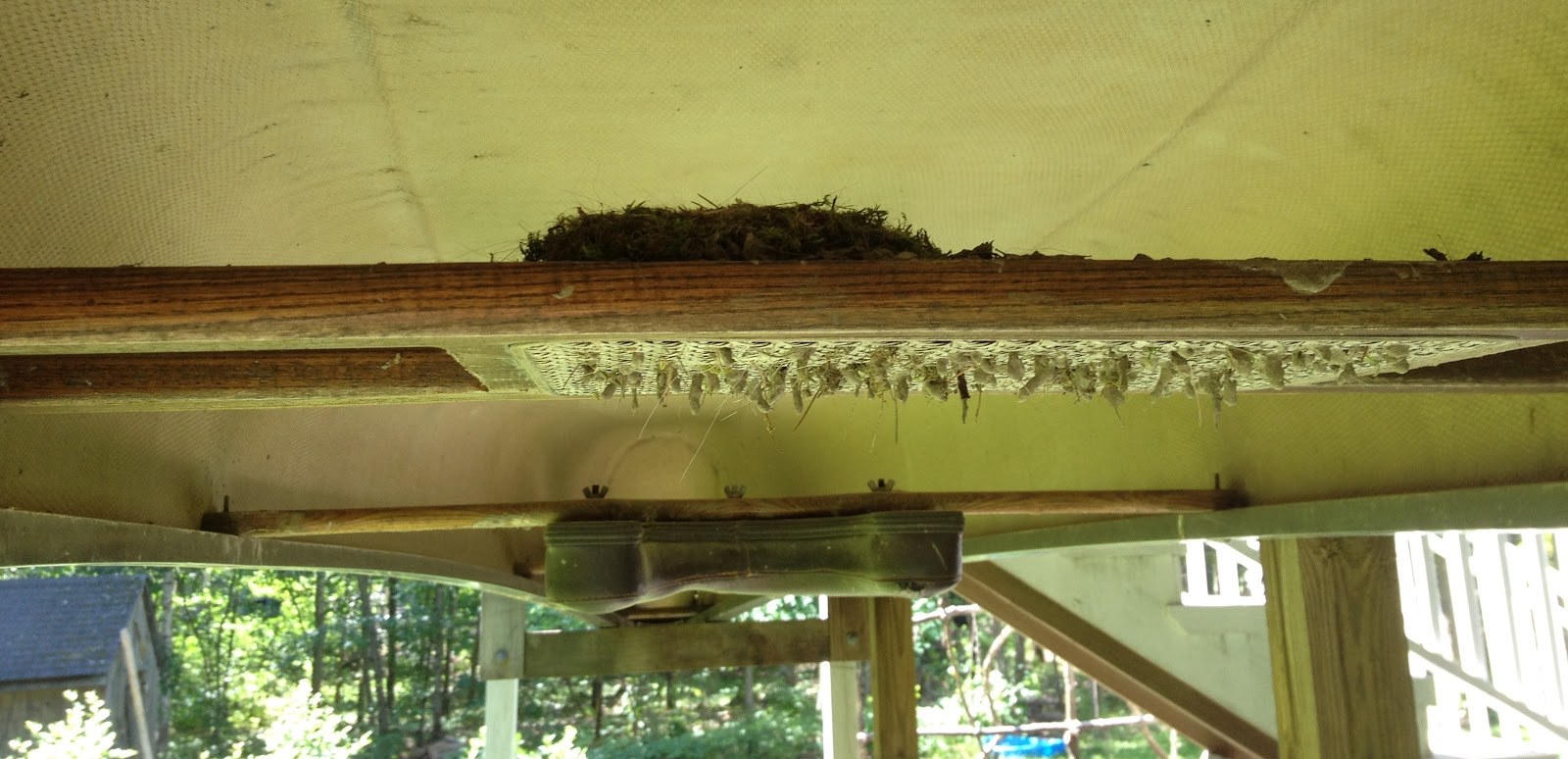
Meanwhile, just a few feet away the phoebe had re-nested. This time on the seat of our canoe that is hanging upside down under the deck. You can tell that we don't canoe much! The phoebes just hatched. Here is a somewhat fuzzy picture of the mossy nest and the five young.
The two families--the robins and the phoebes--seem perfectly at ease near each other. These under-deck nest sites also seem quite safe from predators. I think the chipmunks, which are major predators on bird eggs and young, are too busy eating all of our small peaches in the front yard to notice these hard to reach bird nests.
Speaking of the chipmunks. I live-trapped one this morning, after I watched it skipping away from the old peach tree with a walnut-sized peach in its mouth. That was just one of many peaches they've run off with. Chipmunks are so easy to trap. Against my better professional judgement I drove the trap-happy chipmunk down the road and released it in a nice woodsy area with a stone wall. I hate to kill the cute little rodents.
Such are the goings on in our yard this hot summer day.
Here's how the garden looks on the first full day of summer, just as the morning sun is peaking over the house.
The heat-loving okra and peppers should show a burst of growth the next few days, while the cool-loving peas might sag. Speaking of veggies. We made a delicious dish last night with fresh bok choi (from Stout Oak Farm), freshly picked sugar snap peas, tofu, and a bunch of other things served with buckwheat noodles. This recipe was adapted from Kate Donald at Stout Oak Farm. Sometime in the near future I hope to add some recipes as a side bar. I'll include this one.
A robin pair re-used the successful phoebe nest under the deck. Robins are more restless than phoebes; the mother robin clucked every time we walked onto the deck or nearby the nest. Yet, she was successful in carrying the brood through to hatching. The nest has three robin nestlings and both parents are busy bringing insects to the young. Here are the three hungry (and hot) baby robins as they wait for more food; one flopped its head down when it realized that my arrival was not its mother bringing food.
The two families--the robins and the phoebes--seem perfectly at ease near each other. These under-deck nest sites also seem quite safe from predators. I think the chipmunks, which are major predators on bird eggs and young, are too busy eating all of our small peaches in the front yard to notice these hard to reach bird nests.
Speaking of the chipmunks. I live-trapped one this morning, after I watched it skipping away from the old peach tree with a walnut-sized peach in its mouth. That was just one of many peaches they've run off with. Chipmunks are so easy to trap. Against my better professional judgement I drove the trap-happy chipmunk down the road and released it in a nice woodsy area with a stone wall. I hate to kill the cute little rodents.
Such are the goings on in our yard this hot summer day.
Subscribe to:
Posts (Atom)
Ice Out
Ice Out
-
Whenever it rains hard during the summer, pine cones seem to rain down, the cones knocked from branches in the upper canopy of tall white pi...
-
It was a mourning dove, the pile of feathers beneath the tall white pine. The feathers that I showed yesterday in my blog. You can tell by t...
-
The oldest known hardwood tree in North America--at 700 years old--is a black gum tree tucked away in a hummocky swamp in southern New Hamps...