Tuesday, June 19, 2012

First Cucumber

The timing seems right, the day before a string of 90-100 F days, to taste the first cucumber of the year. My farmer friend Renee tucked a fresh, just picked cucumber in my daypack when I was at New Roots Farm this morning. She planted a few cuke plants in her greenhouse so her son (and friends) could enjoy early cucumbers.

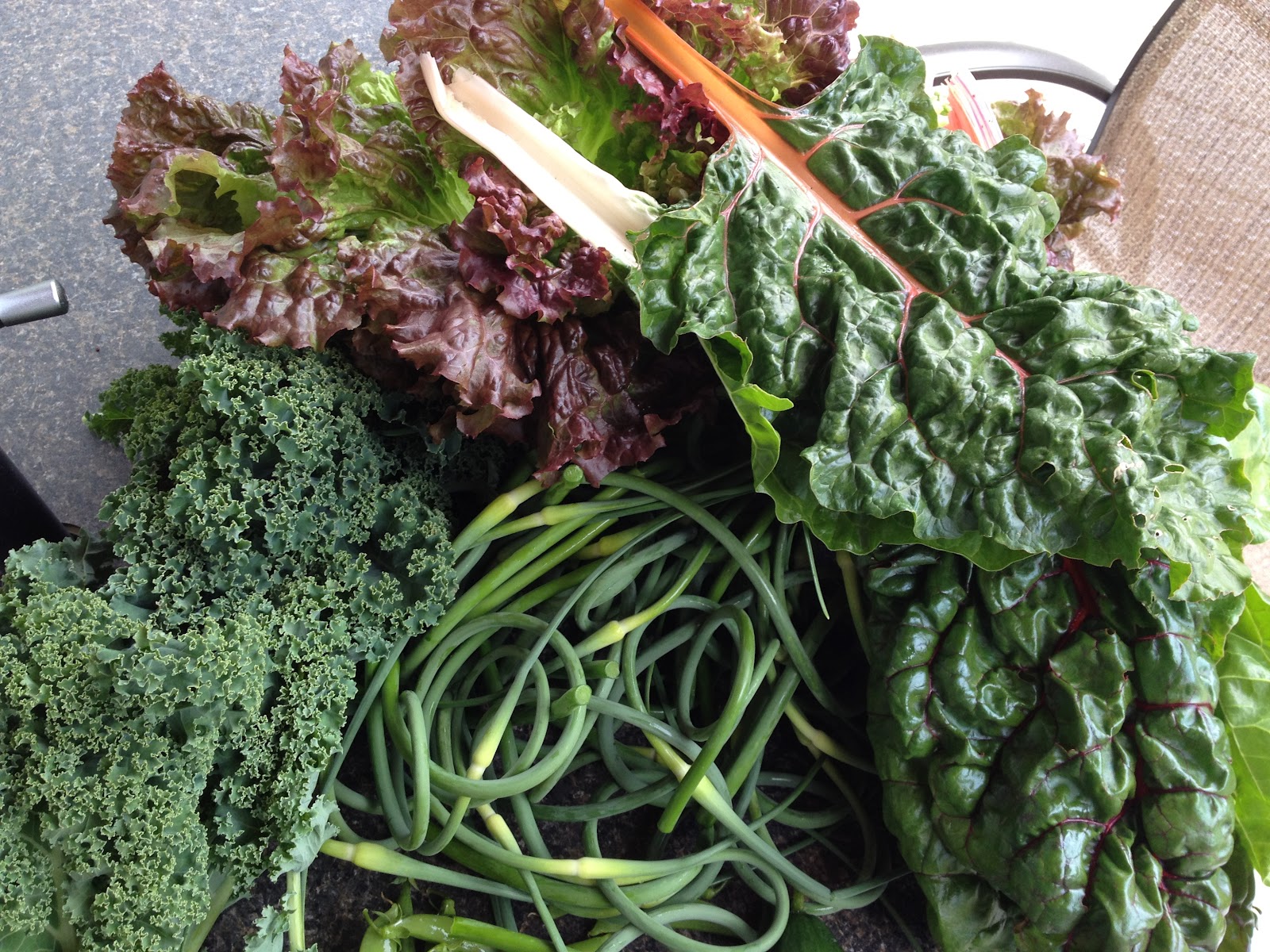
We've been enjoying much fresh food recently, harvests from our own garden and from New Roots. Renee has a special garden for her family and friends who help out, in which she is growing gorgeous lettuce, kale, and chard. Such good fortune that I am in that later group. Here is the bounty that I brought home on my bicycle at mid-day from New Roots. Just look at this harvest--the first cucumber, a pile of sugar snap peas, a bigger pile of garlic scapes, kale and Swiss chard, and a giant head of red lettuce.

Each has a place on the menu. The kale is to become kale chips for snacking. The garlic scapes will become garlic scape pesto, as a spread for sandwiches. The chard will substitute for spinach in an Indian dish called molagootal, the sugar snap peas can be eaten straight up, in salad, or in a pasta (with bok choi and buckwheat noodles), and the lettuce provides the base for my lunch salads. Yum.

Monday, June 18, 2012

Bedrock Gardens

We recently discovered Bedrock Gardens, a 30-acre gem in Lee, not far from our home. The gardens are the work of the couple that owns this private property, Jill Nooney and Bob Munger. In 1987 they began transforming an old dairy farm into a landscaped oasis, creating walking paths, access roads, terraced gardens and streams, vistas, sitting areas, and much more. Jill is a sculptor and her dramatic pieces are placed throughout the property; many are for sale on site or through her website, Fine Garden Art.

I'm not sure when they started opening their place to the public, but we just learned about the open houses recently. We visited the gardens last Saturday, one of the five open houses held from May to September. A local band was playing near the entrance, while a small flock of guinea hens scratched among the gardens and occasionally made a ruckus if too disturbed from their scratchings.

The gardens are now maintained with the help of volunteers and Jill and Bob are hoping to transfer Bedrock Gardens into a non-profit as a way to maintain this lovely space. It is a lot of work. You can read more about their lives and the history of Bedrock Gardens at their website here.

Here are some scenes from our Saturday wandering through Bedrock Garden. You will notice that many of the sculptures are made from old farm or industrial equipment  such as tractor seats, pitchforks, saw blades, wheels, axils; their barn is overflowing with piles of such raw material for future sculptures.

A pair of horse heads guard the entrance to the Perterre Garden.

Gardens decorated with sculptures slopes down from the barn.

The shade garden is filled with hostas and adorned with Gem Stems,
made from glass deck prisms.

A view from the shade garden.

One of my favorites: the Gymnasts mark the entrance to the Tea Garden.

The Tea House, provides a quiet get-away for guests or family.

Two rotating tractor seats provide a wide view of the Wiggle Waggle,
a 200-foot stream with spring house at the top.

A wind fence

A gathering of storks

Ballerinas and Guinea Hens

We plan to return to Bedrock Gardens during the other open houses, to see the gardens in different seasons. With so many gardens and paths and sculptures there is still so much to see.

Friday, June 15, 2012

A June Morning

The robins start singing about 4:15 am. Sometimes a pair of barred owls cackles from the back woods about then too. If the morning temperature is above 50 F, the gray tree frogs respond in kind and start their loud trills. By 4:30 am the phoebe is singing and then the tufted titmouse joins in closer to 5:00 am. I listen to this morning choir as I lie in bed. During the long, lush, lovely days of June, I often get up with the birds.

If you've never experienced early June mornings, between 4:00 and 6:00 am, you are missing one of the most beautiful periods of the day and the year. Morning dew coats the webs of spiders. Songbirds declare their territories in between gathering caterpillars and other insects to feed their nestlings. You might catch a glimpse of a female fox heading out on a hunting trip. The air is cool.

This morning we drove down the road for a longer walk on a nearby conservation area. We watched swallows swoop low over the Cole Farm pond, on their first forays of the day. The wet grass dampened our shoes. On this sunny morning the dampness seeping into our socks felt refreshing.

The day begins slowly and naturally, as the sun warms a sleeping insect and a closed up flower bud. Our own bodies unwind and relax and prepare for the rest of the day as we absorb the rays of the rising sun on this early June morning.


Thursday, June 14, 2012

A Wood Turtle

It is not often that you happen upon a wood turtle in the wild. They are secretive and live among wetland shrubs along rivers, habitats that are difficult to penetrate. Which is perhaps good for the wood turtle. It is one of several species favored by the pet trade, and some are still collected illegally. So, the more it can hide from humans the better.

On Saturday a group of us were inventorying a property as part of a Biothon (noting all the plants and animals observed) and one of the team members found a wood turtle. He brought it out for all of us to see. After we'd admired the handsome male wood turtle he took it back to the same spot where he found it.

My camera is on the blink and the iPhone camera did not do it justice. But my friend Scott Young, a fabulous photography, got some great shots. See his series of photos here. This was a large, handsome, male turtle. Often turtles pull into their shell when held. This wood turtle stuck his head and legs way out, showing off his gorgeous orange legs and striking head. The top shell (carapace) was highly sculpted, a feature that is acknowledged in the wood turtle's species name, "insculpta."

Team member Kim estimated his age at 20 years. That is a long time to avoid roads, collectors, and predators in the highly fragmented landscape of southeastern New Hampshire. To help ensure that this turtle lives at least another 20 years I will remain vague about the exact location of our turtle sighting. Needless to say it was the highlight of our morning.

Thursday, June 7, 2012

A Drowned Muskrat?

Before this year I'd never come across a dead beaver or a dead muskrat in the wild (except for seeing roadkill). This year I've seen both. Back in early April my niece and I discovered a beaver floating in a pond -- you can read about that here. Then yesterday I saw a dead muskrat. It was lying in a small pool of water near the Exeter River in Exeter. Kodi and I were setting off on a walk at Phillips Exeter Academy, a popular dog-walking spot. The muskrat was in the middle of an access road.
Kodi paid no attention so we continued on. When we returned after 30 minutes or so the muskrat was still there. I moved it off into the weeds after taking a few photos. I saw no external injuries to indicate why the muskrat died.

Muskrats are much smaller than beaver; both are rodents with large teeth for eating vegetation. This muskrat was about the size of a small (trim) woodchuck. The most noticeable difference between beaver and muskrat are the tails. Beavers have a broad flat tail, while muskrats have a thin rat-like tail. Here are the two in comparison.
In her most recent column in Northern Woodlands magazine, expert tracker Susan Morse perhaps put it best when she wrote about a muskrat swimming towards her, "The creature resembled an oversized meadow vole, yet acted more like a tiny beaver." The muskrat's rather tidy size and its flexible diet that includes plants as well as aquatic animals enables it to survive in a wide range of habitats and places from freshwater to saltwater.

I'd much prefer to see a muskrat swimming then to stumble across a dead one. Yet, this up close encounter offered a unique opportunity to study its features and to ponder its fate.

Monday, June 4, 2012

Inspiration

We made a quick trip over the wet weekend to visit my parents at Winterberry Farm--the place they've been living for more than 55 years. They were planning a several week driving trip to the midwest this month, but decided to postpone until next year. Because of the planned trip there was not to be a vegetable garden this year. After the change in plans, my Dad got to work planting--sweet corn, pickling cukes, winter squash, pumpkins, a few tomatoes, sunflowers, zinnias and cosmos, and a big patch of his favorite red clover.

When we arrived on Friday the corn was already several inches high and other plants had sprouted. The rows were carefully weeded. I brought a few more seedlings--extras from my garden--which found a home in an empty row. I planted nasturtiums and more zinnias in the flower garden at the back door. My mother likes to look out the kitchen window at the lush backyard. Together, both aged 90, they sit on the Leopold Bench and take in the view.

For many years now Brookfield Farm, a local organic farm, has leased some of the Winterberry Farm fields for crops and pasture. Each year a new crew of young aspiring farmers works at Brookfield and most meet up with my parents as they drive past the house to reach lower fields or to water the cows or when my parents pick up their share of fresh vegetables provided by Brookfield.

Two young farmers who met my parents years ago were Missy and Casey. Missy was growing beautiful cut flowers and selling bouquets. One summer she had a small farm stand at my parent's place, shown here.
Casey and Missy own and operate Old Friends Farm not far from Winterberry Farm in Amherst, Massachusetts. This weekend I learned why it is named Old Friends Farm. Their website is as beautiful as the flowers and other produce that they grow. Under Who's Who at Old Friends Farm it describes each of the farmers and their helpers and tells the story of how they got their name. It is a wonderful tribute to my parents. I've included it here, but check out the website of Old Friends Farm and catch them at a farmer's market if you are in the area. They too inspire.

Many people are curious about our farm name.  Here's the story...


The farm is named in honor of Mary and Dana Snyder, of South Amherst, for their admirable friendship for many, many decades- to each other, to the people around them, and to the land they live on. They let us use some of their land for the first year of the farm, and it started us off!

Mary and Dana are very inspiring to us on many levels... their friendship, their political involvement, their dedication to preserving agriculture in our community, and their remarkable youthfulness.  It became clear that 'Old Friends' would be a great name to remind and honor, and so our farm was named.

Mary and Dana are busy people, and you might see them just about anywhere- on top of the roof, on the farm, in the kitchen, at a contradance, in town protesting, at Ag. meetings, at a swing dance, at the opera, playing boggle, or traveling to visit their kids and grandkids.  If you do see them, do us a favor, (and yourself a favor too!), commend them for their lovely friendship and dedication to our community and the land.  Thank you for being YOU, Mary and Dana!

I'll second that -- thanks for being you Mom and Dad.

Friday, May 25, 2012

Phoebes Fledged

The phoebe nest is empty. I am hopeful that the three young fledged successfully a few days ago. They were bulging out of the nest the last time I peeked at their nest under the deck. The robins are clucking loudly in the yard and chasing chipmunks, protecting their young as best they can.

Warm rain fell for a fourth week in a row, mostly Tuesday to Thursday. The perennials are lush, the still tiny peaches look healthy so far, and the peas are reaching high up the pea fence. I made cilantro-arugula pesto last night from our own plantings. This week we made a delicious asparagus frittata and incorporated spinach into several dishes with fresh ingredients from my farmer friends Renee and Kate. The flavor and texture of these fresh vegetables is welcome after months of winter tubers and store-bought foods.

Our vegetable garden expansion is nearly complete. After slogging away at turning over lawn a shovelful at a time, our neighbor kindly brought over his cultivator and finished the work. Yesterday we added about 10 wheelbarrows of our own compost. We are laying in irrigation tape for the first time this year, a hedge against droughty conditions.

I've seen few insect pollinators during the recent rainy periods, although the warm air temperatures has brought out some to the yard. Yesterday a tiger swallowtail flitted among the flowers and a hummingbird clearwing hovered among the bleeding heart. My camera is on the blink so here is a picture of a clearwing from a few years ago. Such a beautiful moth.
This is one of the most beautiful times of year in New England. Enjoy.

Ice Out

 Ice Out