Flying across the country from Boston to Seattle, several images come into sharp focus. This country is vast; despite the speed of air travel, it took us all day hopping from Boston to Chicago, then on to Denver, before finally landing in Seattle. The sky was clear across the entire country, offering spectacular views of the changing landscape below.
From western New York to to the foothills of the Rocky Mountains the land is broken into geometric patterns by roads, woodlots, and farm fields. In this region, roads run straight, outlining sections of land one mile by one mile or 640 acres. These in turn are divided by roads or fields into smaller parcels of 160 acres, 80 acres, 40 acres, and down. Streams and rivers snake through these sections, breaking up the quilt-like patterns of land surveyed hundreds of years ago. Some waterways are bordered by thin ribbons of green vegetation, others are cropped to the shoreline or drained entirely. Sprawling development spreads out from large towns and major metropolitan areas gobbling up 20, 40, 80, 160 acres, and then whole sections of open country are gone.
Not until we left Denver and climbed over the Rocky Mountains did we see vast areas of undeveloped land. This rugged country extending from the Rockies to the Cascades is dry. Small pockets of smoke rose from forest fires in the Rockies, fields were brown except for those few worthy of irrigation. Much of western Wyoming looked barren and empty.
Leaving the Rockies behind we flew over the Snake River, watched it wind through remote country in western Idaho, and then into Washington and over the massive Columbia River as it winds its way toward the Pacific, hampered by numerous dams along its length. Continuing on our northwest journey, the arc of volcanic mountains emerged -- Mt Hood, Mt St. Helen's, Mt Adams, and then Mt Rainier.
Sitting on the left side of the plane (thanks to tip from a Southwest flight attendant) we watched as Rainier, covered in snow, loomed into view, larger and larger as we approached. The descent into SeaTac airport brings you close to the mountain. Rainier, at more than 14,000 feet, dominates the landscape. This in a landscape of incredible beauty of evergreen forests, coastal mountain ranges, islands among sparkling lakes, and coastal waters.
The long day ended under clear skies. We started the day watching the sun rise over the Atlantic Ocean, followed its path westward, and saw it set over the Pacific Ocean. The image as we crossed the country is one of human exploration and domination of the natural landscape -- cultivated, carved, drained, developed, changed. And yet, tracking the sun's path, seeing the volcanic mountains, the ruggedness of the mountain ranges, looking down at vast areas of barren lands, there are signs that nature still has a hold on this great land.
Saturday, September 19, 2009


Thursday, September 10, 2009
Vinalhaven
Vinalhaven is a working island in Penobscot Bay, Maine. The year-round population of 1,200 people are hardy folk. Many are lobstermen and women, leaving the harbor before dawn in their boats to haul in the days catch. These are not good times for lobstering, with low prices and high costs. Tensions are high among the fleet. On a nearby island a man shot his son-in-law (not fatally) for encroaching on his lobstering area.
 For those of us without private boats, we reach the island via the Maine State Ferry. The ferry leaves Rockland six times per day and a similar one leaves the island at the same times, passing each other along the way. The 15 mile ride takes one hour and 15 minutes. On the trip over and back we saw black guillemots in fall plumage, a few harbor porpoises, many herring gulls, and hundreds of lobster buoys.
The board chairman of our local land trust and his wife donated a 3 night stay at their Vinalhaven home as part of the annual fundraiser. A year ago we bid on this gem and to our surprise ended up as the highest bidder. We spent 3 days on the island last week, our first experience with the idiosyncrasies of the ferry system, which included waiting in line at 3:45 am to reserve a spot on the next days return ferry.
 The ferry holds about a dozen cars, but there is also a weight limit, so if a cement truck needs to make the trip then fewer cars are loaded. It is quite unpredictable which ferries will be full. That seems to fit with the uncertainties of island living. Islanders move at a different pace than mainlanders, their lives governed by tides and weather and other forces beyond their control.
In earlier times Vinalhaven was a center of granite quarrying. Huge blocks of granite were carved out of the ground and shipped to New York City and beyond. Now the old quarries, filled with cold spring water, are swimming holes (but the signs say "No soap and No dogs").
The island is all about life in the sea. Vinalhaven has a dozen or more protected areas with narrow foot paths that lead through spruce-fir forests, around saltmarshes, and to the waters edge. One trail lead us to The Basin. The tide was out allowing us to walk through saltmarsh, scramble down large rocks, and across mudflats hardened by spent sea shells. At the water's edge we watched patterns of light and wave ripple over mussels, snails, barnacles, and seaweed.


 The weather was picture perfect during our stay. No Downeast fog or weeks of rain such as fell in June and July, stressing the lobstermen and everyone else.

 Vinalhaven does not overtly cater to tourists, although there are a few restaurants, one motel, and one IGA with all the food you would need, all within walking distance of the ferry. You can walk on the ferry and stay on the island without a car, but a mountain bike would be useful to reach many beautiful trails and sights; bikes are not allowed on most of the trails. The "working waterfront" is part of the island's appeal--watching the lobster boats head out at dawn and return at midday to unload at the Vinalhaven Fisherman's Coop.
We left the island on the 7:00 am ferry, stopping in Rockland at the Atlantic Baking Company for some coffee, scones, and sourdough bread for the road. A very fine pastry and artisan bread bakery. Downtown Rockland is walkable and full of fine art, crafts, and other locally made products. The Farnsworth Art Museum is home to the Wyeth Center celebrating three generations of Wyeths. Just up the road from the bakery and the art gallery is the home of the Island Institute and the Archipelago Fine Arts Gallery, this summer featuring an exhibit called Catching the Light: The Frenchboro Paintings by Daud Akhriev, a Russian-born artist.
 Danny, by Daud Akhriev
 Danny, by Daud Akhriev
Monday, September 7, 2009
Monarchs and Milkweeds
Yesterday we walked just up the road a piece to the Wiggin Farm Conservation Area. A few years ago, after the town purchased the land from a developer and averted 22 houses, the local boy scout troup helped lay out a trail and installed a bridge over a small stream.

 The trail winds through a 30-acre field, which the town mows once a year in the fall. This gives the bobolinks, turkeys, deer, bees, butterflies, and other meadow creatures time to raise a new generation or two and feed before migrating or settling in for winter.
The meadow is full of flowers at this time of year. Beneath a deep blue sky, the goldenrod and milkweed form a nearly continuous canopy three feet high. Bees are busy gathering nectar. Common milkweed pods are plump with seed and ready to burst.


 Milkweed plants (Asclepias spp.) are the required food of monarch caterpillars. Despite the profusion of milkweed, we have seen few monarchs this year. According to the Monarch Blog Watch monarch populations this year are lower throughout their range. The North American Monarch Conservation Plan says the population does fluctuate year to year, but many factors are causing long-term decline.
 Monarchs are the only butterfly to make a round trip migration. Several generations are born here on the breeding grounds, but the final, migratory generation (the ones you see now) make a very long trip to central Mexico where they overwinter with millions of other monarchs. These same adults then start the trip north again in the spring.
As with other migrants, monarchs face many challenges on this long journey--loss of habitat all along the way, pesticides, parasites, climate change, loss of milkweed populations, genetically modified organisms. The latter include soybeans that tolerate herbicides, whereas milkweed plants do not.
Although monarch butterfly larvae require milkweed as a food source, the adults rely on a variety of plants for nectar. In the fall, monarchs need carbs to fuel their long flight to Mexico. Goldenrods and asters are good sources. This is an important reason to leave at least a portion of wildflower meadows unmowed until late fall so these beautiful orange and black butterflies can bulk up before flight.
If this is the year of the missing monarch, 2006 was a population explosion, especially in our yard. My next post will include a pictorial tale of a monarch transformation.
Wednesday, September 2, 2009
Our Mechanic
Jim our car mechanic is from the old school. When I arrive he says "Hello Ms. Snyder, how are you?" Today I was there for the annual car inspection and to check out a squeaky belt that chirps when I turn the steering wheel. I usually wait when Jim works on my car as he lets you watch him work, getting right in under or next to the car. He wants you there watching and learning. Jim is especially keen that women learn about cars and not be intimidated by them. He explains everything about the car, in between talking about bluebirds, hiking, dogs, gardening, monarchs, with a few rants about government thrown in.
Jim is the second generation owner of this family business. Now in his late 60s he still comes to the garage every day and works hard. His hands and legs are large and strong; his mind is sharp. Now slightly bent when he walks, perhaps caused by arthritis but also likely from decades of stooping under cars on lifts. His son works in the bay next to him; two other youngish guys round out the crew. Jim is polite and curious, the others get the job done but are less talkative and less interested in getting to know their customers.
I was expecting a quick trip to see Jim today. Two hours later I left with my new inspection sticker, a new alternator belt, and a whole lot of info about the best clam flats in Ipswich. Part way into our chat, Joe, another long-time resident stopped to give Jim the state guidelines on clamming. And then Joe's niece arrived and we kept on talking about tomato blight, the yellowjacket paper nest about Jim's work bay door, bluebirds, bats, "fork-tail" swallows, and "B-52 bomber" dragonflies which Jim calls the big ones, he having noticed that they arrived late this year. The fishing and clamming stories kept coming from Joe and Jim and I was getting mighty hungry thinking about fried clams.
We sat outside under a clear blue sky with temps in the low 70s - a perfect fall day. Jim was all smiles once we got back to the belt and the inspection. He said he didn't get to do that very often. Sit around and chat. Too busy working on cars and clamming boats. The first question Jim asked me when I arrived this morning was whether we had monarchs in our yard this summer. He doesn't know what they look like, but he remembers that we had dozens of pupating monarchs two summers ago. He keeps track of seasonal changes, like when the B-52 bombers show-up. Jim lets the yellowjackets buzz about high above his head and wonders why the (barn) swallows haven't been back.
Jim Price's Sunnycrest Garage is two miles from home. I think Jim teaches us so we can do some of the car repairs ourselves, but we keep taking it there because we like to hear his stories and learn even more. Maybe I'll go dig some clams. Jim was pretty specific about which mudflats are best, but I won't tell.
Saturday, August 29, 2009
Winterberry Farm in August
I am back "home" at Winterberry Farm for a few days, visiting family, celebrating my mother's 88th birthday (who has recovered marvelously from her femur fracture in March and is stronger now than before the fall), and helping with late summer yard work.
At dawn, before anyone else is stirring in the house, after the coffee is brewing, Bella and I wander down the field roads and woodland trail to the "back forty." In these last days of August the gray birches are turning yellow, the wild and invasive shrubs and vines are laden with fruit, and the summer crops are giving way to the hardy fall crops.
Families of songbirds forage in the fields, and shrubs, and wetland edges, preparing for fall flight. Four young of the year barn swallows sit side-by-side on a thin branch a few feet above the water, as mother swallow swoops in with an insect for one of her young, their mouths wide open. A gorgeous coyote, with a thick gray-brown coat and long bushy black-tipped tail, hunts for mice and voles among tall goldenrod, queen-anne's-lace, and grasses.
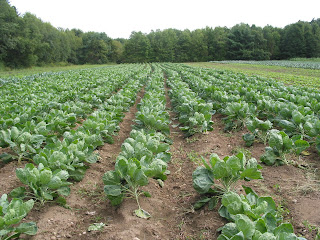
 Entire fields replanted with fall crops of Brussels sprouts,
red and green cabbages.
 In the thickets around the fields,
wild common elderberries (Sambucus canadensis)
droop with dark purple berries.
 Wild apples are red and crisp and sour.
 The invasive shrubs are also laden with fruit.
Autumn olive (Elaegnus umbellata)
with stems dripping in bright fruit
call out for fruit-eating birds and mammals.
 My sister Amy has grown amazing garlic for several years on Winterberry Farm. Planted last October, pulled from the ground in July to dry for a month or more, this weekend we trimmed and sorted. More than 350 bulbs! One hundred (with 5-6 large cloves in each bulb) of the biggest were saved for planting the next crop. I have a bag of 100 bulbs to take home for cooking in the coming year. This is farm gold!

At dawn, before anyone else is stirring in the house, after the coffee is brewing, Bella and I wander down the field roads and woodland trail to the "back forty." In these last days of August the gray birches are turning yellow, the wild and invasive shrubs and vines are laden with fruit, and the summer crops are giving way to the hardy fall crops.
Families of songbirds forage in the fields, and shrubs, and wetland edges, preparing for fall flight. Four young of the year barn swallows sit side-by-side on a thin branch a few feet above the water, as mother swallow swoops in with an insect for one of her young, their mouths wide open. A gorgeous coyote, with a thick gray-brown coat and long bushy black-tipped tail, hunts for mice and voles among tall goldenrod, queen-anne's-lace, and grasses.
The farmers, interns, and volunteers have toiled all summer to grow food for Brookfield Farm, a CSA that leases some of our land. The fruits of their labor are visible in every field.
The storage onions, large and firm,
are pushing up through the soil.
 Small, orange pumpkins emerge as the vines wither.
are pushing up through the soil.
 Small, orange pumpkins emerge as the vines wither.
 Entire fields replanted with fall crops of Brussels sprouts,
red and green cabbages.
 In the thickets around the fields,
wild common elderberries (Sambucus canadensis)
droop with dark purple berries.
 Wild apples are red and crisp and sour.
 The invasive shrubs are also laden with fruit.
Autumn olive (Elaegnus umbellata)
with stems dripping in bright fruit
call out for fruit-eating birds and mammals.
 My sister Amy has grown amazing garlic for several years on Winterberry Farm. Planted last October, pulled from the ground in July to dry for a month or more, this weekend we trimmed and sorted. More than 350 bulbs! One hundred (with 5-6 large cloves in each bulb) of the biggest were saved for planting the next crop. I have a bag of 100 bulbs to take home for cooking in the coming year. This is farm gold!

Monday, August 24, 2009
Albinism
Albinism is an inherited condition that affects the production of the pigment, melanin. People or other animals with albinism have little or no pigment in their eyes, skin, and hair. A cell called melanocyte produces the pigment; these cells are present in people with albinism, but a genetic mutation interferes with the production or distribution of melanin.
We recognize people with albinism by their snow white hair, light skin, and pale pinkish blue eyes. In some cultures, particularly in East Africa, albinistic people are treated as outcasts and worse. Our neighbors next door have two children with albinism. Despite the stigma that popular culture attaches to this condition, these kids have the most fun outdoors of any kids in our neighborhood. They swim, kayak, bike, and otherwise play outside all summer long. Far from thinking of their condition as a disease or disorder, their appearance has no bearing on their outlook on life, as far as we can tell.
There are no major health concerns associated with albinism, except for apparently an increased risk of skin cancer and some potential vision problems. The melanocytes produce something akin to umbrellas in our skin, protecting us from ultraviolet radiation. Lacking these internal "umbrellas" albinistic people require extra care out in the sun. We all should take more care in the sun.
My nephew-in-law Sid sent the following photos that he took of an albinistic cobra in southern India. The patterns are stunning on a cobra anyway and this one is especially beautiful. Note the pink eyes. The redness comes from light entering the pupil and reflecting off the blood vessels in the retina. Typically the pupil appears black because pigment molecules in the retina absorb light entering the eye, preventing it from reflecting back out.


 There is some thought that animals with albinism may be more visible to predators or prey, and hence have a shorter lifespan. I was not able to confirm that in a quick online search. Some predators may not notice an albinistic prey because their search image may be for a brown animal not a white animal. Many different animals can produce albinistic offspring, but just seeing an animal that is white does not mean that it has albinism. Some other mutations can cause patches of hair or skin to lack pigment. Regardless, they are striking, and are often treated differently.
Our neighbor kids have shown us that their "differences" are quite normal!
Thursday, August 20, 2009
Cool Rivers
This week the heat is sizzling and I am sure many, many, too many for me, people are at the beach. Call me odd, but lying under a hot sun at the seashore along with hoards of other people is the last place I want to be when it is really hot. You come away sunburned, sticky from the salt, bitten by huge greenhead flies, cranky from the traffic, and not really cooled off. Okay, the surfing looks fun.
During the dog days of summer I seek cool, inland rivers and lakes. I've always preferred freshwater for recreating. Maybe it stems from our family camping trips to Moosehead Lake in Maine, Hapgood Pond in Vermont, and that I learned (sort of) to swim in a lake near our home. We never made family trips to the beach. Instead we camped, canoed, hiked, looked for moose and loons, and generally splashed around in cool, fresh water. And is there a better place on earth than the Boundary Waters Canoe Area in Minnesota?!
 Although the tides are interesting and create neat habitats, I can't be bothered about tying up boats so they aren't left high and dry when the tide goes out. And there is the not so small dilemma of sea level rise. As with many places (such as California!) I like to visit on occasion and at certain times of year (the beach in winter), but I prefer not to live too close.
As others were no doubt elbowing for beach space this week, I headed inland to the Isinglass River. With some colleagues and Bella, I walked along the hemlock-shaded cool shoreline watching dragonflies dance above the flowing water and lingered by the brilliant cardinal flowers.

 By the time we finished our walk along the Isinglass the sun was overhead, but the cool air along the river stayed with me. As we returned to the cars along Pig Lane, an old gravel road, we quenched our thirst and appetite with some sweet-tasting, wild-growing blackberries. I drove home with the windows down and not a bit of traffic to lose my cool.
Subscribe to:
Posts (Atom)
-
 Whenever it rains hard during the summer, pine cones seem to rain down, the cones knocked from branches in the upper canopy of tall white pi...
-
 It was a mourning dove, the pile of feathers beneath the tall white pine. The feathers that I showed yesterday in my blog. You can tell by t...
-
 The oldest known hardwood tree in North America--at 700 years old--is a black gum tree tucked away in a hummocky swamp in southern New Hamps...