Ice Out
Sunday, January 25, 2026


Saturday, January 24, 2026
Red Squirrels
In 2011, we had many mature white pines removed from our yard, trees that were shading our driveway and house in winter and others that had the potential to fall on our house during a storm or high winds. It was a good decision, but it changed the habitat. A few favorite animals that visited close-in regularly, became less common, especially two favorites: brown creepers and red squirrels. Both prefer conifer forests, although not exclusively.
The sawyers that day (Urban Tree Service) did a fine job on a incredibly cold winter day (similar to today), climbing the trees, hanging off a trunk with a chain saw, lifting the tops and then the trunks off with a tall crane.
 |
| Urban Tree Service lifts the top of one of our pines after it was cut by the sawyer. |
Brown creepers and red squirrels are still plenty common in the surrounding woods so I get to enjoy them regularly. But I did miss seeing them in our yard. So far we've had a real winter -- cold, regular snowfall, and now a big storm and sub-freezing temperatures on the way. Whether it is the weather or other conditions, I do not know, but both of these animals are visiting our front yard again. Such joy!
The red squirrel might be my favorite mammal, well, at least my favorite yard mammal. I love their perkiness, their reddish-brown fur and white belly, and the white ring around each eye. A week ago three red squirrels (maybe a family group) foraged among the perennials and shrubs, along with gray squirrels and an array of birds. Lately, one visits every day, scurrying through snow tunnels then popping up to feed on a seed. In the photos below you can see the little ear tufts that they grow in winter.


The red squirrel is reported to be very territorial. I have noticed this in non-winter seasons when they scold at any intruders to their territories including humans. In winter, in our yard, they are deferential to the gray squirrels and a little skittish when there are quick movements by birds or others.
UPDATES to Yard 2026 animal list:
Birds
21. Northern cardinal
22. White-throated sparrow
23. Pileated woodpecker
24. Tree sparrow
25. Brown creeper
26. Red-tailed hawk (flyover)
Mammals
5. Virginia opossum
Sunday, January 4, 2026
Our Wetland in Winter
We moved to our house in 1994, 31+ years ago. Our backyard abuts a large wetland that froze enough each winter that we could walk, snowshoe, or ski across to the woods on the other side. This opportunity lasted about ten years, then ended for two reasons: the land across was sold for a housing development and winters got warmer. The wetland stopped freezing solid enough to hold our weight.

Animal tracks were covered with the fresh snow, but were still discernable: coyote, deer, cottontail rabbit, mouse. A mix of sun and clouds. Bluebirds backlit, flew among the tall alders. A few bird nests tucked low in the buttonbush clusters, topped with snow. The beaver lodge frozen solid. Quiet solitude.
The shrubs stand dormant with more than two months before buds can burst in Spring. Speckled alder bushes hold male and female flower buds that formed at the end of last summer, as well as last year's cones and new leaf buds. I share the alder's anticipation for warm Spring days.

A speckled alder.
Above: long, male catkins and female flower buds
and leaf buds along the stem wait for Spring.
Below: last year's fruits (female cones).


A buttonbush casts its shadow on the canvas of fresh snow.
Saturday, January 3, 2026
A Tiny Nest
Two friends recently traveled to Ecuador on a 5-day birding trip, where they tallied 275 species, including 41 different hummingbirds. Here in New Hampshire we have just one species, the ruby-throated. We cherish this little beauty, especially when it visits our summer gardens and nests somewhere in nearby trees. We see them zoom here and there but never track their visits to a nest.
A few days ago I was looking at a mature red oak tree in our backyard and thought I spotted a tiny nest. With leaves mostly gone from hardwood trees and shrubs in winter, it is fun to spot bird nests and ponder which bird built the nest. Clues include nest size, materials used to build the nest, height above ground, and how the nest is situated on a branch.
This afternoon, after Henna and I finished a 3 mile road walk, she wanted to spend some time in the pen in the backyard. We entered from the back and there on the ground under the mature oak tree was the tiny nest. It is the cutest of nests, about 1.5 inches across and an inch deep, made of cattail fluff on the inside and tree lichens on the outside plastered like icing on a cake. The nest is the same size as a pecan tassie or a mini muffin.
Today's treasure in our yard.

Friday, January 2, 2026
Embracing Winter
Some winter days we yearn for a get away or extended visit to a warm climate. Last Monday was one of those days. It rained all day, ruining the snow for walking and animal tracking, and was just miserable. All of December felt unusually cold, but I think I've gone soft. A cold, not warm, December should be the norm here.
A dusting of snow on New Year's Eve covered up the ice, making it slightly more treacherous to walk, but it also restored winter beauty to the woods. I spread a little extra bird seed to help the birds get through the icy, cold spells and build up a little fat against the blustery winds. We don our extra clothing and venture out with Henna regardless of the temperature, choosing trails or the road based on conditions of the day. A fire in our wood stove is bright and cheery and keeps us extra warm and cozy.
Yesterday I listened to Ezra Klein's (NYT) podcast with Stephen Batchelor, author of books on Buddhism and meditation. During part of the interview, Bachelor explains the four tasks in Buddhist teaching:
1. Embrace life
2. Let go of reactivity
3. Dwell in the non-reactive space
4. Cultivate a way of life, a path
There are many lessons threaded throughout this conversation that I will continue to explore. I especially appreciate that "doubt" is an important tenet and is to be embraced as it leads to curiosity and awakening. He quotes a Buddhist aphorism: “Great doubt, great awakening. Little doubt, little awakening. No doubt, no awakening.” I always have doubts.
My immediate response (although maybe I am supposed to pause first) to this podcast is to embrace winter. Batchelor notes that Task 3--dwelling in the non-reactive space is nirvana. He goes on to say that,
"people I know who have no interest in meditating have had experiences where all of their muddled and worried thoughts, for some reason, just die down. People might find this in doing sports, for example — running every day. They might find it by going for hikes in the countryside or just working in their gardens. There are all manner of activities we do that have nothing to do with meditation in a formal sense but are moments whereby, suddenly, we find we are at peace with ourselves. That, to me, is the nonreactive space."
I appreciate this take, as I find joy, inspiration, and spiritual guidance in nature. Rather than yearning for heat and humidity in January in New Hampshire, I am embracing each aspect of each winter day. The full moon rising. Ten turkeys scratching the snow for tossed seeds. An Accipter snatching a starling from our yard, slamming it a few times on the ground while a large crow arrives to intimidate the hawk, the starling reviving and hissing at its foe. The Accipiter releasing the starling that flies off as the crow gives chase. Life carries on.

New yard birds for 2026
19. American crow
20. sharp-shinned hawk (based on size and shape)
Mammals to date:
1. gray squirrel
2. red squirrel
3. eastern cottontail
4. white-tailed deer
Thursday, January 1, 2026
2026 Day 1 - First Evening Grosbeak
A new day, a new year, an inch of fresh snow with new flurries through the morning, and a glimpse here and there of blue sky. Around 7:45 this morning I looked out at the feeders and saw a large goldfinch in the crabapple tree that looked too big to be a goldfinch and thought, "a female evening grosbeak!" Birders in northern and western New Hampshire have reported sightings of this favorite bird for several weeks or longer. It's an eruption year due to poor food sources in Canada, so I've been on the lookout for grosbeaks. A wonderful gift for one to arrive in our yard this New Year's Day.
I watched the front yard from our dining room on and off all day from sunup to sundown. We tallied an amazing number of bird species: 18 for the day. Surprisingly, cardinals, so plentiful a few weeks ago, were absent. Three crows that had been visiting regularly were also missing today. But it was a joyful mix of birds that shared the bounty of sunflower seeds and beef suet.
In decreasing order of abundance in our yard today: European starling (13), northern junco (12), wild turkey (10 - our regular flock, arrived at 9:45), house finch (9), black-capped chickadee (5), eastern bluebird (4), purple finch (3), tufted titmouse (3), downy woodpecker (3), American goldfinch (3), red-bellied woodpecker (a pair), mourning dove (2), white-breasted nuthatch (1), hairy woodpecker (1), blue jay (1), and three favorites: evening grosbeak! (female), northern flicker (female), and yellow-bellied sapsucker (female).
Only two gray squirrels ventured out. The wind kicked up around noon so they must have stayed snug in their tree nests.

A gray squirrel track intersects the tracks of songbirds.
2025 Year End
The month of December and 2025 closed out on a cold and mostly cloudy winter day. Here's hoping that in 2026 we find more joy, compassion, community, and spiritual guidance in nature.
We are thankful for our home that brings in lots of light and offers many windows into our yard to observe wild things. During the growing season we share our garden bounty with rabbits, chipmunks, deer, and an occasional woodchuck. An opossum wanders through year-round, taking refuge under one of our sheds. The moles tunnel just below the surface of the grass, aerating the lawn, while skunks forage for grubs leaving small divots in the yard.
I set out two wildlife cameras -- 20+ year-old so not the best imagery, but it documents the night-time visitors. Two deer, a mother and fawn, visited often, and a small buck a few times.


The bird feeders went up around December 1st. A day too early as a bear or two found them. Thereafter the temperatures dropped and the bears, presumably, tucked into their dens for the winter. A female yellow-bellied sapsucker continued to visit the suet, staying later than usual. Others have reported the same.
Our gardens survived and flourished despite cold rain in May and drought in late summer. But it has become hard to grow any Brassicas due to the abundance of cabbage white butterflies. The garlic crop was successful with a new crop of 197 bulbs planted on November 2nd. Soon, it will be time to peruse seed catalogs, plan the garden, and dream of warm soil and green shoots.
Sunday, December 21, 2025
Winter Solstice 2025
Cardinals and juncos are the first to arrive at the feeders. They fly in before first light. They are also the last to leave for their night roosts in the early evening, well after sunset. Late afternoon yesterday, it was a cardinal convention at the feeders: 7 male and 5 female cardinals. These were mixed in with many of our winter songbirds. The flock of ten turkeys passed through mid-afternoon.
About 4:00 in the afternoon yesterday, while I was watching the bird feeder birds, a red-shouldered hawk landed on a tall white pine tree in our neighbor's yard, across from our house. It scooched over about a foot until it was pressed up against the tree trunk. We watched til it got too dark to see. As soon as it was light enough to see this solstice morning, I looked across at the white pine, and the hawk was still leaning against the trunk. It got a good 14 to 15 hours sleep, as it didn't budge until 7 AM, when it fluffed its feathers and scooched over about a foot from the trunk.
Two male cardinals tried to harass the red-shouldered from a distance, but it didn't move from its perch, about 35 feet up in the pine. Around 7:15, I saw a pileated woodpecker fly to the same tree trunk and then the hawk was gone. I missed its movements while I was looking down at a white-throated sparrow and the woodpecker distracted me. The birds in our yard at the time -- downy woodpeckers, finches, juncos, chickadees, titmice -- were not bothered by having a red-shouldered hawk (a mostly mammal and amphibian predator) nearby. If it were an accipiter all hell would break loose: small birds scattering and woodpeckers going stock-still for ten minutes or more.
After a few very cold weeks this December, last week ended with several warm days and nights, melting away the snow in the south-facing areas. A fresh opossum track is printed in the remaining snow, heading toward the cover beneath an old shed. They aren't well-adapted for the cold with thin ears and a bare tail, but they persist. Rabbit tracks and pellets are everywhere in our yard: beneath bushes, atop the snow, on exposed, green lawn. Our grass should be well-fertilized.
Seven gray squirrels joined the birds beneath our feeders. Most them seem content picking at fallen seeds. But one or two are quite athletic and determined to reach the feeders. We watch as they fling themselves from the nearby crabapple tree or make a running leap from a garden fence post. They miss 5 out of 6 times, but manage to nail the landing enough that they try again and again after we shoo them off.
Twenty different bird species visited our yard over the weekend. While I was brushing my teeth, I caught sight of a brown creeper foraging on a black birch in our backyard. It's always good to be alert in the bathroom. In Costa Rica last March, I was in our open air bathroom when I spotted a pale-billed woodpecker climbing the trunk of a large tree. The first and only sighting on the trip. At La Leona Lodge on the Osa Peninsula, iguanas climbed the walls of our outdoor shower.

Monday, December 15, 2025
Ten Turkeys
Since late summer we've watched a flock of ten wild turkeys wander through our neighborhood. We don't catch sight of them every day, but when we do, we are impressed that all ten are still alive and together. Especially given a wet Spring, drought in late Summer, and a cold December. It's a mixed flock of two to three hens and their offspring (males and females). We note their traits that help them survive predators--a heavy, bulky body,;daytime feeding habit; and nighttime roosting in tall trees--traits that defy our local predators (coyotes, foxes, bobcats) that hunt by night.
These turkeys have a regular route, but shift their roost site and daytime movements a bit, perhaps to further confuse any predators or to choose roost sites that provide more cover during cold, windy nights. Near us, they roost in stands of tall white pines or big oak trees, hopping up to some of the highest limbs before settling down on a branch. How they sleep and balance their bulky bodies is still a bit of a mystery.
We've watched them march back to their roost areas late in the day, before sundown. In the morning they fly down from their roost after sunrise and start the march toward preferred foraging areas. Sometimes we see them on the move in the woods behind our house. Other times they use the road to travel from their roost to daytime feeding areas, and back again. Despite these slight variations they always seem to roost just north of us and travel south to feed in woods that are sandwiched between a large wetland and a hay field.
 |
| The ten turkeys today, on their way to roosting in the late afternoon. |
 |
The ten turkeys in our yard in early November, a morning stop.
|
Thursday, September 25, 2025
A Welcome Rain Brings Out the Reds
Thursday, September 25, 2025
The rain started last evening and continues this morning. Radar shows a swath of rain across New Hampshire, Vermont, and northern New York, a region much in need of this moisture. It is a steady rain, not a downpour, which helps the water soak into the hardened earth rather than run-off where it won't help replenish the parched ground and local aquifers. This is the first all-day rain that I can recall since earlier in summer. We got a sprinkle or quick shower now and then but mostly any predicted rainfall dissipated before we received a single drop.
I've kept the vegetables going with regular watering; green beans, Swiss chard, zucchini, lettuce, arugula, and cilantro still lush and producing. Peppers, eggplants, and tomatoes are nearing the end of their life. Perennials get less attention, except for the annual marigolds and nasturtiums that I plant from seed in May and that reach their full glory now.

If there is one shrub that I recommend everyone plant in their yard, it is winterberry, Ilex verticillata. You need at least two, as male and female flowers are on separate plants. Unfortunately you can't tell which is which when young. But if you get it right and end up with a female plant, there is nothing more beautiful than a winterberry in fruit in September, especially on a rainy day. The fruits are persistent, loved by birds, and by Spring they've all been consumed.

Sunday, September 21, 2025
Cooper's and Rabbits
Sunday, September 21, 2025
The days are getting shorter such that our first walk with Henna around 6 AM is now dark enough for a headlamp. Coldest morning yet, too, at 39F. Gloves and hat temperature. By the time we walked around the block, daylight was upon us.
Near Shy Man's house (we have nicknames for neighbors that we don't know) I heard a "kak-kak-kak" -- a Cooper's hawk calling from one of the trees. As we turned the corner onto our road, the Cooper's flew overhead, calling "kak-kak-kak." The Cornell Lab says this call is an alarm call, made to defend the nest or during courtship, but I assume neither is happening now. It could also be an irritated female. That sounds plausible.
Srini noticed some loose feathers and down in the corner of our yard. The feathers had a hint of red. I'm thinking a female cardinal consumed by the local Cooper's hawk. Maybe after I heard and saw it this morning it snagged the cardinal as they are also up early.
We were away for four days last week and I was thinking I hadn't noticed the young rabbits in our yard, nor their mother (distinguished by her tattered left ear). As light faded for the day, a bit before 7 PM, the mother rabbit and one if her offspring appeared in our yard near the crabapple. Not long after another adult joined them (this one has a notched left ear), although all three kept their distance from each other. The two adults seemed to be courting each other, staying close, some occasional jumps and turns. These cottontails breed often; she might be ready to move on from her current youngsters and start again.
Saturday, September 6, 2025
A Bear! and Rain!
Two unusual sightings in our yard today.
I slept in til 5:20 this morning. When I retrieved the disk from the wildlife camera strapped to the crabapple tree in our front yard, I scrolled through the pictures to see the resident rabbits and two deer that visit daily. Then a big black blob appeared in one -- a black bear! The time stamp said 5:17 AM...if only I had rolled out of bed at my usual 5 AM, I might have seen it out the dining room window. Although, it is now a bit dark at that hour and I likely would have been looking the other way focused on making a pot of coffee. Tomorrow morning I will be more alert.
 |
| A black bear rambles through our yard this morning. |
We've had little rain since some time in July. The ground is rock hard. The outdoor plants are asking for more water. We've been teased at least once a week since mid-July with potential thunderstorms to bring rain. Each time they pass our patch with barely a drop. I recall only a few times during this stretch where we got a sprinkle, only enough to wash dust off the leaves.
The forecast for today held promise. We even heard rain falling during the night, but it was just a sprinkle again. As I write this mid-afternoon, the dark clouds are forming, some rain is falling, and I hear thunder (but that could also be the Blue Angels Air Show at Pease). Now, a few hours later, as storm clouds roll through and thunder in the distance, we get a nice drenching. This feels like a true rain -- an unusual sighting, to be sure, this growing season.
Thursday, September 4, 2025
Chocolate Covered Cherry Coleus
The ground is parched, the garden plants are thirsty, the lawn is crispy brown in the hot, dry places in our yard. The NH Drought Map shows us only at "Moderate Drought." It feels and looks worse, "Severe" at least. When I plant vegetables in May and keep at the weeds through June, the plants are lush and look to be in the right places. August was rough, with so little rain and hot days. Now, in early September is the time to assess where to plant vegetables next year (as some things didn't work) and begin converting more flower beds to drought-tolerant plants.
Each year I tell myself not to plant too many annuals as they require constant watering, especially this year. And each year I do it anyway. One annual plant that exceeded my expectations for beauty and grit is a coleus that I purchased as seedlings from a local nursery and planted in pots. Known as the Chocolate Covered Cherry Coleus, it has grown tall and lush and beautiful in its red and purple and green-edged foliage.
 | |
| Chocolate Covered Cherry Coleus |
Gardening guides say to cut back flower stalks of annuals and perennials during the growing season to encourage more growth. I was about to do this to these coleus in early August, when I noticed bumble bees and hummingbirds visiting the tiny blue flowers. So, I've left them all and enjoy seeing the pollinators as well as the lovely arrangement of the flower stalks. This is one annual that will stay on my 2026 planting list.
Tuesday, September 2, 2025
Sharing the Bounty
Our yard is a mosaic of raised beds for vegetables, fruit trees and bushes, perennial gardens, and wild, native meadows and shrub thickets (bordered by a patch of woods). We grow food for ourselves and create habitats for wildlife from insects and spiders to deer and fox. Since we draw wild creatures to our yard, it is only fair that they sometimes venture into our food plots.
Lately, a doe has been wandering through around 6 in the morning (when we see her) and probably at other times. The leaves on our small peach tree are disappearing, a few more each day. Today I watched her amble under the spreading crabapple tree, eating a few fallen fruits as she went. Then she meandered over to the peach. She was eyeing me through the window as I was looking at her. She can browse other plants in our yard, but the peach is too far. I opened the window to shoo her away and she barely moved. Eventually she wandered away, munching leaves of a dogwood then asparagus fronds. She sniffed a pokeweed, but passed on that as they are poisonous. Finally, she plowed through the underbrush to the next yard.
 |
| Our resident doe advancing on the peach tree. |
Monday, September 1, 2025
A Fall Return
My mother would have been 104 yesterday, on August 31st. She was always a fan of my blog, as I suppose a mother would be. (I still miss her 9 years after her passing). I wandered away from Spicebush Log a few times, trying out WordPress and Substack, neither providing the ease of writing and posting as blogger. In her memory and honor, I am returning to my roots here at my original blogging headquarters.
In his eloquent book of essays, A Rural Life, Verlyn Klinkenborg, writes of his compulsion to start a journal of life on his New York farm at the dawn of each New Year. Aldo Leopold, writing about a land ethic and stories from his Wisconsin Farm in A Sand County Almanac, begins his "Sketches Here and There" in January. In Naturally Curious, naturalist Mary Holland begins her month-to-month photographic and descriptive journey of New England natural happenings in March, "for March is the month of 'awakenings,' when the earth begins to thaw and life begins to stir after months of relative inactivity."
I am restarting my writing here on September 1st, a nod to my mother and to my love of Fall in New England. Especially this year, after a rainy May and June and a hot, dry July and August, the recent string of stunningly beautiful days restores my urge to observe and describe and share my observations of nature and land.
Yesterday offered an auspicious start. While enjoying a first cup of coffee around 6 AM, a small, 6-point buck with velvet-covered tines and shedding his summer fur appeared in the roadside across from our driveway. An hour or more later, a small doe stood in the same spot. On our walk with Henna at the Piscassic Greenway, we heard the whoosh of wings as a raven flew, otherwise silently, over our heads and farther on we watched a green heron preening atop a snag in the big wetland. Returning from an 18-mile gravel bike ride, we stopped to watch a mixed flock of a dozen ravens and turkey vultures soaring. Back in our yard, a barred owl called from the woods behind.
Onward to Autumn in New England.
 |
| A leaf-footed bud patrols a zinnia stalk on our deck. |
Tuesday, January 2, 2024
First Walks of 2024
We rise early, well before sunrise. It helps to go to bed early. Fortunately the New Year's Eve celebratory fireworks in the neighborhood ended relatively early so that we and our 12-year old dog Henna could drift off to sleep. Henna is not a fan of loud noises.
As we do every morning, we rang in the New Year before dawn. After savoring a cup of coffee sitting by the wood stove, I bundled up and headed out with Henna, a headlamp clamped to my head. Our first walk is aways in the morning darkness. Henna sniffs around for overnight animal movements. I glance at the sky--darn, still cloudy. The ground is still snow-free and soft, it feels more like March than January.
By mid-morning on New Year's Day we were walking the wide flats at Seapoint Beach in Kittery, Maine. The tide was just coming in, a dozen or so others were there, many with dogs running happily after tennis balls and greeting each other. The calm ocean water shimmered under the brilliant winter sun. A few sea ducks far offshore dove below the surface of the ice-cold sea. I marvel at the circulatory system and anatomy of ducks and geese that allow them to thrive in the cold water, while we require many layers of clothing in winter even on land.
On this clear, crisp first day of 2024, I feel fortunate to be surrounded by such natural beauty.

Thursday, January 20, 2022
Winterberry Bird Scat
A week ago--on a coldish January day--a small flock of robins ate all the berries from one winterberry shrub in our yard. They flew off as quickly as they arrived, after the last fruit was plucked.
Winterberry (Ilex verticillata) is my favorite native shrub, its beautiful red berries brighten an otherwise late fall landscape and the bounty of juicy berries serve as a mid-winter food for birds.
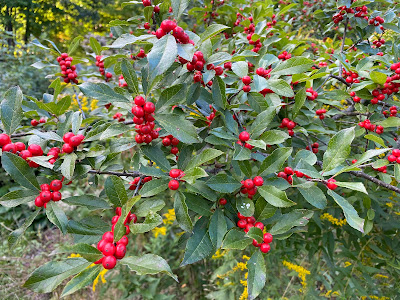
The bright red berries of our winterberry in September.
Winterberry is typically dioecious, with male and female flowers on separate plants. Only the female plants produce the bright red berries; each berry sports a small black dot. The greenish-white flowers are so inconspicuous that I often miss noting their blooms in early summer. The berries are the show-stopper, especially in early fall when the red berries are surrounded by the dark green, finely-toothed leaves or in winter set against a snowy landscape.
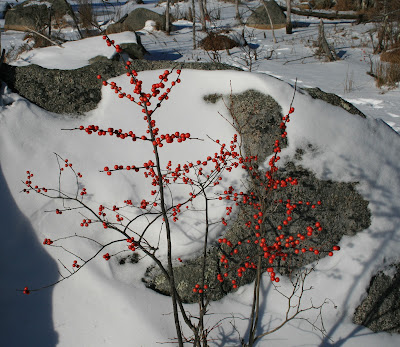
December winterberries.
Lots of rain last fall and into early winter has kept water levels high in local streams and rivers. Despite the high water, wetlands have frozen solid due to the recent stretch of very cold temperatures. Yesterday we explored one such ice-covered local beaver pond. We heard what sounded like a flock of crows cawing from the woods above, only to realize it was the clang of our microspike-clad footsteps.
We walked around an unoccupied beaver lodge, something only possible in mid-winter. An intact skeleton of a cormorant lay among the beaver-chewed, sun-bleached lodge sticks. Our dogs Kodi and Henna sniffed about but didn't detect anything breathing inside the lodge.
As the wetland narrowed upstream, we stepped around shrubs, sedge hummocks, and uprooted trees. A few bluebirds and chickadees flitted around us. A thicket of winterberry was stripped bare of its fruits. At the base was a tell-tale sign that a flock of birds had devoured the berries: winterberry scat. Birds have an efficient digestive system and some can process a fleshy fruit with small seeds--such as a winterberry--in less than an hour.
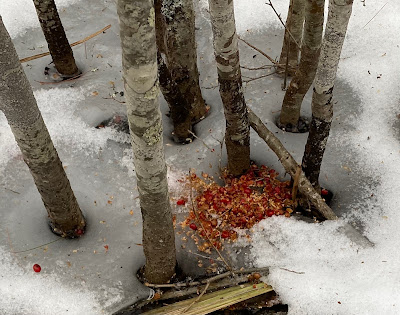
A pile of bird scat (aka poop) below a thicket of winterberry.
The contents are entirely winterberry skins and seeds.
Winterberry is a favorite addition to holiday wreaths. A local farm has started a small plantation of winterberry shrubs as a commercial source of these beautiful berries. I clipped a few twigs from our bush in December (before the bird banquet) and added them to our wreath. Just today a few bluebirds picked off all the winterberries. Happy to oblige them this sustenance on a cold winter day.
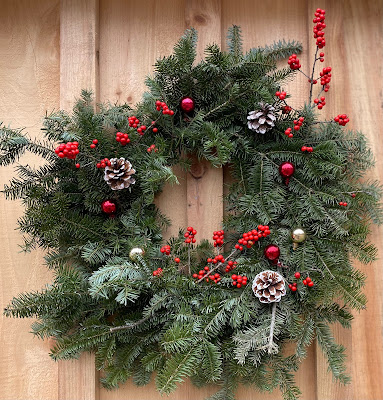
Our wreath before the bluebirds ate the winterberries.
Sunday, March 28, 2021
Robin Song
Drab morning under a gray sky; a cold, southeast breeze chills my face. A robin sings its cheery spring song, another robin chuckles, while a third one sounds an alarm call from the woods.
Saturday, March 27, 2021
Crows on Morning Foray
Six crows fly east across the field, while a more raucous group of eight circle Bald Hill, land on the tallest pines, then fall silent. A light wind carries no foul odors.
Phoebe arrived in our yard today.
Friday, March 26, 2021
Light Rain
Light rain and mid-40s overnight; one spring peeper on the road--dead. Sweet fragrance of fresh wood chips, the remnants of Asplundh's clearing of the powerline along our road yesterday. Woodcock continue to rule the predawn songscape.
Subscribe to:
Posts (Atom)
-
 Whenever it rains hard during the summer, pine cones seem to rain down, the cones knocked from branches in the upper canopy of tall white pi...
 -
 It was a mourning dove, the pile of feathers beneath the tall white pine. The feathers that I showed yesterday in my blog. You can tell by t...
 -
 The oldest known hardwood tree in North America--at 700 years old--is a black gum tree tucked away in a hummocky swamp in southern New Hamps...